

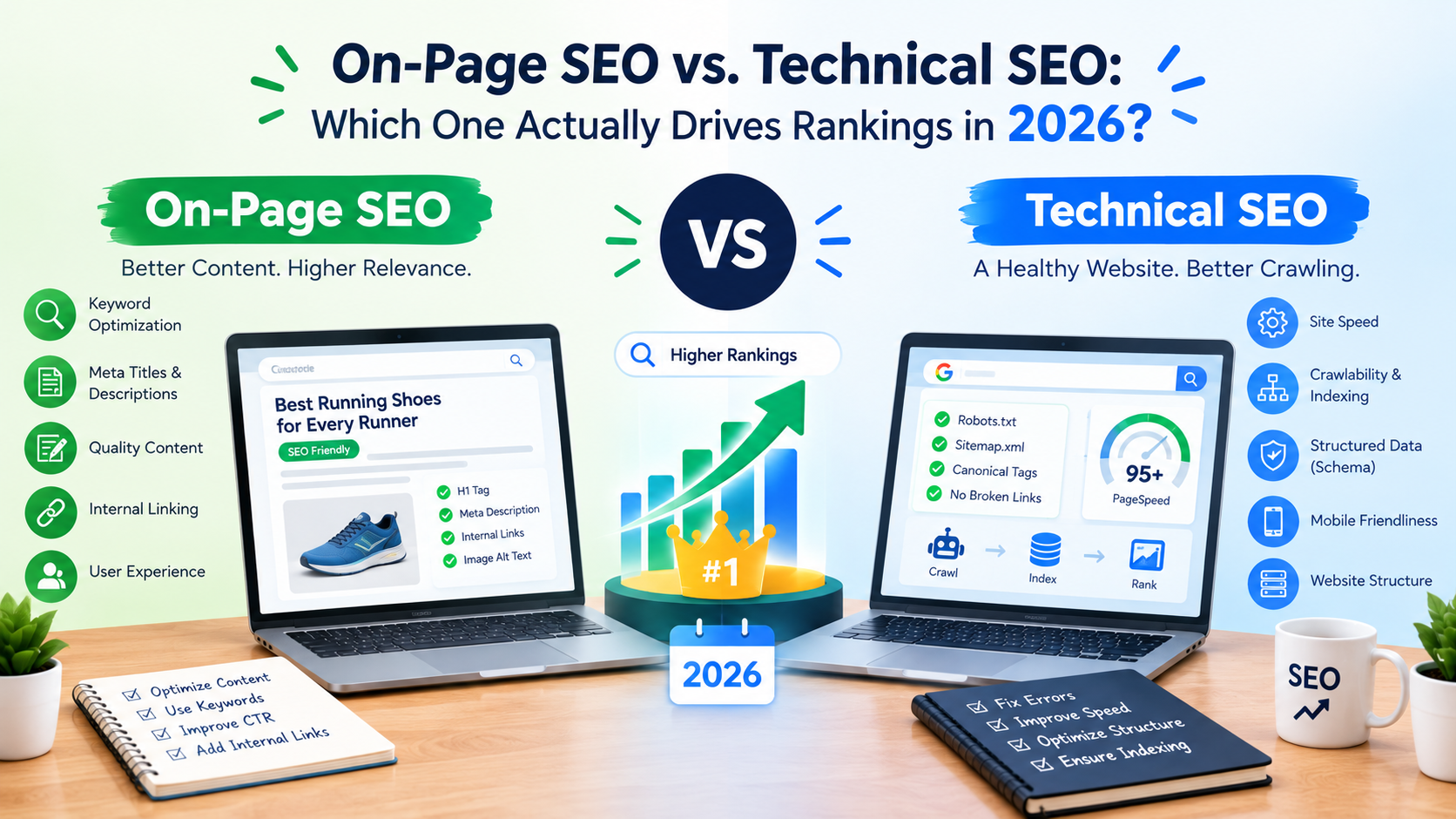
If you've ever argued with a teammate about whether to fix your site's crawl errors first or rewrite your meta titles first, you've lived the on-page SEO vs technical SEO debate. It's one of the most common questions marketers ask when planning an SEO roadmap, and honestly, there's no single right answer, but there is a right way to think about it.
At Cronbay Tech, an SEO company in Bangalore, we've audited hundreds of websites across industries, SaaS, e-commerce, fintech, and local service businesses, and the pattern is always the same: sites that ignore either on-page SEO or technical SEO hit a ceiling. You can't out-write a broken website, and you can't out-code weak content.
In this guide, we'll break down what each discipline actually does, where they overlap, which one deserves priority at different stages of your SEO journey, and how to build a strategy that uses both correctly.
What Is On-Page SEO?
On-page SEO refers to all the optimizations you make directly on a web page to help it rank higher and earn more relevant traffic. It's the content-facing side of SEO, the part your readers actually see and interact with.
On-page SEO techniques include:
- Keyword optimization — placing target keywords naturally in titles, headers, and body copy
- Title tag and meta description optimization — writing compelling, keyword-rich snippets that improve click-through rate
- Header structure (H1, H2, H3) — organizing content logically for readers and search engines
- Internal linking — connecting related pages to spread authority and guide users
- Content quality and depth — answering search intent thoroughly, with E-E-A-T signals like expertise and original insight
- Image optimization — alt text, compressed file sizes, descriptive filenames
- URL structure — short, readable, keyword-inclusive slugs
Think of on-page SEO as the "what you say and how you say it" layer of your website.
Why On-Page SEO Matters
Google's algorithm is built to match search intent with the most relevant, useful content. No amount of technical polish will rank a page that doesn't actually answer the searcher's question. On-page SEO is where relevance is built, it tells Google (and your readers) exactly what a page is about and why it deserves to rank.
A well-optimized page typically sees:
- Higher click-through rates from search results (due to compelling titles and descriptions)
- Lower bounce rates (because content matches intent)
- Stronger topical relevance signals across the site
What Is Technical SEO?
Technical SEO is the behind-the-scenes work that ensures search engines can crawl, index, and render your website correctly, and that users get a fast, smooth experience once they land on it.
Technical SEO techniques include:
- Website crawlability and indexability — making sure search bots can access and understand your pages (robots.txt, XML sitemaps, canonical tags)
- Website speed optimization for SEO — reducing load times through caching, compression, and code minification
- Core Web Vitals SEO — improving Largest Contentful Paint (LCP), Interaction to Next Paint (INP), and Cumulative Layout Shift (CLS)
- Mobile-friendly website SEO — responsive design and mobile-first indexing compliance
- Structured data and schema markup — helping search engines understand content context (FAQ schema, product schema, article schema)
- HTTPS and site security
- Fixing broken links, redirect chains, and duplicate content issues
Think of technical SEO as the "can Google even reach and trust your content" layer.
Why Technical SEO Matters
If Google's crawlers can't access your pages, or your site takes eight seconds to load on mobile, it doesn't matter how brilliant your content is, it simply won't rank. A 2024 industry study by Portent found that websites loading in under 2 seconds had significantly higher conversion rates than those loading in 5+ seconds, and Google has repeatedly confirmed that Core Web Vitals are a confirmed ranking factor.
Technical SEO is the foundation. Without it, every other SEO effort is working on borrowed time.
On-Page SEO vs Technical SEO: Key Differences
Here's a side-by-side breakdown to make the on-page SEO vs technical SEO differences crystal clear:
| Factor | On-Page SEO | Technical SEO |
|---|---|---|
| Focus | Content relevance and user experience | Site infrastructure and crawlability |
| Primary goal | Match search intent | Enable search engines to access and render pages |
| Who handles it | Content writers, SEO strategists | Developers, technical SEO specialists |
| Examples | Title tags, keywords, internal links | Site speed, schema, mobile responsiveness |
| Visible to users? | Yes | Mostly invisible, but affects experience |
| Impact timeline | Can show results in weeks | Can take longer, but unlocks all other SEO |
Both fall under the umbrella of on-page SEO vs off-page SEO conversations too, but it's worth noting technical SEO is sometimes considered a subset of on-page SEO since it also lives "on" your website, unlike off-page efforts like backlinks and social signals.
Which Matters More for Rankings?
Here's the honest answer: it depends on where your website currently stands.
If Your Site Has Technical Issues, Fix Technical SEO First
If Google can't crawl your pages, your sitemap is broken, or your mobile experience is poor, no amount of content optimization will help. We've seen cases where a client's beautifully written blog posts sat unindexed for months simply because of a misconfigured robots.txt file. One technical SEO audit and a two-line fix brought those pages into Google's index within a week, and they started ranking almost immediately because the content was already strong.
Rule of thumb: Technical SEO sets the ceiling for what's possible. On-page SEO determines how close you get to that ceiling.
If Your Site Is Technically Sound, Prioritize On-Page SEO
Once crawlability, speed, and indexability are solid, on-page SEO becomes your biggest lever for climbing rankings. This is where keyword optimization, content depth, and search intent alignment do the heavy lifting. A technically perfect but thin, generic page will still lose to a well-optimized, in-depth competitor.
The Real Answer: You Need Both, in Sequence
Think of it like building a house:
- Technical SEO is the foundation — plumbing, electrical, structural integrity
- On-page SEO is the interior design — layout, furniture, the things people actually experience and judge
You wouldn't decorate a house with no foundation, and you wouldn't leave a well-built house empty. Ranking website optimization requires both working together.
On-Page SEO Checklist (2026)
Use this list as a quick audit for any page you're optimizing:
- [ ] Primary keyword appears in H1, first 100 words, and at least one subheading
- [ ] Title tag is under 60 characters and includes the primary keyword
- [ ] Meta description is 150–160 characters with a clear value proposition
- [ ] Content directly answers the searcher's intent (informational, transactional, navigational)
- [ ] Headers (H2/H3) are structured logically and include secondary keywords naturally
- [ ] Internal links point to 3–5 relevant pages on your site
- [ ] Images have descriptive alt text and are compressed
- [ ] URL is short, readable, and includes the target keyword
- [ ] Content length matches or exceeds top-ranking competitors
- [ ] E-E-A-T signals are present (author credentials, data sources, real examples)
Technical SEO Checklist (2026)
- [ ] XML sitemap submitted to Google Search Console
- [ ] Robots.txt isn't blocking important pages
- [ ] All pages return correct HTTP status codes (no unexpected 404s or 500s)
- [ ] Canonical tags are correctly implemented to avoid duplicate content
- [ ] Core Web Vitals (LCP, INP, CLS) meet Google's "Good" thresholds
- [ ] Site is fully mobile-responsive
- [ ] HTTPS is enabled site-wide
- [ ] Structured data/schema markup is implemented for key page types (FAQ, Article, Product)
- [ ] Redirect chains and broken internal links are cleaned up
- [ ] Page speed is optimized through image compression, caching, and minified code
How On-Page SEO Works: A Step-by-Step Guide
- Research search intent — Understand what the searcher actually wants when they type your keyword
- Map your primary and secondary keywords — Place them naturally, not forcefully
- Write a compelling title and meta description — These directly impact click-through rate
- Structure content with clear headers — Helps both readability and featured snippet eligibility
- Add internal links — Connect to related content to build topical authority
- Optimize for E-E-A-T — Include real examples, data, and expert commentary
- Review and refresh periodically — On-page SEO isn't a one-time task; content needs updates as search trends shift
How Technical SEO Works: A Step-by-Step Guide
- Run a technical SEO audit — Identify crawl errors, broken links, and indexation gaps
- Fix crawlability issues — Correct robots.txt, submit updated sitemaps
- Improve site speed — Compress images, enable caching, reduce server response time
- Optimize for Core Web Vitals — Address layout shifts and interaction delays
- Implement structured data — Add schema markup for rich results
- Ensure mobile-friendliness — Test responsiveness across devices
- Monitor ongoing health — Use Google Search Console to track indexing and performance over time
Real-World Example: Why Both Matter Together
We worked with a Bangalore-based client whose website had excellent, well-researched content, but rankings were stagnant. A technical audit revealed slow server response times and missing schema markup. After fixing the technical foundation and keeping the content as-is, organic visibility improved within six weeks, because the content was already strong; it just needed a technically sound platform to perform on.
In another case, a client had a technically flawless, lightning-fast website, but thin, generic content. Rankings were still weak because the pages didn't convincingly answer user intent. Once we rewrote the content with better keyword optimization and E-E-A-T-driven depth, rankings climbed significantly.
The lesson: neither discipline works in isolation. A complete SEO services strategy treats them as two halves of the same engine.
Common Mistakes Businesses Make
- Over-focusing on content while ignoring crawl errors — You can publish 100 blog posts, but if Google can't index them, they're invisible
- Chasing Core Web Vitals perfection while content stays thin — Speed doesn't matter if there's nothing valuable to load
- Treating SEO audits as one-time projects — Both technical and on-page SEO require ongoing monitoring, not a single fix-and-forget pass (see also: common SEO mistakes to avoid)
- Ignoring mobile experience — With mobile-first indexing, a poor mobile experience directly hurts rankings regardless of desktop performance
How to Decide Where to Start
If you're unsure where your website stands, ask these three questions:
- Is Google indexing all my important pages? Check Google Search Console's Coverage report. If pages are missing, start with technical SEO, here's how to fix Google indexing issues.
- Are my Core Web Vitals in the "Good" range? If not, prioritize speed and performance fixes.
- Is my content ranking on page 2–3 but not page 1? This usually signals a content/on-page SEO gap, not a technical one, your site is being crawled and indexed fine, but the content isn't competitive enough. A long-tail keyword strategy is often the quickest way to close that gap.
A proper technical SEO audit combined with an on-page content review is the fastest way to find out exactly where your priorities should be. You can also start with a free website audit.
FAQs
1. What is the main difference between on-page SEO and technical SEO?
On-page SEO focuses on content elements like keywords, titles, and internal links that improve relevance for search intent. Technical SEO focuses on backend elements like site speed, crawlability, and structured data that help search engines access and understand your site.
2. Can I rank without technical SEO?
It's very difficult. If search engines can't crawl or index your pages properly, even the best content won't appear in search results. Technical SEO is the foundation that makes on-page SEO efforts visible to Google.
3. Is technical SEO a one-time task?
No. Technical SEO requires ongoing monitoring. New broken links, slow-loading pages, or indexing issues can appear anytime your site is updated. Regular audits are essential.
4. How often should I update my on-page SEO?
Review your top-performing and highest-opportunity pages every 3–6 months. Search intent and competitor content evolve, so your on-page elements should too.
5. Does Core Web Vitals really affect rankings?
Yes. Google uses Core Web Vitals (LCP, INP, CLS) to assess user experience. They are part of Google's page experience signals, although good scores alone don't guarantee higher rankings.
6. Should small businesses prioritize on-page or technical SEO first?
Start with a technical audit to rule out crawlability or speed issues. Once the foundation is solid, shift focus to on-page content optimization for sustained ranking growth.
Final Thoughts: Build Both, Strategically
The on-page SEO vs technical SEO debate isn't really about picking a winner, it's about sequencing your efforts correctly. Technical SEO builds the foundation that makes your site crawlable, fast, and trustworthy. On-page SEO builds the relevance and depth that convinces Google (and your readers) your content deserves to rank.
If your website is struggling to rank despite good content, or you're not sure whether your technical foundation is holding you back, a professional audit can save months of guesswork.
Ready to find out exactly what's holding your rankings back? Talk to Cronbay Tech — Bangalore's trusted SEO company for a complete on-page and technical SEO audit tailored to your website.
Why Cronbay Tech Is the Right Partner for This
Cronbay Tech's SEO company in Bangalore page is the natural authority link for this content because it represents the full-service SEO offering, combining technical audits, on-page optimization, and content strategy under one roof. Readers who land on this blog post are typically evaluating why their rankings have stalled, which makes them high-intent prospects for a comprehensive audit, exactly what that page delivers.

.png)