

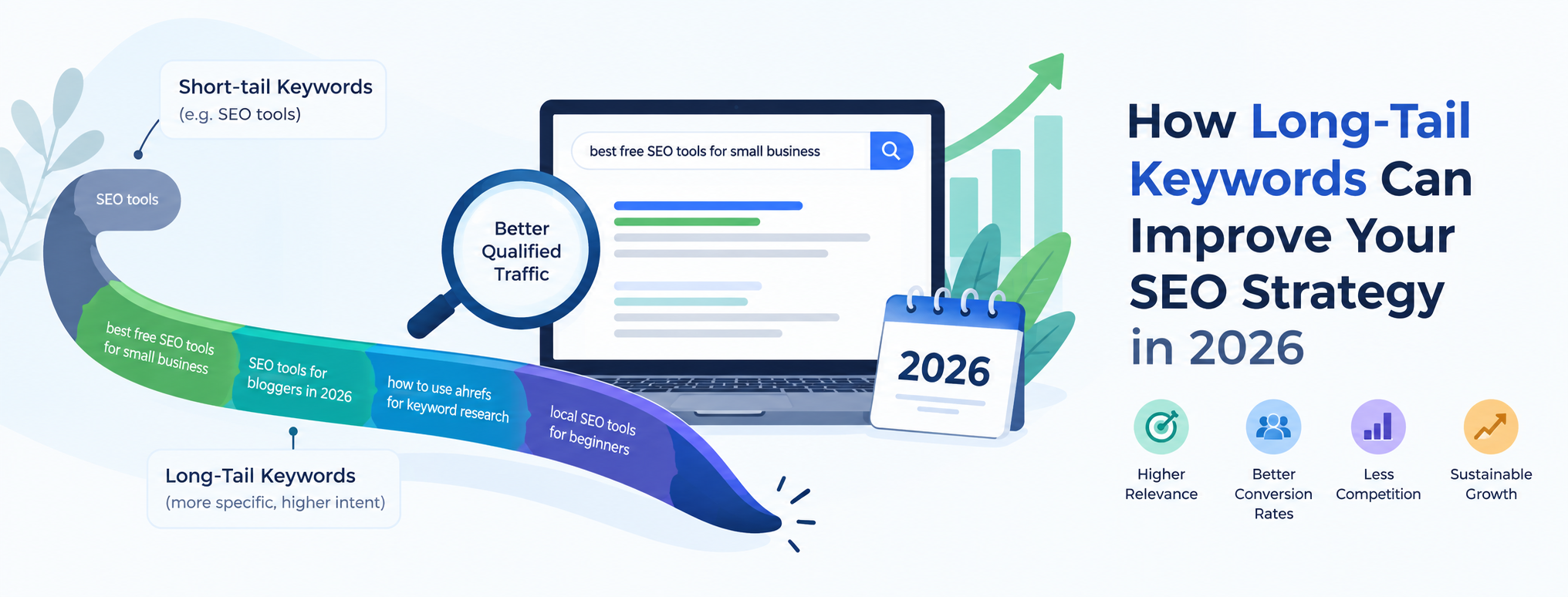
Nobody types "SEO" into Google when they are ready to hire someone. They type "SEO company in Bangalore for B2B SaaS" or "why did my organic traffic drop after the last core update." Search in 2026 is specific and conversational, and AI often answers it before anyone clicks. That is why a long tail keyword strategy has moved from a side tactic for small websites to the backbone of modern SEO.
Broad keywords still matter for direction. But rankings, leads and AI citations increasingly come from the precise phrases real buyers use. This guide covers what long-tail keywords are, why they matter, how to find them, and how to build a system around them that compounds over time.
Long-tail keywords are specific, multi-word search phrases that show clear intent, such as "technical SEO audit for a Shopify store in India." Each one has lower search volume than a broad term. Together they make up most of all searches, face less competition, convert better, and match the conversational way people use Google, voice assistants and AI tools.
Key Takeaways
- Long-tail keywords are defined by specificity and intent, not just word count.
- They offer lower competition, faster rankings and higher-quality traffic than broad head terms.
- Large studies put long-tail queries at the majority of all searches, with commonly cited figures ranging from about 80% to over 90%.
- AI Overviews, ChatGPT-style assistants and voice search reward content that answers specific, natural-language questions.
- The best results come from grouping long-tail keywords into clusters, not chasing them one page at a time.
- Measuring impressions, positions and conversions per cluster tells you where to invest next.
What Are Long-Tail Keywords?
A long-tail keyword is a highly specific search query that reflects a clear need. "Running shoes" is broad. "Lightweight running shoes for flat feet under ₹5,000" is long-tail: it tells you the product, the problem, and the budget.
The name comes from the demand curve of search behaviour. A small number of head terms sit at the top with enormous volume. Behind them stretches a long "tail" of millions of unique, lower-volume queries. Each one is small, but together they account for most of the searching people actually do.
Three misconceptions cause most bad long-tail decisions:
Myth 1: Long-tail means four or more words. Length is a rough guide only. "Best CRM" is short but competitive. "CRM for real estate agents in Bangalore" is longer, but the real difference is that it is narrow and intent-rich. Judge a keyword by how specific the need is.
Myth 2: Low volume means low value. Fifty monthly searches from people ready to buy can outperform ten thousand casual visits. A phrase that brings ten qualified enquiries a month is worth more than a head term that brings none.
Myth 3: You need a page for every phrase. Search engines understand meaning, not just exact strings. One well-built page can rank for dozens of close variations. Creating a thin page for every variant only splits your authority and causes cannibalisation.
Long-Tail vs Short-Tail Keywords
| Short-tail | Mid-tail | Long-tail | |
|---|---|---|---|
| Example | "SEO" | "SEO services India" | "SEO services for ecommerce stores in Bangalore" |
| Typical length | 1–2 words | 2–3 words | 3+ words |
| Search volume | Very high | Medium | Low per phrase |
| Competition | Extreme | High | Low to moderate |
| Intent clarity | Vague | Partial | Very clear |
| Conversion potential | Low | Medium | High |
| Best use | Pillar topics, brand awareness | Category and service pages | Blog posts, FAQs, niche landing pages |
Short-tail and long-tail keywords are not rivals. Short-tail terms define your topics and pillar pages. Long-tail terms support them and capture the buyers who are ready to act. The healthiest sites use both, with long-tail doing most of the conversion work.
Why Long-Tail Keywords Are Important for SEO in 2026
The importance of long-tail keywords has grown because search itself has changed. Here are the main benefits of long-tail keywords.
1. Lower Competition and Faster Rankings
Ranking for "SEO services" means competing with agencies, directories and giant publishers. Ranking for "technical SEO audit for JavaScript websites" means competing with a handful of pages. For newer sites or sites with modest authority, this is often the only realistic route to page-one visibility. Long-tail keywords for higher rankings are simply more attainable.
2. Higher-Quality Organic Traffic
Someone who searches for a detailed phrase already knows what they want. That is why long-tail keywords for organic traffic tend to bring visitors who read more, bounce less, and enquire more often. Industry studies commonly report substantially higher conversion rates for long-tail queries than for head terms. Your own data will show the same pattern.
3. Better Match with Search Intent
Every query has a reason behind it. Long-tail phrases carry that reason on the surface, which makes it easier to build the right page for the right need.
4. Cost Efficiency Across Channels
The same specificity that helps organic rankings lowers costs in paid search. Fewer advertisers bid on narrow phrases, so clicks are cheaper and ads that mirror the query tend to perform better.
5. Compounding Topical Authority
Each long-tail article that answers a real question adds evidence that your site understands the subject. Over time that strengthens the whole cluster. If you want to go deeper on this, our complete guide to topical authority in SEO explains how clusters build trust with search engines.
6. Visibility in AI-Driven Results
AI systems assemble answers from pages that respond clearly to specific questions. Long-tail content is built for exactly that, which we cover in detail below.
Long-Tail Keywords and Search Intent
Long-tail keywords and search intent are closely linked, and this is where many strategies go wrong. A phrase can be long and still be aimed at the wrong page type. Match every keyword to one of four intents:
- Informational: the searcher wants to learn. "How to do a technical SEO audit" fits a guide or tutorial.
- Commercial investigation: the searcher is comparing options. "Best SEO companies in Bangalore for startups" fits a comparison or list post.
- Transactional: the searcher is ready to act. "Hire an ecommerce SEO agency in Bangalore" fits a service page.
- Navigational: the searcher wants a specific brand or page.
The easiest check is to search the phrase yourself and look at page one. If Google shows guides, write a guide. If it shows service pages, build a service page. Your content format has to match what the results already tell you.
This is how a good strategy connects blog content to revenue pages. An informational article can naturally lead readers to a service page when the next step is obvious. For instance, someone reading about site architecture problems may be ready for technical SEO services in Bangalore. Someone struggling with category-page rankings may need ecommerce SEO services.
Long-tail keywords and user intent also reveal the person behind the search. "Free SEO checklist" and "SEO consultant for a manufacturing company" signal very different budgets and urgency. Use those differences to shape your calls to action.
Long-Tail Keywords and AI Search
How AI Overviews and Answer Engines Use Specific Queries
Google's AI Overviews, ChatGPT-style assistants and Perplexity-type tools do not simply list ten links. They compose answers, and they tend to pull from content that answers a narrow question clearly and is easy to extract. That is why long-tail keywords and AI search work so well together. Conversational prompts are long-tail by nature. Nobody asks for an AI tool "SEO." They ask "what is the best way to fix duplicate content on a large ecommerce site?"
If you want long-tail keywords for AI Overviews, focus on structure as much as wording:
- Put a direct, one-to-three-sentence answer near the top of the relevant section.
- Use question-style headings that mirror how people phrase prompts.
- Support the answer with steps, tables or short lists that are easy to lift.
- Show expertise with specific examples, not generic advice.
- Add clear author and business information so the source can be trusted.
Our AI SEO checklist for 2026 walks through these signals in a practical order, and it pairs well with the tactics in this guide.
Long-Tail Keywords for Voice Search
Voice queries are longer and more natural than typed ones. People say "which SEO company near me handles ecommerce stores" rather than typing fragments. Long-tail keywords for voice search work best when you:
- Answer questions in plain, spoken-style language.
- Use FAQ sections with concise answers.
- Keep local details accurate, including location, service area and business information.
- Load pages quickly on mobile, where most voice searches happen.
Long-Tail Keywords for Google
Traditional ranking still matters and still rewards the same fundamentals. Long-tail keywords for Google work when the page fully satisfies the query, loads well, has a clear structure, and earns trust through internal and external signals. AI visibility and classic rankings are not separate projects. Strong pages usually win both.
The Three Types of Long-Tail Keywords
Understanding the type helps you decide whether to build a page or fold the phrase into an existing one.
Supporting long-tail keywords are close variations of a main topic that do not deserve their own page. "SEO services pricing," "SEO service cost" and "how much do SEO services cost" belong on one page.
Topical long-tail keywords cover a distinct subject that needs its own page. "How to fix crawl budget issues on large websites" is a good example.
Conversational long-tail keywords are full of questions and prompts, such as "what is the difference between on-page and off-page SEO?" These are ideal for FAQ sections, featured snippets and AI answers.
How to Find Long-Tail Keywords
Here is a practical approach to long-tail keyword research that does not depend on expensive tools.
Step 1: Start with Seed Keywords
Write down five to ten core topics your business covers, such as "technical SEO," "ecommerce SEO," "SEO audit" and "link building." These are the roots of your clusters.
Step 2: Mine Google's Own Suggestions
Type each seed into Google and read the autocomplete suggestions. Add letters after the seed to surface more. Then scan the "People Also Ask" boxes and "Related searches" at the bottom of the page. These come from real behaviour, which makes them a reliable, free source of long-tail keyword ideas.
Step 3: Use Keyword Tools
Tools such as Google Keyword Planner, Ahrefs, Semrush and Ubersuggest can expand a seed into hundreds of variations. Filter by keyword difficulty, and prioritise phrases with a clear commercial or informational purpose. Treat volume as a rough guide rather than a target.
Step 4: Mine Your Own Data
Google Search Console is the most underused source. Filter for queries with many impressions but positions between 8 and 20. You are already close to page one for these, so one improved page can unlock quick gains. Also review your site search, sales call notes and support tickets. Every question a customer asks is a keyword.
Step 5: Study Competitors
Run a keyword gap analysis to find phrases competitors rank for and you do not. Look at their headings, FAQ sections and comparison pages, not just their rankings. Focus on gaps where you can add something better, rather than copying.
Step 6: Listen to Communities
Reddit threads, Quora answers, LinkedIn discussions and industry forums show how real people phrase problems, including the awkward, unpolished wording that tools often miss.
Step 7: Use AI for Ideation, Then Validate
AI assistants are useful for brainstorming questions and angles quickly. Always validate the output against real data before you commit. A suggestion that sounds plausible is not evidence that anyone searches for it.
A Simple Long-Tail Keyword Research Strategy
Collecting keywords is the easy part. The real work is deciding what to do with them. This long-tail keyword research strategy keeps the process repeatable:
1. Collect. Gather phrases from every source above into one sheet.
2. Clean. Merge duplicates and near-duplicates. Remove anything off-topic.
3. Classify by intent. Tag each phrase as informational, commercial, transactional or navigational.
4. Group into clusters. Sort phrases into topics. Each cluster gets one main page and several supporting pieces.
5. Score. Rate each opportunity on business relevance, intent strength, difficulty and current position. A simple 1–5 score on each is enough. Business relevance should carry the most weight, because traffic that never converts is not an achievement.
6. Map to pages. Decide which existing page targets each phrase, and where a new page is needed.
7. Sequence. Start with high-relevance, low-difficulty phrases and pages you can improve quickly. Build the bigger pillar content next.
This turns a messy keyword list into a long-tail SEO strategy you can actually execute month by month.
How to Use Long-Tail Keywords in Your Content
Knowing how to use long-tail keywords matters as much as finding them. Search engines in 2026 reward meaning, not repetition.
Put the phrase where it belongs. Include the primary phrase in your title tag, H1, URL, first paragraph and at least one subheading. Use natural variations elsewhere.
Answer first. Open each major section with a direct answer, then expand. This helps readers, featured snippets and AI extraction.
Use questions as headings. Turn "People Also Ask" questions into H2 and H3 headings, and answer each one cleanly.
Add depth, not filler. Original examples, screenshots, data from your own work, and clear steps make a page worth ranking. Cover what a searcher would want to know next.
Link with purpose. Link related cluster pages to each other and to the pillar. Link supporting articles to the service pages they naturally lead to. Strong off-site signals help too, and our guide to off-page SEO techniques shows how to build them.
Do not stuff. Repeating a phrase unnaturally makes content worse and gains nothing. If a sentence reads awkwardly aloud, rewrite it.
This is what proper long-tail keyword optimization looks like: one clear page per intent, with supporting variations woven in naturally.
Long-Tail Keyword Targeting for Different Business Types
Long-tail keyword targeting looks different depending on your model.
Local and service businesses should combine service, location and situation. "SEO services for small businesses in Bangalore" is a strong start. Add a use case or industry and it becomes sharper still. If you are choosing a provider yourself, our roundup of the top SEO companies in Bangalore shows how buyers compare options.
Ecommerce stores should use long-tail phrases on product and category pages: specific materials, sizes, use cases and price bands. Customer reviews and Q&A also add natural long-tail language automatically. A dedicated ecommerce SEO plan should cover both category architecture and product-level optimisation.
B2B and SaaS companies should target problems and comparisons, such as "alternatives to [tool] for small teams" or "how to integrate [tool] with [platform]."
Content publishers should build clusters around questions and guides, using long-tail phrases as individual article topics.
Long-Tail Keyword Examples
Here are long-tail keyword examples across different situations, showing how broad terms narrow into high-intent phrases.
Service business (SEO agency)
- Head term: "SEO"
- Mid-tail: "SEO services Bangalore"
- Long-tail: "technical SEO audit for a WordPress website in Bangalore"
- Long-tail: "SEO services for ecommerce brands with more than 1,000 products"
Ecommerce
- Head term: "handbags"
- Long-tail: "vegan leather laptop bag for women under ₹3,000"
- Long-tail: "waterproof travel backpack for cabin luggage"
SaaS
- Head term: "invoicing software"
- Long-tail: "GST invoicing software for freelancers"
- Long-tail: "how to automate recurring invoices for a small agency"
Informational
- Head term: "keyword research"
- Long-tail: "how to find long-tail keywords with Google Search Console"
- Long-tail: "what is search intent in SEO with examples"
Notice the pattern. Each long-tail phrase adds one or more modifiers: a location, an audience, a budget, a platform, a problem or a format. When you need long-tail keyword ideas, ask which modifiers your customers actually use.
How to Measure Long-Tail Keyword Performance
Long-tail results build gradually, so measure the right things.
- Impressions and clicks per cluster in Google Search Console. Rising impressions usually appear before clicks.
- Average position trends. A page moving from position 18 to position 9 over three months is a strong sign, even before it hits page one.
- Click-through rate. If you rank well but nobody clicks, improve your title and meta description.
- Conversions by landing page. Track enquiries, sign-ups or sales from long-tail pages separately from your homepage.
- Assisted conversions. Informational posts often introduce a visitor who converts later through another page.
- AI visibility. Periodically test your priority questions in major AI tools and note whether your brand or content appears.
Review monthly, refresh pages that stall, and double down on clusters that convert.
Common Long-Tail Keyword Mistakes to Avoid
Chasing volume over relevance. A phrase with 500 searches that never converts is worse than one with 30 that does.
Ignoring intent. Writing a blog post for a keyword where Google shows product pages will rarely work.
Creating thin pages. One near-empty page per variation dilutes your site. Combine related phrases into stronger pages.
Cannibalising your own content. If two of your pages target the same intent, they compete. Consolidate or differentiate them.
Neglecting technical health. Great content still struggles if it is hard to crawl, slow, or poorly structured. Regular technical checks matter, which is where technical SEO services make the difference.
Publishing and forgetting. Long-tail content needs updates as search behaviour, tools and results change.
Long-Tail Keywords Strategy 2026: A 90-Day Plan
If you are starting from scratch, here is a realistic sequence.
Days 1–15: Research. Build your seed list, collect phrases from Google, tools and Search Console, then classify by intent and group into clusters.
Days 16–30: Prioritise. Score clusters, map phrases to pages, and pick your first three to five clusters.
Days 31–60: Create and improve. Update existing pages that already sit near page one. Publish the first pillar and supporting articles, with clean internal linking.
Days 61–90: Measure and expand. Review Search Console data, fix underperformers, test AI visibility for your key questions, and plan the next round of clusters.
Frequently Asked Questions
A long tail keyword strategy is an SEO approach built around specific, intent-rich search phrases instead of broad, highly competitive terms. It involves researching those phrases, grouping them into topic clusters, creating content that fully answers each need, and measuring results.
There is no fixed rule. Most long-tail keywords have three or more words, but specificity and intent matter more than length.
Yes. New sites rarely have the authority to compete for broad terms, so specific phrases with lower competition offer the fastest route to early rankings and traffic.
They can. AI-generated answers tend to draw on pages that answer specific questions clearly. Answer-first writing, question-based headings and structured formatting improve your chances.
Use Google autocomplete, People Also Ask, related searches, Google Search Console, Reddit, Quora and your own customer questions. Free tools like Google Keyword Planner also help.
Yes. Search engines understand related meanings, so a comprehensive page can rank for many close variations of the same intent.
Yes, but as topic anchors. Use them for pillar pages and category pages, while long-tail content captures the specific, high-intent searches around them.
Small wins can appear within weeks on pages that are already close to page one. Newer clusters typically take a few months to build momentum, depending on competition and site strength.
Conclusion
A strong long tail keyword strategy is not about avoiding competition. It is about meeting people where they actually search: with specific questions, clear needs and real buying intent. In 2026, with AI answers and voice queries shaping how people find information, specificity is what gets you found, cited and chosen.
Start with intent, build clusters, write answers worth citing, and measure what converts. If you want expert help turning keyword research into rankings and leads, Cronbay Tech can help. Explore our SEO services, see how a trusted SEO company in Bangalore approaches strategy, or get support with technical SEO and ecommerce SEO.

.png)