
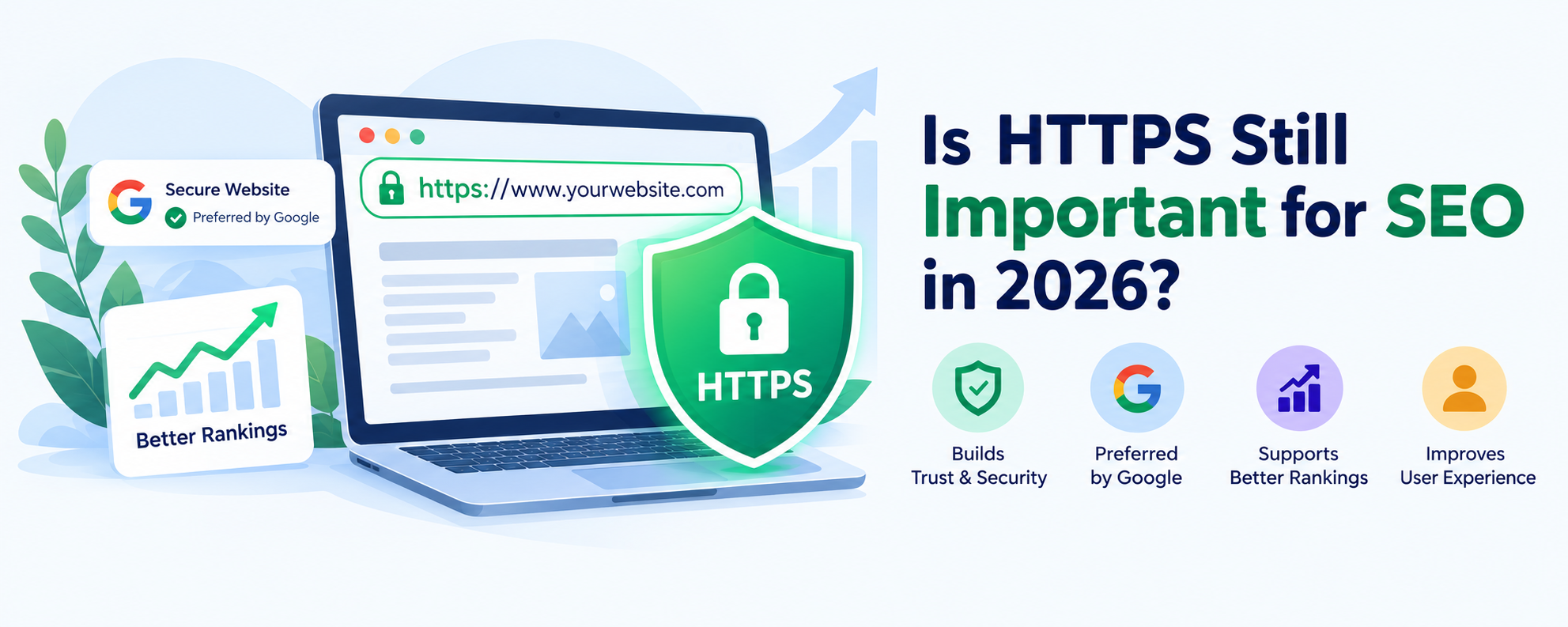
Does HTTPS affect SEO in 2026? Learn how HTTPS impacts rankings, trust, and Core Web Vitals, plus a full HTTPS migration checklist from Cronbay Tech.
If you type an unsecured web address into Chrome today, a warning appears before the page even finishes loading. That single moment tells you almost everything you need to know about where HTTPS stands in 2026.
Back in 2014, Google confirmed that HTTPS SEO was officially a ranking factor. Website owners rushed to install SSL certificates, hoping for a quick jump in rankings. More than a decade later, the question has changed. It is no longer "should I install HTTPS?" It is "can my website survive without it?"
In this guide, we will break down whether HTTPS still affects SEO in 2026, how big a ranking factor it really is, what benefits it brings beyond rankings, and the exact steps to migrate from HTTP to HTTPS without losing traffic. If you are running an SEO campaign, managing an ecommerce store, or simply trying to understand HTTPS and SEO before your next website audit, this article covers everything you need.
If you'd rather have a specialist audit your site's technical foundation instead of doing it yourself, our technical SEO services in Bangalore cover HTTPS, Core Web Vitals, crawlability, and indexing issues in a single audit.
What Is HTTPS and Why Does It Exist?
HTTPS stands for Hypertext Transfer Protocol Secure. It is the encrypted version of HTTP, the protocol that governs how data moves between a visitor's browser and your web server.
When a website runs on HTTPS, every piece of data exchanged between the browser and server, passwords, contact form entries, payment details, personal information, is encrypted using SSL/TLS technology. Without encryption, that same data can be intercepted by anyone monitoring the connection, particularly on public Wi-Fi or compromised networks.
Visitors can always tell whether a site is secure by looking at the address bar. A padlock icon means the connection is encrypted. Its absence, or a "Not Secure" warning, tells visitors the opposite.
How an HTTPS Connection Actually Works
The process behind that small padlock icon happens in milliseconds, but it involves several steps:
| Step | What Happens |
|---|---|
| 1 | The browser requests a secure connection to the website |
| 2 | The server responds with its SSL/TLS certificate |
| 3 | The browser checks whether the certificate is valid and unexpired |
| 4 | The browser confirms the certificate was issued by a trusted Certificate Authority |
| 5 | The browser and server agree on a shared encryption key |
| 6 | The browser sends encrypted requests |
| 7 | The server returns encrypted responses |
| 8 | The encrypted session continues for as long as the visitor stays on the site |
Most modern websites now run on TLS 1.3, the latest and fastest version of the encryption protocol, which has removed almost all of the performance concerns that once came with securing a website.
Is HTTPS Still a Google Ranking Factor in 2026?
Yes, but the honest answer sits in the middle of "it matters a lot" and "it barely matters at all."
Google confirmed HTTPS as a lightweight ranking signal back in 2014, and that has not changed. What has changed is the context around it. In 2014, most websites still ran on HTTP, so switching to HTTPS gave early adopters a genuine, if small, competitive edge.
In 2026, that edge has disappeared for a simple reason: almost every website is already secure. According to W3Techs' usage statistics, well over 90% of the web's top websites default to HTTPS, and Chrome's own security engineering blog has reported that roughly 95% of browsing traffic already happens over encrypted connections. When nearly every competitor in your niche already has HTTPS, it stops being an advantage and becomes the baseline everyone is expected to clear.
So does HTTPS affect SEO? In isolation, installing an SSL certificate will not move your website from page five to position one. Content quality, search intent relevance, backlinks, user experience, and E-E-A-T signals all carry far more ranking weight. But if two competing pages are otherwise evenly matched, the secure one will usually have the edge. HTTPS is a tie-breaker, not a trophy.
HTTP vs HTTPS: A Quick SEO Comparison
| Factor | HTTP | HTTPS |
|---|---|---|
| Data encryption | None | Full encryption via SSL/TLS |
| Browser trust signals | "Not Secure" warnings | Padlock icon, no warnings |
| Google ranking signal | No advantage | Confirmed lightweight ranking factor |
| Access to modern browser features | Limited or blocked | Full access (geolocation, PWAs, push notifications) |
| Referrer data in Google Analytics | Often stripped or shown as "direct" | Passed correctly between HTTPS sites |
| User trust and conversions | Lower, especially on forms and checkout | Higher, particularly for ecommerce |
| Compliance readiness | Falls short of basic data protection expectations | Meets baseline security expectations |
For an ecommerce brand, this comparison is not academic. Shoppers entering card details on an HTTP checkout page will see a security warning and, in most cases, abandon the purchase entirely. If you run an online store, our ecommerce SEO services in Bangalore fold HTTPS, checkout trust signals, and technical SEO into one strategy built around conversions, not just rankings.
Why HTTPS Still Matters, Even Beyond Rankings
Even if HTTPS only nudges rankings slightly, its impact on the rest of your website's performance is far from small.
1. Visitor Trust
Modern browsers actively warn users when a connection is not secure. A "Not Secure" label next to your domain name is enough to make visitors abandon a contact form, close a checkout page, or simply leave. Trust is lost before a single word of your content gets read.
2. Data Protection
HTTPS encrypts everything exchanged between browser and server. Without it, sensitive information like passwords, personal details, and payment data can be intercepted on unsecured networks. This is no longer viewed as optional; it is considered baseline responsibility for any business collecting customer data.
3. Compliance Expectations
Businesses that handle customer information are increasingly expected to demonstrate basic data protection practices. HTTPS is one of the simplest, lowest-cost ways to meet that baseline expectation, and its absence can raise red flags during audits or partnership reviews.
4. Access to Modern Web Features
A surprising number of modern web technologies simply will not function over HTTP, including:
- Geolocation services
- Browser push notifications
- Progressive Web Apps (PWAs)
- Service workers
- Secure payment gateway integrations
If your roadmap includes any of these features, HTTPS is not a future consideration, it is a prerequisite.
5. Accurate Analytics Data
When an HTTPS site links to an HTTP site, referrer data often gets stripped, and that traffic shows up as "direct" in Google Analytics instead of being correctly attributed. Running your whole site on HTTPS keeps your referral data clean and your reporting accurate, something every SEO services engagement depends on to measure real progress.
Does HTTPS Slow Down Your Website?
This used to be a fair concern. Early SSL implementations added a noticeable performance overhead to page load times.
That is no longer true. Modern protocols like TLS 1.3 and HTTP/3 have all but eliminated the performance cost of encryption. Combined with a properly configured CDN and caching setup, an HTTPS website should load just as fast, sometimes faster, than its HTTP equivalent.
If your website feels slow, HTTPS is rarely the real culprit. The more likely causes are unoptimized images, bloated JavaScript, poor server response times, or a lack of caching. This is exactly the kind of issue our technical SEO services in Bangalore are built to diagnose, since Core Web Vitals depend far more on these factors than on your connection protocol.
HTTPS and Core Web Vitals
Google's page experience signals, Largest Contentful Paint, Interaction to Next Paint, and Cumulative Layout Shift, measure loading speed, interactivity, and visual stability. None of these metrics directly reward HTTPS.
What HTTPS does is remove one possible source of friction. A secure connection means visitors are not interrupted by browser warnings, and modern encryption protocols run efficiently enough that they add no meaningful delay to your Core Web Vitals scores.
In other words, HTTPS will not fix a slow website, but a properly configured HTTPS setup will not slow one down either. Treat it as part of your technical foundation, not a speed strategy on its own.
How to Migrate from HTTP to HTTPS Without Losing Rankings
If your site is still running on HTTP, migrating requires care. Rankings and traffic can dip temporarily if the move is handled poorly, but a clean migration usually shows measurable improvement within weeks.
- Install an SSL certificate. Most hosting providers now offer free certificates through Let's Encrypt, or paid options with extended validation for ecommerce sites.
- Set up 301 redirects. Every HTTP URL should redirect permanently to its HTTPS equivalent — never a 302 or a blanket redirect to the homepage.
- Update internal links. Every internal link, image source, and script reference should point to the HTTPS version to avoid unnecessary redirect chains.
- Fix mixed content. Pages that load securely but still pull in images, fonts, or scripts from HTTP sources will trigger partial security warnings. Audit and update every resource reference.
- Update canonical tags. Canonical URLs should always point to the HTTPS version of each page to avoid duplicate content confusion.
- Update your XML sitemap. Submit the HTTPS version of your sitemap and remove the outdated HTTP one.
- Update Google Search Console and Analytics. Add and verify the HTTPS property, and set it as the preferred domain.
- Check for mixed-content warnings in browser console tools. Fix any remaining insecure resource calls before considering the migration complete.
- Monitor rankings and traffic for four to six weeks. A short-term dip is normal; a sustained drop usually signals an unresolved technical issue.
Migrations are also a natural opportunity to fix long-standing structural issues, such as inconsistent URL structures or thin category pages, which is why many migrations are handled alongside a broader technical SEO audit rather than in isolation.
The Three Mistakes That Undo Most HTTPS Migrations
Even a simple move to HTTPS can go wrong in ways that quietly cancel out the benefits.
Leaving mixed content behind. A page can load securely overall while still pulling a handful of images, scripts, or fonts from an insecure source. Browsers flag this as a partial warning, which confuses visitors about how safe the page actually is.
Skipping proper redirects. Moving to HTTPS without setting up clean 301 redirects splits link equity between the old and new versions of every page, quietly weakening your domain's authority for months.
Forgetting to update internal links. Old internal links still pointing to HTTP pages force an unnecessary redirect hop on every click. It is a small thing individually, but across hundreds of pages it adds real, measurable drag.
A single audit pass after migration, checking sitemap, canonicals, internal links, and mixed content, catches nearly all of these issues before they become a client-facing problem.
What Should You Actually Focus On in 2026?
HTTPS deserves a permanent spot on every technical SEO checklist, but it is no longer where the real ranking battles are fought. Businesses that treat HTTPS as "done" and move on to more impactful work tend to outperform those still chasing it as a primary strategy.
The areas that move rankings meaningfully in 2026 include:
- Content quality and search intent alignment — matching what searchers are actually looking for, not just targeting keyword volume
- E-E-A-T signals — demonstrating Experience, Expertise, Authoritativeness, and Trustworthiness across your content
- Topical authority — building depth around a subject rather than isolated, disconnected articles (our guide on building topical authority breaks this down in detail)
- Off-page signals and backlinks — earning links from relevant, authoritative sources, covered in our breakdown of off-page SEO techniques for 2026
- AI-driven search visibility — appearing correctly in AI-generated answers and overviews, which our AI SEO checklist for 2026 walks through step by step
- Core Web Vitals and mobile usability — technical performance that directly affects both rankings and conversions
- Internal linking and site architecture — helping search engines and users navigate your content efficiently
HTTPS belongs on this list too, but near the bottom, as a foundation rather than a growth lever. Think of it the way you'd think of a building's plumbing: essential, expected, and never something you win an award for getting right.
HTTPS for Ecommerce, YMYL, and High-Trust Websites
Not every website carries the same level of risk if it skips HTTPS, but for certain categories, the stakes are much higher.
Ecommerce stores collect payment information directly on-site. A checkout page without HTTPS will trigger browser warnings at the exact moment a customer is deciding whether to complete a purchase. Cart abandonment rates on insecure checkout pages are consistently higher, regardless of how strong the rest of the funnel looks.
YMYL websites — sites covering Your Money or Your Life topics such as finance, healthcare, and legal advice, are held to a higher standard for trustworthiness under Google's quality guidelines. HTTPS alone will not satisfy E-E-A-T requirements, but its absence on a YMYL site is an immediate red flag that undermines every other trust signal you have built.
Lead generation sites that collect names, phone numbers, and email addresses through contact forms are handling personal data whether they realize it or not. Visitors are increasingly cautious about what they submit online, and a missing padlock icon is often enough to make them close the tab before hitting submit.
If your business falls into any of these categories, HTTPS is not just a technical checkbox. It is directly tied to how much of your traffic actually converts into leads, sales, or sign-ups.
Does HTTPS Help with AI Search and Answer Engines?
As search shifts toward AI-generated overviews and answer engines, a new question has emerged: does a secure connection affect whether your content gets pulled into an AI-generated answer?
There is no confirmed direct signal here, but the pattern lines up with how these systems are built. AI answer engines tend to draw from sources that already rank well organically and demonstrate strong trust signals, and HTTPS is one small part of that trust picture. A site that is secure, fast, and well-structured is simply more likely to be treated as a citable source than one that is not. For a deeper look at optimizing specifically for this shift, our AI SEO checklist for 2026 covers the technical and content changes worth prioritizing.
Frequently Asked Questions
Yes, but only as a lightweight ranking signal. HTTPS will not move a poorly optimized page to the top of search results, but between two otherwise similar pages, the secure one typically has a slight advantage.
SSL and TLS are the underlying technologies that make HTTPS possible. Most people use "SSL" and "HTTPS" interchangeably, but technically, modern sites run on TLS, not the original SSL protocol. The SEO impact is the same either way, it is the encrypted connection that matters, not the specific protocol name.
No. Migrating from HTTP to HTTPS removes a small disadvantage rather than adding a new advantage. Sites with strong content, solid backlinks, and good technical SEO will see the real gains; HTTPS alone will not compensate for weak fundamentals elsewhere.
Not directly. Core Web Vitals measure loading speed, visual stability, and interactivity, which depend on code quality, image optimization, and server response time. Modern HTTPS protocols run fast enough that they will not hurt your scores, but they will not fix an already slow site either.
Practically, no. With the vast majority of web traffic already encrypted and browsers actively warning visitors away from insecure pages, running on HTTP creates unnecessary risk, weakens visitor trust, and puts you at a quiet disadvantage compared to competitors who have already made the switch.
Very urgent. An expired certificate triggers immediate browser warnings, and most visitors leave before the page even finishes loading. Treat a certificate issue with the same urgency as a full site outage.
Final Thoughts
HTTPS is no longer a competitive SEO tactic, it is the minimum standard every professional website is expected to meet. Its direct ranking impact is small, but its influence on trust, security, compliance, and conversions is significant.
In 2026, the businesses winning in search are not the ones still debating whether to install an SSL certificate. They are the ones who treated HTTPS as a solved problem years ago and redirected their energy toward content quality, technical SEO, and authority building instead.
If you are unsure whether your website's technical foundation, including HTTPS, Core Web Vitals, and crawlability, is holding your rankings back, our team can help. As a leading SEO company in Bangalore, Cronbay Tech offers complete SEO services that start with a thorough technical audit and build outward into content, authority, and conversion strategy. You can also see how we compare to other agencies in our roundup of the top 10 SEO companies in Bangalore for 2026.

.png)