
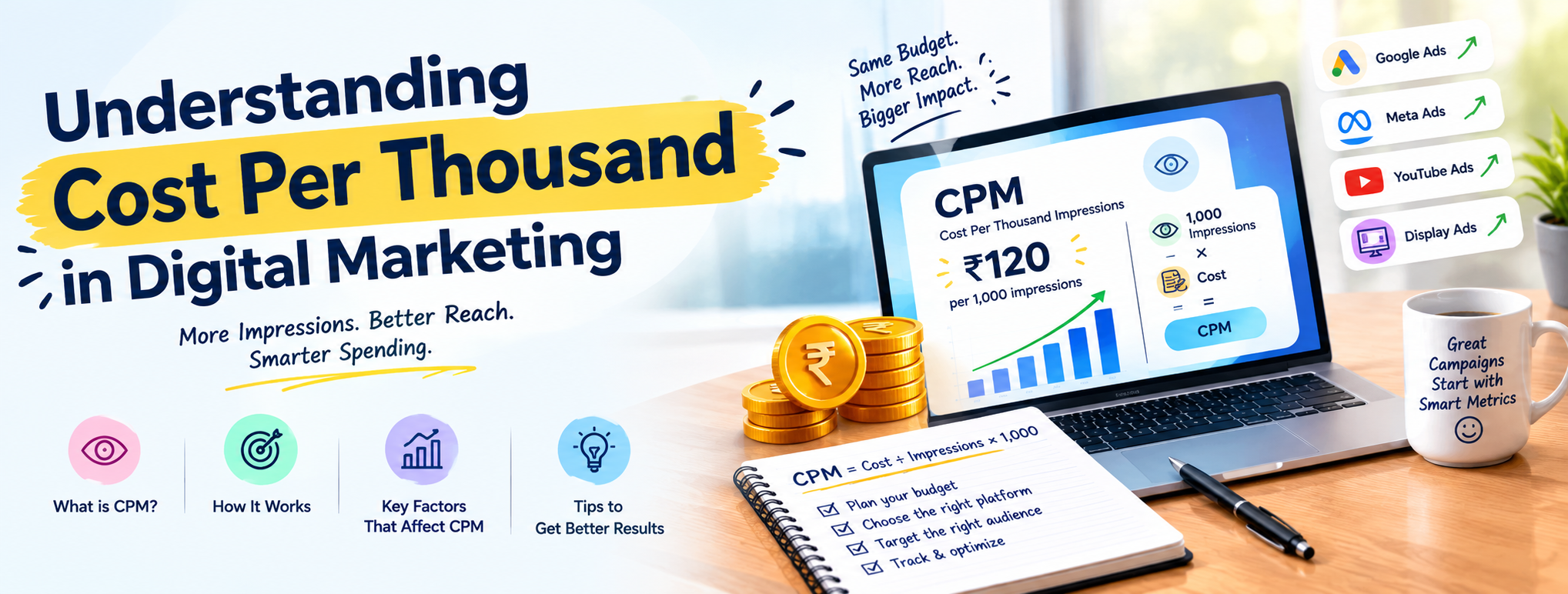
If you have spent any time setting up a display, social, or video ad campaign, you have almost certainly come across the acronym CPM. Cost Per Thousand (CPM), sometimes written as cost per mille, using the Latin word for "thousand", is one of the oldest and most widely used pricing models in advertising, and it remains a cornerstone metric in digital marketing today.
Whether you are a brand new marketer trying to understand an ad platform's billing dashboard, or a business owner comparing media quotes from different agencies, understanding Cost Per Thousand in digital marketing is essential to spending your advertising budget wisely. This guide breaks down what CPM means, how CPM works, how to calculate it, how it compares to other pricing models like CPC and CPA, and how to actually bring your CPM advertising cost down without sacrificing results.
What Is CPM in Digital Marketing?
CPM (Cost Per Thousand) is an advertising pricing model in which an advertiser pays a fixed rate for every 1,000 impressions their ad receives. An "impression" is counted each time an ad loads and is displayed to a user, it does not require a click, a view of a certain duration, or any other action.
So, what is CPM in digital marketing in plain terms? It is simply the price tag attached to exposure. If a platform quotes a CPM rate of ₹200, that means the advertiser pays ₹200 every time their ad is shown 1,000 times, regardless of how many people actually engage with it.
This makes CPM fundamentally different from performance-based pricing models, which charge only when a specific user action occurs. CPM advertising is, at its core, a model built around reach and visibility rather than direct response.
Cost Per Thousand Impressions Meaning
The "thousand" in Cost Per Thousand refers to the batch size used for pricing. Ad inventory is rarely sold one impression at a time because a single impression is worth a fraction of a cent on most platforms. Bundling impressions into units of 1,000 makes the pricing model practical to display, compare, and bill.
So the cost per thousand impressions meaning can be summarized as: the price an advertiser pays to have their ad displayed 1,000 times on a publisher's website, app, or platform.
Why CPM Matters in Digital Marketing
CPM in digital marketing matters because it is the common currency used to compare the cost-efficiency of different media buys. A marketer running campaigns across Google Display Network, Facebook, YouTube, and a programmatic ad exchange needs a single, standardized way to compare how expensive each channel is relative to its reach. CPM provides that standard.
It also plays a central role in:
- Media planning and budgeting, since CPM lets marketers forecast how far a given ad budget will stretch.
- Brand awareness campaigns, where the goal is maximum visibility rather than immediate conversions.
- Publisher revenue, since websites and apps that sell ad space are often paid on a CPM basis by advertisers or ad networks.
How CPM Works
To understand how CPM works, it helps to walk through the mechanics of a typical campaign.
- An advertiser sets a campaign budget and chooses CPM as the bidding or pricing strategy on their ad platform of choice.
- The platform (or an ad exchange, in the case of programmatic buying) serves the ad to eligible users based on targeting criteria such as demographics, interests, device, or location.
- Each time the ad loads on a page or screen and is counted as viewable, one impression is logged.
- Once 1,000 impressions accumulate, the advertiser is charged the agreed CPM rate.
- The campaign continues serving impressions until the budget is exhausted or the campaign end date is reached.
Impressions vs. Page Views
A common point of confusion when learning how CPM works is the difference between an impression and a page view.
- A page view is recorded when a user's browser loads a web page.
- An impression is recorded when a specific ad element on that page loads and is displayed.
A single page view can generate multiple impressions if more than one ad unit appears on the page. Conversely, not every page view results in an ad impression, for example, if an ad fails to load, is blocked, or the ad slot is empty. This distinction matters because CPM advertising cost is calculated strictly on ad impressions, not on overall site traffic.
Viewability and Ad Fraud Considerations
Modern CPM campaigns increasingly factor in viewable impressions rather than raw served impressions. A viewable impression generally means a meaningful percentage of the ad (commonly 50%) was on-screen for at least one second for display ads, or two seconds for video. Platforms like Google Ads and the Media Rating Council (MRC) have pushed the industry toward viewability-based measurement because a served-but-never-seen impression provides little value to the advertiser.
Ad fraud, including bot traffic and impression stacking, is another factor that affects how CPM campaigns are managed. Reputable ad networks use fraud detection and brand safety tools to filter out invalid traffic before it is billed, which is one reason working with established platforms or a trusted SEO company in Bangalore for campaign management matters.
CPM Formula: How to Calculate CPM
The CPM formula is straightforward:
CPM = (Total Campaign Cost ÷ Total Impressions) × 1,000
Step-by-Step CPM Calculation
Suppose a business spends ₹15,000 on a display advertising campaign and receives 300,000 impressions.
- Divide the total cost by total impressions: ₹15,000 ÷ 300,000 = ₹0.05
- Multiply by 1,000: ₹0.05 × 1,000 = ₹50
The CPM rate for this campaign is ₹50, meaning the advertiser pays ₹50 for every 1,000 times the ad is shown.
Reverse Calculation: Finding Total Cost from CPM
If you already know the CPM rate and want to estimate total spend, use this version of the formula:
Total Cost = (CPM Rate × Total Impressions) ÷ 1,000
For example, at a CPM rate of ₹80, running a campaign for 500,000 impressions would cost: (₹80 × 500,000) ÷ 1,000 = ₹40,000
Understanding how to calculate CPM in both directions helps marketers set realistic budgets and forecast expected reach before a campaign even launches.
What Is a Good CPM Rate?
There is no single "good" CPM rate that applies universally, average CPM varies significantly by industry, platform, geography, ad format, and target audience competitiveness. That said, here are some general observations marketers commonly reference:
| Factor | Effect on CPM |
|---|---|
| Highly competitive industries (finance, insurance, legal) | Higher CPM |
| Niche or long-tail audiences | Lower CPM |
| Premium ad placements (above the fold, homepage) | Higher CPM |
| Broad targeting with large audience pools | Lower CPM |
| Video and connected TV formats | Higher CPM |
| Native and in-feed display formats | Lower to moderate CPM |
Rather than chasing a universally "good" number, the more useful question is whether your CPM rate is delivering a positive return relative to your campaign goals. A high CPM that drives strong brand recall and downstream conversions can be more valuable than a low CPM that reaches an uninterested or low-quality audience.
High CPM Meaning and Low CPM Meaning
- High CPM meaning: A high CPM typically indicates that you are competing for a sought-after audience, a premium ad placement, or a less abundant form of inventory (such as video or connected TV). It isn't inherently bad, it often correlates with better-quality placements and more engaged audiences.
- Low CPM meaning: A low CPM usually points to lower competition for that inventory, broader or less specific targeting, or less premium placement. Low CPM campaigns are budget-friendly but can sometimes come with lower-quality traffic if not monitored carefully.
Factors Affecting CPM
Several variables influence CPM advertising cost on any given platform:
1. Audience Targeting
Narrow, high-intent audience segments (for example, "CFOs at mid-size companies") typically cost more per thousand impressions than broad demographic targeting, because fewer advertisers can reach that same pool.
2. Ad Placement and Format
Above-the-fold placements, homepage takeovers, and video pre-roll slots generally command higher CPM rates than in-article or sidebar placements.
3. Seasonality
CPM rates often spike around high-demand periods such as festive shopping seasons, year-end sales, or major news cycles, as more advertisers compete for the same inventory.
4. Device and Platform
Mobile CPM, desktop CPM, and connected TV CPM can differ substantially depending on user behavior and advertiser demand on each surface.
5. Ad Quality and Relevance
Platforms like Google Ads and Meta factor in ad relevance and quality scores. A low-quality or poorly targeted ad may be charged a higher effective CPM to compensate for lower expected engagement.
6. Geography
CPM rates in markets with higher average advertiser spend (such as the US, UK, or Australia) tend to be higher than in markets with lower average ad budgets.
How to Reduce CPM
Bringing down your CPM advertising cost without compromising reach or quality takes a mix of targeting discipline and creative optimization:
- Refine audience targeting so your ad is shown to a more precisely qualified pool, reducing wasted impressions.
- Improve ad relevance and quality scores by aligning ad creative and messaging closely with the audience's intent.
- Test multiple ad creatives to identify which versions the platform rewards with lower delivery costs.
- Expand placement options rather than restricting a campaign to only the most competitive, premium inventory.
- Adjust campaign timing to avoid the most expensive, high-competition windows when possible.
- Use frequency capping to prevent overspending on repeated impressions to the same users.
- Negotiate directly with publishers for fixed CPM deals when running larger-scale campaigns.
CPM vs CPC vs CPA: Choosing the Right Pricing Model
CPM is just one of several pricing models available in digital advertising. Understanding CPM vs CPC vs CPA helps marketers choose the right model for their campaign objective.
CPM vs CPC
CPC (Cost Per Click) charges advertisers only when a user clicks the ad, rather than simply viewing it.
| CPM | CPC | |
|---|---|---|
| You pay for | Every 1,000 impressions | Every click |
| Best suited for | Brand awareness, reach | Driving traffic, direct response |
| Risk | Pay even without clicks | Pay only for engaged action |
| Typical use case | Display and video branding campaigns | Search and performance campaigns |
Comparing cost per thousand vs cost per click often comes down to campaign intent: CPM is about visibility at scale, while CPC is about driving a specific action, such as a website visit.
CPM vs CPA
CPA (Cost Per Action) charges advertisers only when a defined conversion event occurs, such as a purchase, signup, or form submission.
CPM vs CPA represents an even bigger gap in risk exposure than CPM vs CPC. With CPA, an advertiser pays only for outcomes that matter most to the business, making it attractive for performance marketers. However, CPA campaigns typically require more data and a proven conversion funnel to run effectively, and rates per action tend to be significantly higher than a straightforward CPM buy.
CPM vs PPC
PPC (Pay-Per-Click) is often used as an umbrella term that includes CPC-based advertising. When comparing CPM vs PPC, remember that PPC models (including CPC) are performance-driven, while CPM is impression-driven. Many advertisers use both models together: CPM for upper-funnel awareness, and PPC/CPC for lower-funnel conversions.
When to Choose CPM Over CPC or CPA
CPM advertising model tends to be the better fit when:
- The primary campaign goal is brand awareness or reach rather than immediate conversions.
- You are launching a new product or brand and need broad visibility.
- You want predictable budgeting, since cost scales with impressions rather than fluctuating user behavior.
- You are running retargeting or frequency-based campaigns designed to reinforce brand recall over time.
Benefits of CPM Advertising
- Budget predictability. Because cost is tied directly to impressions rather than unpredictable user actions, CPM campaigns are easier to forecast and budget for.
- Scalable reach. CPM is well suited to campaigns that need to reach large audiences quickly, such as product launches or seasonal promotions.
- Cost-effectiveness for upper-funnel goals. For brand awareness, CPM is typically cheaper per impression than performance-based alternatives.
- Useful comparison metric. CPM gives marketers a consistent way to compare efficiency across platforms, publishers, and formats.
- Supports publisher monetization. For website owners and app developers, CPM-based ad sales provide a steady, calculable revenue stream.
Advantages and Limitations of CPM Marketing Strategy
While the benefits above make a strong case for CPM, a balanced CPM marketing strategy should also account for its limitations:
- No guarantee of engagement. You pay for impressions regardless of whether users interact with the ad.
- Risk of low-quality placements. Without careful platform and publisher selection, CPM ads can appear in low-visibility or irrelevant contexts.
- Vulnerability to ad fraud. Bot traffic can inflate impression counts if proper fraud protection isn't in place.
- Harder to directly attribute conversions. Unlike CPC or CPA, CPM doesn't inherently tie spend to a measurable action, making ROI analysis more complex without additional tracking (such as view-through conversion tracking).
The most effective digital marketing CPM strategies combine awareness-focused CPM campaigns with performance tracking layered on top, so marketers can still assess downstream impact even though the pricing model itself is impression-based.
CPM Across Major Advertising Platforms
CPM for Google Ads
On the Google Display Network, CPM for Google Ads bidding (including Viewable CPM, or vCPM) allows advertisers to pay specifically for impressions that are verified as viewable, rather than simply served. This is particularly useful for brand awareness campaigns where actual visibility is the priority.
CPM for Facebook Ads
CPM for Facebook Ads operates within Meta's auction-based system, where the final rate is influenced by audience overlap, ad relevance, estimated action rates, and overall advertiser demand for that audience segment at that time.
CPM for Display Advertising
CPM for display advertising remains one of the most common pricing structures across ad exchanges and programmatic platforms, covering everything from banner ads to rich media units across publisher networks.
CPM for YouTube Advertising
CPM for YouTube advertising typically applies to non-skippable formats and bumper ads, where advertisers pay per thousand impressions rather than per view, making it a strong fit for campaigns prioritizing broad video reach.
CPM for Social Media Advertising
Across platforms, CPM for social media advertising is shaped heavily by audience targeting precision, creative quality, and seasonal demand, with rates fluctuating throughout the year based on overall advertiser competition for ad inventory.
CPM Benchmarks and Industry Averages
While exact average CPM figures shift constantly due to market demand, auction dynamics, and seasonality, a few general benchmarking principles hold steady across industries:
- Search and shopping-adjacent industries (finance, legal, insurance, real estate) tend to see higher-than-average CPM due to intense advertiser competition.
- E-commerce and retail brands typically see CPM spikes during major shopping seasons.
- B2B campaigns targeting niche professional audiences often carry higher CPM due to smaller available audience pools.
- Broad-reach consumer categories (entertainment, lifestyle, general news) typically see comparatively lower CPM due to larger inventory supply.
Rather than relying solely on published industry-average CPM figures, which vary by source, region, and time period, it's generally more reliable to benchmark your own campaigns against your account's historical performance and against competitors in your specific niche.
How to Run a Successful CPM Campaign
- Define clear objectives. Confirm that brand awareness or reach, not direct conversions, is genuinely the right goal for a CPM-based buy.
- Set a realistic budget. Use the CPM formula to estimate how many impressions your budget will realistically deliver.
- Choose the right platform and format. Match your audience's media habits to the platform, video for YouTube, feed-native for social, banner inventory for display networks.
- Target precisely, but not too narrowly. Overly broad targeting wastes impressions on uninterested users; overly narrow targeting inflates CPM unnecessarily.
- Prioritize viewability. Where available, use viewable CPM (vCPM) bidding to ensure you're paying for impressions users can actually see.
- Monitor and optimize continuously. Track frequency, placement performance, and engagement signals, and adjust targeting or creative as the campaign runs.
- Layer in conversion tracking. Even though CPM is impression-based, pairing it with view-through and click-through tracking helps quantify downstream business impact.
CPM Campaign Optimization Checklist
- Review placement reports regularly and exclude poor-performing sites or apps.
- Test creative variations to find which combinations the platform rewards with efficient delivery.
- Apply frequency caps to avoid overexposing the same users.
- Use audience exclusions to prevent budget waste on existing customers, where appropriate.
- Revisit targeting parameters mid-campaign based on early performance data.
- Compare CPM performance across platforms periodically rather than committing budget to a single channel indefinitely.
Final Thoughts on CPM Advertising
Cost Per Thousand remains one of the most dependable pricing models in digital advertising because it offers predictable, scalable, and easily comparable costs for reaching an audience. It isn't the right fit for every campaign objective, performance-focused goals are often better served by CPC or CPA models, but for brand awareness, product launches, and large-scale visibility campaigns, CPM advertising continues to be a foundational part of a well-rounded digital marketing strategy.
The businesses that get the most value out of CPM campaigns are the ones that combine the model's cost predictability with disciplined targeting, continuous optimization, and a clear understanding of how CPM fits alongside other pricing models in the broader marketing funnel.
If you're looking to build a digital marketing and SEO strategy that makes every rupee of your advertising and content budget work harder, working with an experienced SEO company in Bangalore can help you align your paid media decisions, including CPM-based campaigns, with a long-term organic growth plan.
Frequently Asked Questions
1. What does CPM stand for in digital marketing?
CPM stands for Cost Per Thousand (from the Latin "mille," meaning thousand). It refers to the cost an advertiser pays for every 1,000 impressions of their ad.
2. How is CPM calculated?
CPM is calculated using the formula: CPM = (Total Campaign Cost ÷ Total Impressions) × 1,000. For example, a ₹15,000 campaign that generates 300,000 impressions has a CPM of ₹50.
3. What is a good CPM rate?
There is no universal "good" CPM rate — it depends on industry, audience, platform, and ad format. A CPM is considered good when it delivers impressions that support your campaign's broader goals at a cost-efficient rate relative to your benchmarks.
4. What is the difference between CPM and CPC?
CPM charges advertisers per 1,000 impressions regardless of clicks, while CPC (Cost Per Click) charges only when a user clicks the ad. CPM suits awareness goals; CPC suits traffic and direct-response goals.
5. What is the difference between CPM and CPA?
CPM charges based on impressions, while CPA (Cost Per Action) charges only when a specific conversion event, like a purchase or signup, occurs. CPA carries less risk for advertisers but usually costs more per outcome than CPM per impression.
6. Is CPM a good pricing model for small businesses?
Yes, CPM can work well for small businesses, particularly for building brand awareness on a predictable budget. However, businesses with limited budgets and a strong need for direct conversions may find CPC or CPA models more immediately cost-effective.
7. How can I lower my CPM advertising cost?
You can reduce CPM by refining audience targeting, improving ad relevance and creative quality, testing multiple ad variations, expanding placement inventory, applying frequency caps, and adjusting campaign timing to avoid high-competition periods.
8. Does a high CPM mean a bad campaign?
Not necessarily. A high CPM often reflects competitive, high-value audience segments or premium placements. What matters more is whether the resulting impressions and downstream engagement justify the cost relative to your campaign objectives.
Read More: SEO & Digital Marketing Resources
Want to learn more about SEO, digital marketing, link building, local SEO, and paid advertising? Explore these helpful guides from Cronbay Technologies to build a stronger digital marketing strategy.

.png)