
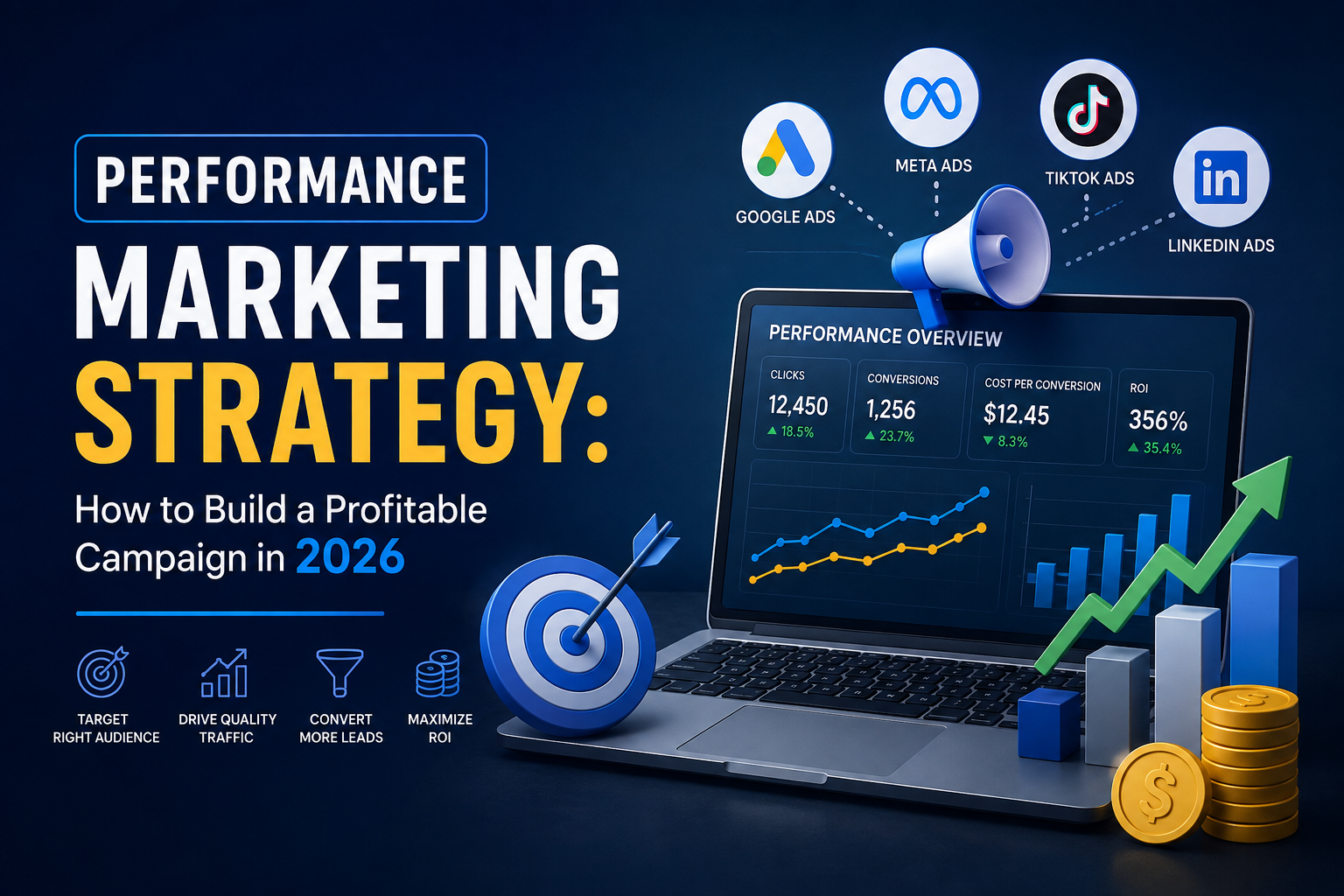
Build a profitable performance marketing strategy in 2026. Learn the framework, tools, and steps top brands use, plus how a Bangalore agency can help you scale.
Introduction
You are spending money on ads every month. Clicks are coming in. But sales? Barely moving.
This is the most common complaint business owners bring to marketing agencies today: "We are running ads, but nothing is converting."
The problem is rarely the platform. It is the absence of a real performance marketing strategy.
Random boosted posts and one-off Google Ads campaigns do not build businesses. A structured strategy does. In 2026, digital ad spend worldwide is on track to cross $835 billion, and performance-based formats now account for the majority of display advertising budgets, because brands want proof, not promises, for every rupee spent.
This guide breaks down exactly how to build a performance marketing strategy that turns ad spend into predictable revenue, the framework, the steps, the tools, and the mistakes to avoid. Whether you run a startup, manage marketing for a growing company, or are a developer trying to understand how paid growth actually works, this article gives you a practical, no-fluff roadmap.
What Is a Performance Marketing Strategy?
A performance marketing strategy is a data-driven plan where every marketing rupee is tied to a measurable outcome, a click, a lead, a sale, or an app install. Unlike traditional advertising, where you pay for impressions or visibility regardless of results, performance marketing means you pay for outcomes.
In simple terms: you are not buying ads. You are buying results.
A true strategy includes:
- Clear, measurable goals (leads, sales, signups)
- The right marketing channels for your audience
- A tested offer and message
- Tracking and attribution systems
- A continuous optimization loop
Without these five pieces, you have a campaign, not a strategy.
Why Do Businesses Need a Performance Marketing Framework in 2026?
The rules of digital advertising have changed. Acquisition costs are rising across Google, Meta, and programmatic platforms. Privacy-first tracking has made audience targeting harder. Customer journeys are more fragmented, spanning devices, apps, and platforms before a single sale happens.
This is exactly why a loose, reactive approach no longer works. You need a performance marketing framework, a repeatable system, not a one-time campaign.
Here's what's driving the shift in 2026:
- AI-led optimization is now standard. Google, Meta, and programmatic platforms rely heavily on machine learning to adjust bids, placements, and creative delivery in real time. Brands still optimizing manually are falling behind.
- First-party data is the new currency. With third-party cookies fading, brands that collect and use their own customer data are seeing outsized gains in ad revenue efficiency.
- Video and short-form content dominate attention. Platforms like YouTube Shorts, Instagram Reels, and short-form video ads are becoming central to performance funnels, not just brand awareness.
- Search remains the highest-intent channel. Global search advertising spend is projected to stay the largest digital ad format in 2026, because users searching with intent convert at far higher rates than passive scrollers.
A strategy that ignores these shifts will burn the budget fast. A strategy built around these compounds.
(Want a channel-specific breakdown? Our guide on pay-per-click advertising covers how paid search fits into the bigger picture.)
How to Build a Profitable Performance Marketing Strategy: Step-by-Step?
Here is the exact framework we use when building a performance marketing plan for clients, whether they are D2C brands, SaaS companies, or local service businesses.
Step 1: Define One Clear, Measurable Goal
Before touching any ad platform, answer one question: what does "success" actually look like?
- Is it 50 qualified leads a month?
- Is it a target cost per acquisition (CPA)?
- Is it a specific return on ad spend (ROAS), like 4x?
Vague goals like "get more visibility" cannot be optimized. Specific numbers can.
Step 2: Know Your Audience Better Than Your Competitors Do
Build a real customer profile, not guesses. Use:
- Existing customer data (who actually buys from you)
- Website analytics (what pages convert)
- Competitor research (who they are targeting and how)
A campaign built for "everyone" converts nobody. A campaign built for a specific, well-understood buyer converts consistently.
Step 3: Choose the Right Channel Mix
Not every channel fits every business. A good performance marketing plan usually blends two or three channels rather than betting everything on one.
| Channel | Best For | Typical Use Case |
|---|---|---|
| Google Search Ads | High-intent buyers | Someone actively searching for your product/service |
| Meta Ads (Facebook/Instagram) | Awareness + retargeting | Visual products, impulse purchases, lead generation |
| Programmatic/Display | Retargeting at scale | Re-engaging site visitors across the web |
| LinkedIn Ads | B2B lead generation | Software, consulting, enterprise services |
| YouTube/Short-form Video | Brand + performance hybrid | Storytelling that drives clicks |
Start with one or two channels where your audience is already active, prove profitability, then expand.
Step 4: Build Landing Pages That Convert, Not Just Load
Sending paid traffic to a generic homepage is one of the most common (and costly) mistakes businesses make. Every campaign needs a dedicated landing page that:
- Matches the ad's message exactly
- Loads in under 3 seconds
- Has one clear call-to-action
- Is optimized for mobile first
A 1% improvement in landing page conversion rate can lower your cost per acquisition significantly, often more impactful than raising your budget.
Step 5: Set Up Tracking Before You Spend a Single Rupee
This step gets skipped constantly, and it is the most expensive mistake in performance marketing. Without proper tracking, you are optimizing blind.
At minimum, set up:
- Conversion tracking (Google Ads, Meta Pixel)
- Google Analytics 4 goals/events
- Call tracking (if leads come via phone)
- UTM parameters on every campaign link
If you can't measure it, you can't improve it, and you definitely can't scale it profitably.
Step 6: Launch Small, Test, Then Scale
Never launch your full budget on day one. Start with a testing budget across:
- 2–3 ad creatives
- 2–3 audience segments
- 1–2 messaging angles
Let data, not opinions, decide what wins. Kill underperformers within the first 7–14 days and reallocate the budget to what's working.
Step 7: Optimize Continuously
A performance marketing campaign is never "done." Weekly review is now standard practice among data-driven marketers, since even minor budget shifts, bid adjustments, and creative refreshes compound into major gains over a quarter.
Review weekly:
- Cost per lead/acquisition
- Click-through and conversion rates
- Ad fatigue (declining performance on the same creative)
- Audience overlap and saturation
Digital Performance Marketing: Key Trends Shaping 2026
If you want your digital performance marketing efforts to stay ahead, keep an eye on these shifts:
- AI-generated search results are changing discovery. A large share of users now interact with AI-generated answers before clicking traditional links, which means content and ads need to be structured clearly enough for AI systems to understand and surface them.
- Omnichannel journey orchestration is becoming mainstream. Unifying customer data across email, ads, and site behavior is no longer optional for brands competing at scale.
- Programmatic dominance continues to grow, with machine-learning-driven bidding making micro-targeting more precise across devices.
- Privacy-compliant, first-party data strategies are directly correlated with stronger ad revenue outcomes as third-party tracking keeps shrinking.
Brands that adapt their performance marketing framework to these shifts now will have a real competitive edge over the next two to three years, not just the next quarter.
(For a deeper look at how paid campaigns fit into broader business growth, see our post on why PPC matters for business growth.)
Common Mistakes That Kill Performance Marketing Campaigns
Even experienced marketers fall into these traps:
- Chasing vanity metrics. Clicks and impressions feel good but don't pay bills. Focus on cost per acquisition and revenue.
- Changing campaigns too fast. Ad platforms need data to learn. Making changes every 2 days resets the learning phase and wastes budget.
- Ignoring mobile experience. Over half of paid traffic today comes from mobile devices; a slow mobile landing page destroys conversion rates.
- No retargeting strategy. Most visitors don't convert on the first visit. Without retargeting, you're paying to attract the same visitor twice.
- Treating it as a one-time project. Performance marketing is a system that needs continuous management, not a "set it and forget it" campaign.
Why Work With a Performance Marketing Agency in Bangalore?
Building and managing all of this in-house takes time, tools, and specialized expertise ,something most business owners simply don't have spare bandwidth for.
This is where a specialized performance marketing agency in Bangalore makes a measurable difference. Bangalore's position as India's startup and tech hub means agencies here work daily with SaaS companies, D2C brands, and fast-scaling businesses, giving them direct, current experience with what actually converts across Indian and global markets.
A good agency brings:
- Access to tested frameworks instead of trial-and-error
- Platform-certified specialists (Google, Meta, LinkedIn)
- Dedicated tracking and reporting systems
- Faster iteration based on real campaign data, not guesswork
At Cronbay Tech, we build performance marketing strategies around one principle: every rupee spent must be traceable to a result. Our team manages everything from campaign setup to continuous optimization, so you get growth without needing to become a full-time marketer yourself.
Explore our PPC management services to see how we structure paid campaigns for measurable ROI, or read more about pay-per-click advertising strategy on our blog.
FAQs
Digital marketing is the broad umbrella covering all online marketing activities, including branding and content. Performance marketing is a subset focused specifically on measurable, outcome-based campaigns where you pay for results like clicks, leads, or sales.
There's no fixed number, it depends on your industry, competition, and goals. Most businesses start with a testing budget (often ₹20,000–₹50,000/month for small businesses) to gather data before scaling up based on what performs.
Search campaigns can show results within days, since they target existing demand. Social and display campaigns usually need 2–4 weeks of testing before consistent, profitable patterns emerge.
A performance marketing plan is the overall strategy, goals, channels, budget, and timeline. A campaign is a single execution within that plan, like one Google Ads push for a product launch.
Yes. Because you only pay for measurable results, performance marketing is often more budget-efficient for small businesses than traditional advertising, as long as tracking and targeting are set up correctly.
Agencies bring tested frameworks, platform expertise, and full-time attention to your campaigns, reducing the trial-and-error cost of learning on your own budget, and typically shortening the time to profitability.
Conclusion: Turn Ad Spend Into Predictable Growth
A winning performance marketing strategy isn't about spending more, it's about spending with a system. Clear goals, the right channels, proper tracking, and continuous optimization turn scattered ad spend into predictable, repeatable revenue.
2026 belongs to brands that treat performance marketing as a discipline, not a guessing game.
If you're ready to build a performance marketing campaign that actually delivers ROI, our team at Cronbay Tech can help you plan, launch, and scale it the right way.

.png)