
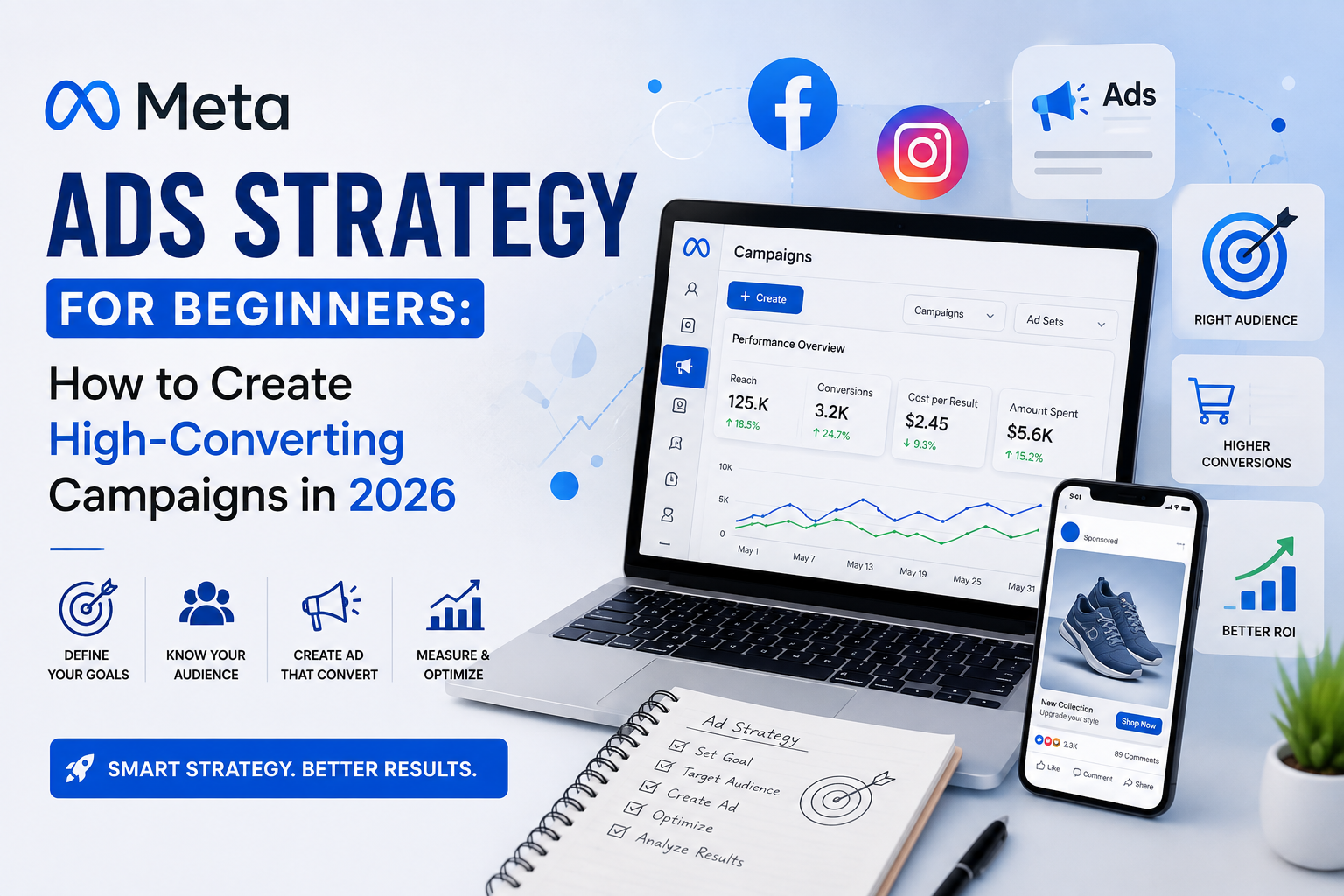
Learn a proven Meta ads strategy for beginners. Step-by-step guide to building high-converting Facebook and Instagram ad campaigns that drive real ROI.
Introduction
You launched a Facebook ad. You watched the "impressions" climb. And then… nothing. No leads, no sales, just a shrinking budget and a lot of confusion.
If that sounds familiar, you're not alone. Most beginners lose money on their first few campaigns, not because Meta ads don't work, but because they skip the strategy and jump straight to "Boost Post."
In 2026, Meta ads still delivered a median return on ad spend (ROAS) of roughly 2.2x to 2.8x across industries, with top performers hitting 4x–6x. The gap between the two groups isn't luck, it's strategy: the right funnel, the right targeting, and creativity that actually stops the scroll.
This guide breaks down a complete Meta ads strategy for beginners, the exact framework we use at Cronbay Technologies, a performance marketing agency in Bangalore, to build high-converting campaigns for our clients. Whether you're a business owner testing your first campaign or a marketer sharpening your skills, you'll walk away with a repeatable, data-backed process.
What Is a Meta Ads Strategy?
A Meta ads strategy is a structured plan for using Facebook and Instagram advertising to reach specific business goals, awareness, leads, or sales, by combining the right campaign objective, audience targeting, creative, budget, and measurement approach.
It's not just "running ads." It's the thinking behind the ads:
- Who are you trying to reach?
- What action do you want them to take?
- What message will move them to act?
- How will you know if it worked?
Without answering these first, even a well-designed ad will underperform. This is the foundation of every successful paid social advertising campaign.
Why Meta Ads Still Matter in 2026
Some marketers assume Meta's dominance has faded with the rise of TikTok and connected TV. The data says otherwise.
- Meta's advertising reach still spans over 3 billion people monthly across Facebook and Instagram.
- Meta's Advantage+ AI-powered campaigns are now outperforming manually built campaigns by roughly 20–22% in ROAS, according to recent industry benchmarking.
- Retargeting campaigns on Meta regularly deliver 3.6x ROAS or higher, far above cold prospecting.
For a business in Bangalore's fast-growing D2C, SaaS, and retail scene, this makes Meta advertising one of the highest-leverage channels for performance marketing, provided the strategy behind it is sound.
Want a deeper comparison of platforms before you commit a budget? Check out our breakdown of Facebook vs Instagram advertising to decide where your audience actually spends time.
Step-by-Step: Building a High-Converting Meta Ads Strategy
Step 1: Define One Clear Campaign Objective
Every high-converting campaign starts with a single, specific goal. Meta's Ads Manager groups objectives into three buckets:
- Awareness — Reach, Brand Awareness
- Consideration — Traffic, Engagement, Video Views, Lead Generation
- Conversion — Sales, App Promotion, Store Visits
Beginner mistake: choosing "Engagement" when the real goal is sales. More likes don't pay bills. If revenue is the goal, choose the Sales or Leads objective and let Meta's algorithm optimize toward that action, not vanity metrics.
Step 2: Understand Your Audience Before You Target Anyone
Before opening Ads Manager, answer these questions:
- Who has already bought from you (customer list)?
- Who visits your website but doesn't convert?
- What are their pain points, in their own words?
This research feeds directly into three audience types inside Meta:
- Core Audiences — built from demographics, interests, and behaviors
- Custom Audiences — built from your existing data (email lists, website visitors, app users)
- Lookalike Audiences — new people who resemble your best existing customers
Pro tip: Custom Audiences built from your top 10% of customers (by revenue) almost always outperform broad interest targeting for conversion campaigns.
Step 3: Structure Your Campaign Like a Funnel
A single flat campaign rarely converts cold traffic efficiently. Instead, build a simple three-stage funnel:
| Funnel Stage | Objective | Audience | Goal |
|---|---|---|---|
| Top (TOFU) | Awareness / Video Views | Cold, interest-based | Build recognition |
| Middle (MOFU) | Traffic / Engagement | Website visitors, video viewers | Build intent |
| Bottom (BOFU) | Sales / Leads | Cart abandoners, past visitors | Convert |
This mirrors classic PPC funnel logic, if you're new to paid media structure in general, our guide to pay-per-click advertising covers the fundamentals that apply across Google and Meta alike.
Step 4: Write Ad Creative That Stops the Scroll
Creative now drives an estimated 50–70% of Meta ad performance, more than targeting or bidding. In a feed full of content, your ad has under 2 seconds to earn attention.
High-converting creative checklist:
- Hook in the first frame (text overlay or bold visual, not a slow build-up)
- Native, UGC-style video outperforms polished studio ads for most categories
- Clear, benefit-led headline (not just a product name)
- One call-to-action per ad — don't ask people to "Shop Now" and "Learn More" simultaneously
- Vertical video (9:16) for Reels and Stories placements
Example: A Bangalore-based skincare brand we worked with replaced a studio product shot with a 15-second UGC video of a real customer's routine. Cost per purchase dropped by 34% in two weeks, same budget, same audience, only the creative changed.
For a closer look at what makes an ad campaign convert from start to finish, see our guide on building a Facebook ad campaign.
Step 5: Set a Realistic Budget and Let the Algorithm Learn
A common beginner error is changing the budget or targeting every day. Meta's algorithm needs a learning phase, roughly 50 conversions per ad set within a 7-day window, to optimize delivery.
Beginner budget guidelines:
- Start with a minimum of ₹500–₹1,000/day per ad set for testing
- Run each test for at least 4–7 days before judging results
- Avoid making more than one major change at a time (creative, audience, or bid, not all three)
Step 6: Track the Right Metrics
Vanity metrics (likes, reach) don't tell you if a campaign is profitable. Track these instead:
- CTR (Click-Through Rate) — ad relevance
- CPM (Cost per 1,000 Impressions) — auction competitiveness
- CPA (Cost per Acquisition) — cost per lead/sale
- ROAS (Return on Ad Spend) — revenue ÷ ad spend
As a benchmark, the Meta Ads average ROAS across industries in 2026 sits at roughly 2.2x–2.8x, with retargeting campaigns often exceeding 3.5x. Anything below your break-even ROAS (calculated as 1 ÷ gross margin) needs optimization, not just more budget.
Facebook Ads for Beginners: 5 Mistakes to Avoid
- Targeting too broad or too narrow. Extremely niche audiences under 1,000 people limit delivery; overly broad audiences waste money on irrelevant clicks.
- Ignoring the Meta Pixel / Conversions API. Without proper tracking, the algorithm can't optimize for real conversions, and iOS privacy changes make server-side tracking (Conversions API) essential in 2026.
- Using one ad creative for weeks. Ad fatigue sets in fast; refresh creative every 1–2 weeks for active campaigns.
- Sending traffic to a slow or generic landing page. A great ad with a poor landing experience still fails to convert.
- Judging performance too early. Give the algorithm time to exit the learning phase before making changes.
Meta Ads vs Other Paid Social Channels
While this guide focuses on Meta, it's worth knowing where it fits in the broader paid social advertising landscape:
- Instagram ads work best for visually-driven, aspirational products (fashion, beauty, lifestyle)
- Facebook ads still lead for lead generation, local businesses, and older demographics
- Running both together, within one Meta campaign, typically improves reach and reduces CPMs compared to isolating a single platform
If you're deciding how to split the budget between the two, our comparison of Facebook vs Instagram breaks down audience behavior on each.
When to Bring in a Performance Marketing Agency
DIY campaigns work well for testing and learning. But once budgets scale past a few thousand rupees a day, the complexity multiplies, multiple ad sets, creative testing at volume, pixel and CAPI setup, and constant optimization become a full-time job.
This is where a dedicated performance marketing agency in Bangalore adds measurable value: structured funnels, faster creative iteration, and data-driven budget allocation that a solo marketer or small team often can't sustain alongside daily operations.
At Cronbay, our approach to Meta advertising combines paid social with broader social media marketing services and PPC management services, so campaigns work together across the funnel instead of competing for the same budget in silos.
Conclusion: Turn Strategy Into Results
A winning Meta ads strategy isn't about secret hacks, it's about getting the fundamentals right: one clear objective, a funnel-based structure, audience data you actually own, scroll-stopping creative, and disciplined measurement.
Start small, test deliberately, and let data, not guesswork, guide your next move. The businesses seeing 4x–6x ROAS on Meta today aren't spending more; they're spending smarter.
Ready to turn your Meta ads into a predictable revenue channel?
Talk to Cronbay's Performance Marketing Team in Bangalore →Get a free audit of your current Facebook and Instagram ad account.
FAQs
Start with a single, clear objective (leads or sales), build a simple three-stage funnel (awareness, consideration, conversion), and let each ad set run at least 4–7 days before optimizing.
Most beginners can start testing with ₹500–₹1,000 per day per ad set. What matters more than budget size is giving campaigns enough time and data to exit Meta's learning phase.
Yes. Meta ads deliver a median ROAS of roughly 2.2x–2.8x across industries in 2026, with retargeting campaigns and Advantage+ AI campaigns often performing significantly higher.
Facebook ads tend to perform better for lead generation and local/service businesses, while Instagram ads perform better for visually driven, lifestyle, and fashion brands. Running both within one campaign usually improves overall reach.
At least 4–7 days, or until the ad set reaches roughly 50 conversions, Meta's algorithm needs this data to exit the learning phase and optimize delivery efficiently.
If you're managing a small, testing-stage budget, DIY is a great way to learn. Once spend scales and campaign complexity grows, a performance marketing agency can improve ROAS through structured testing, creative production, and full-funnel strategy.
.png)