
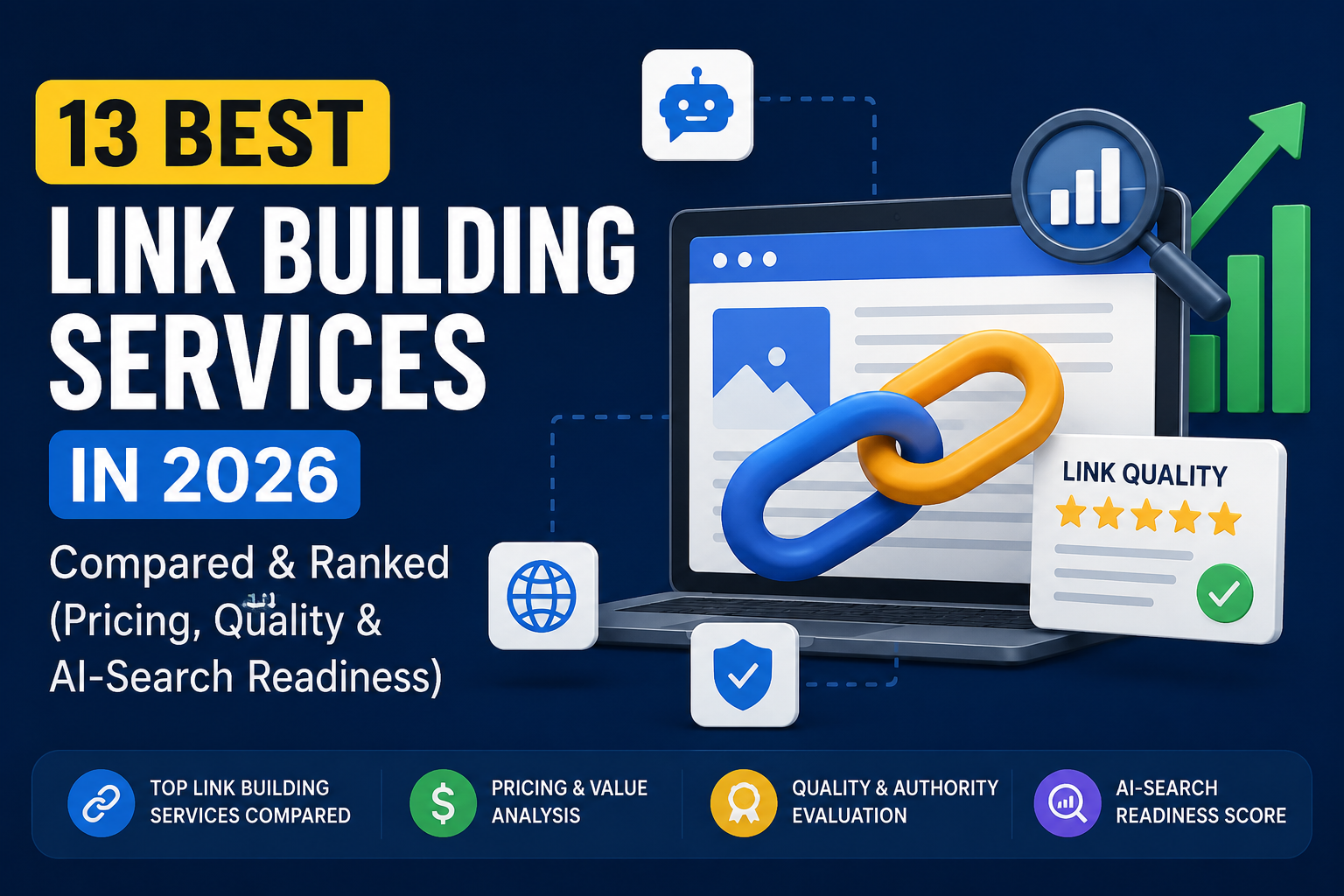
The best link building services in 2026 are the ones that earn links through digital PR, original data, and genuinely useful content, not the ones selling links by the hundred. Based on pricing transparency, editorial quality, and AI-search readiness, our top picks are Siege Media (best for enterprise digital PR), Cronbay Technologies (best for full-funnel SEO + link building on a single retainer), uSERP (best for guaranteed DR placements), Page One Power (best for large-scale outreach), and fatjoe. (best for fast, on-demand orders). Below, we break down every service type, real 2026 pricing, who each agency is actually built for, and the exact criteria we used to rank them plus the services you should avoid entirely.
Link building is the one part of SEO almost every website owner outsources, and it's also the part where the most money gets wasted. You're not just buying links. You're buying someone else's judgment about which sites are safe, which pitches will land, and which shortcuts will get your domain quietly deprioritized six months from now.
We reviewed the two most-cited resources on this topic, cross-checked their pricing claims against current market rates, and built a single evaluation framework one that accounts for something neither older guide fully addresses: how a link's editorial context now affects whether your brand gets cited in AI Overviews, ChatGPT, and Perplexity, not just where it ranks on page one.
What Is a Link Building Service?
A link building service is an agency or freelancer that acquires backlinks to your website from other domains on your behalf usually through outreach, digital PR, guest content, or content designed to earn links organically. The service handles prospecting, pitching, and placement so you don't have to build relationships with hundreds of publishers yourself.
Not all link building services work the same way, and the method matters more than the marketing copy. A $200 "guest post package" and a $10,000/month digital PR retainer are technically the same category of service, but they produce completely different outcomes for your rankings.
How We Evaluated These Services
Every agency and service type below was assessed against six criteria:
- Link quality and relevance — Are placements on real, topically relevant sites with organic traffic, or low-traffic filler domains?
- Transparency — Is pricing, process, and link inventory disclosed, or is everything hidden behind a sales call?
- Editorial authenticity — Are links earned through genuine newsworthiness/utility, or purchased placements dressed up as "outreach"?
- Risk profile — Does the tactic violate Google's link spam policies?
- AI-search readiness — Does the placement build the kind of citation-worthy, entity-level authority that LLM-powered search surfaces (AI Overviews, ChatGPT, Perplexity) pull from?
- Reporting and guarantees — Do you get visibility into what you're paying for, and any performance accountability?
Link Building Services Compared: By Type
Before you pick an agency, it helps to know which category of service actually fits your situation. Here's how the seven main types stack up.
| Service Type | How It Works | Typical Cost | Best For | Risk Level |
|---|---|---|---|---|
| Digital PR agency | Pitches data, studies, or newsworthy angles to journalists for coverage + links | $3,500–$20,000/month | Brands with budget for high-authority, high-DR coverage | Low |
| Organic/content-led link building | Publishes genuinely useful content (guides, tools, data) that earns links passively | $1,000–$20,000+/month | Long-term compounding growth, content-first brands | Very low |
| Guest posting services | Places bylined articles with contextual links on relevant sites | $80–$500 per link | Niche authority + referral traffic | Medium (scale carefully) |
| Niche edits / link insertions | Adds your link into existing, already-ranking articles | $50–$300 per link | Fast, budget-conscious link acquisition | Medium |
| HARO-style expert platforms (e.g., Featured) | You answer journalist queries in exchange for a citation/link | Free–$199/month | Cheap, high-authority homepage links | Low |
| Full-service SEO agencies | Link building bundled inside a broader SEO retainer | $500–$50,000/month | Businesses that want SEO + links under one roof | Varies |
| Infographic/visual content studios | Designs shareable visual assets to attract organic links | $1,000–$4,000 per asset | One-off link building pushes | Low |
Full breakdown of each, with pros and cons:
1. Digital PR Agencies
What it is: A team that turns your data, product, or expertise into a story journalists actually want to cover, then secures the coverage (and the link). This is closely related to digital PR as a standalone service, which some agencies (including ours) run alongside link building for a combined authority push.
Pros: Highest-authority links available; builds brand mentions that carry weight in AI Overview citations, not just SEO; taps existing journalist relationships.
Cons: Expensive; no guaranteed outcome per campaign; some placements are "mentions" without an actual hyperlink, so confirm link inclusion in the contract.
2. Organic / Content-Led Link Building
What it is: Instead of asking for links, you publish something worth linking to — original research, free tools, definitive guides — and links accumulate naturally over time as part of a broader content marketing strategy.
Pros: The most durable, white-hat method that exists; compounds over years; the same content that earns links also earns AI Overview citations, since both reward genuinely useful, well-sourced pages.
Cons: Slow to start; requires real content investment; results aren't guaranteed to any specific page.
3. Guest Posting Services
What it is: An agency finds relevant sites, pitches an article, writes it, and gets it published with a link back to you.
Pros: Contextual, relevant links; can drive meaningful referral traffic if placed on an active site; pay-per-result model.
Cons: Google explicitly discourages large-scale guest posting for links — keep it under roughly 5–10% of your overall link profile; quality varies wildly between vendors, and some route "guest posts" through their own low-quality network instead of real publications.
4. Niche Edits / Link Insertions
What it is: Your link gets inserted into an already-published, already-ranking article on a relevant site, instead of a new post being created.
Pros: Fast; often cheaper than guest posts; can land on pages with existing authority and traffic.
Cons: Easy to abuse at scale; always verify the host page has real organic traffic and isn't part of a link farm before buying.
5. Expert-Source / HARO-Style Platforms
What it is: Platforms like Featured connect you with journalists who need quotes or data for a story. Respond well, get cited and linked.
Pros: Extremely cheap or free; can land links from major outlets (we've seen DR 90+ placements from a single well-answered query); low black-hat risk.
Cons: Time-intensive — someone has to monitor and respond to queries constantly; most links point to your homepage, not the deep page you actually want ranked; no guarantee of placement.
6. Full-Service SEO Agencies
What it is: Link building bundled inside a broader retainer that also covers technical SEO, content, and on-page work.
Pros: One vendor, one invoice; links are built with your actual SEO strategy in mind rather than in isolation.
Cons: Only a fraction of the retainer typically goes toward actual link acquisition; quality depends entirely on which agency you pick — this category has the widest range between excellent and mediocre providers.
7. Infographic / Visual Content Studios
What it is: A design-led agency builds a shareable visual asset (infographic, interactive chart, data visualization) intended to attract organic embeds and links.
Pros: Hands-off once delivered; can go viral and generate a burst of links; no retainer required.
Cons: Hit or miss — some assets earn dozens of links, others earn none; promotion usually isn't included, so you still need distribution.
The Best Link Building Agencies in 2026
Here's how the leading named agencies compare once you get past the category-level differences.
Cronbay Technologies
Best for: Businesses that want link building tied directly to measurable SEO and organic growth, not a standalone deliverable.
Cronbay Technologies runs link building as part of an integrated SEO process — audits, content, and outreach working off the same keyword and topical-authority map, rather than links being bought in isolation from the rest of the strategy. That matters because a link earned on an irrelevant or poorly-targeted page does very little for rankings or AI-search visibility, no matter how high its Domain Rating.
The team focuses on relevant, editorially-placed links from real publishers, backed by transparent reporting on where every link is coming from and why. This sits inside a broader SEO services offering, so links are built to support the same pages your keyword strategy and content are already targeting, not bought in isolation.
For businesses evaluating providers based in India, this is worth a look if you want a partner that can also handle the on-page and technical side of the campaign, not just outreach — including our dedicated link building services in Bangalore for local businesses.
Siege Media — Best for Enterprise Digital PR
Combines manual outreach with a passive content-led acquisition process built around original data studies and interactive tools — assets journalists cite because they're genuinely useful, not because they were paid to. Strong fit for larger budgets ($5k+/month territory) and brands that want links and AI-citation-worthy authority at the same time.
uSERP — Best for Guaranteed Placements
Offers performance-based guarantees tied to strict Domain Rating and traffic minimums on every link, a rarer commitment in an industry that usually promises "quality" without defining it. Plans start around $10,000/month, positioning it toward mid-market and larger SaaS/tech brands.
Page One Power — Best for Large-Scale Outreach
Twelve-plus years in the space with a heavy focus on white-label and enterprise campaigns, plus its own SEO auditing layer to identify where links will move the needle most. Pricing typically runs $50,000–$100,000/year, so it's built for serious, sustained budgets.
fatjoe. — Best for Fast, On-Demand Orders
A UK-based, dashboard-driven service where you can see every link in real time and set your own DR/link targets. Transparent per-service pricing (from roughly £60 for a niche edit) makes it one of the few providers where you don't need a sales call just to see a price.
BlueTree — Best for SaaS
Editorial-first digital PR built around long-term relationships with 300+ tech publications — a strong option specifically for SaaS and technology brands, with tiered monthly plans from $5,000.
Sure Oak — Best for Multi-Service Flexibility
Offers a genuinely wide menu — editorial insertions, EDU/scholarship links, link audits, reclamation, and toxic-link cleanup — useful if your link profile needs remediation as much as growth.
The HOTH — Best for Secondary Assets
Distinctive for building links to secondary properties (YouTube channels, Facebook pages) in addition to your main site, alongside more traditional local and content-based link acquisition.
Neil Patel — Best for Content-Driven Volume
Built its own backlink profile (4M+ links) through linkable content marketing before productizing the same approach for clients — a useful proof point if you want evidence the method actually works.
Rhino Rank — Best for Agencies and Resellers
Publishes per-link pricing directly on its site (niche edits from ~$50, guest posts from ~$80) with no retainer required — the most transparent pricing model on this list, aimed at agencies that need predictable, scalable volume.
Editorial.Link, Green Flag Digital, and Stellar SEO
Round out the field for specific niches: Editorial.Link for flexible, vertical-specific campaigns starting at $1,750; Green Flag Digital for resource-page-focused, community-oriented campaigns; Stellar SEO for regulated industries (finance, healthcare, legal) where every placement needs a documented audit trail.
How Much Do Link Building Services Actually Cost in 2026?
Pricing varies enormously by method — here's what the market actually charges, consolidated across providers:
| Link Type | Typical Cost |
|---|---|
| Niche edit / link insertion | $50–$300 per link |
| Guest post | $80–$500 per link |
| High-authority editorial placement (digital PR) | $300–$600+ per link |
| HARO/expert-source platform | Free–$199/month |
| Entry-level agency retainer | $2,000–$5,000/month |
| Mid-market retainer | $5,000–$10,000/month |
| Enterprise/regulated-industry retainer | $10,000–$50,000+/month |
The rule of thumb: if a provider is charging under $50 for a link with no visible source site, assume it's low-quality inventory. Legitimate, editorially-placed links almost never come that cheap, because someone still has to build the relationship or create something worth linking to. If you want a clearer picture of what a campaign would cost for your specific site, get a custom quote rather than relying on published ranges alone.
Link Building Services to Avoid
These tactics still get sold as "link building packages" in 2026. All of them either violate Google's spam policies outright or produce links too weak to matter — and none of them build the kind of editorial presence that gets a brand cited in AI Overviews.
- Private blog networks (PBNs). Clusters of sites built solely to sell links. Google has been penalizing PBN-based schemes for years, and any ranking lift collapses the moment an algorithm update — or a manual review — catches the network.
- Cheap marketplace gigs (Fiverr and similar). If 100 links cost $10, the placements are on low-traffic, zero-relevance domains. You're paying for the appearance of a backlink profile, not authority.
- Mass article directories and Web 2.0 blasts. Bulk-submitted links carry no meaningful authority and can actively dilute your existing profile's credibility.
- Automated link building software. Anything that builds links "at scale" with no human editorial review is, by definition, bypassing the exact standards Google — and AI search systems — are optimizing to reward.
- Paid guest posts on pay-to-publish sites. If a site charges you to publish and doesn't disclose the arrangement, that's a paid link under Google's guidelines, full stop.
- Press release "distribution" services. Most press release links are nofollowed today, and Google has stated it largely ignores them for ranking purposes. Useful for visibility, not for links.
- Reciprocal link schemes. "I'll link to you if you link to me" arrangements with unrelated sites are a manipulation signal Google has targeted since its earliest algorithm updates.
- Negative SEO / toxic link attacks. Not something you'd hire, but worth monitoring — audit your backlink profile periodically to catch and disavow spammy links pointed at you by a competitor.
How to Choose the Right Link Building Service
Run every provider through this checklist before you sign anything:
- Ask to see real, live examples of recent placements — not just a client logo wall. A legitimate agency can show you the actual pages your links would live on.
- Confirm whether the price is per-link, retainer, or hybrid, and what happens if a monthly link quota isn't hit.
- Check if links go to your homepage only, or to the deep pages you actually need ranked. Homepage-only link building (common with HARO-style platforms) has limited value for anything beyond brand authority.
- Ask what percentage of their placements are guest posts vs. earned/organic. A profile over-indexed on guest posts is a red flag for both Google and long-term durability.
- Ask how they think about AI search. In 2026, a link building partner should be able to explain how placements build the kind of citable, entity-level authority that shows up in AI Overviews and LLM answers — not just backlink count.
- Request a sample report. If a provider can't show you what monthly reporting looks like before you're a client, that's worth noting.
- Match the service to your content readiness. Outreach-based services (guest posts, niche edits, PR) all assume you already have strong content worth linking to. If you don't, a content-led or full-service agency is the better starting point.
Is Link Building Still Worth It in 2026?
Yes — but the definition of a "good" link has shifted. Industry survey data shows the share of marketers who consider link building a top-priority tactic has declined in the past year, largely because budgets are shifting toward digital PR and editorial visibility. That's not a sign links stopped mattering; it's a sign the type of link that matters has changed.
AI Overviews, ChatGPT, and Perplexity don't just count backlinks — they weight editorial context, brand mentions, and how consistently a domain shows up in credible, relevant coverage. A single earned placement in a topically-relevant publication now does more for both traditional rankings and AI visibility than a dozen low-context guest posts. That's the core reason to prioritize digital PR and content-led link building over volume-based tactics going into 2027 planning.
Frequently Asked Questions
A link building service is an agency or vendor that earns backlinks to your website from other domains on your behalf, typically through digital PR, content marketing, guest posting, or outreach — handling prospecting and placement so you don't have to build hundreds of publisher relationships yourself.
Individual links range from $50–$150 for niche edits, $80–$500 for guest posts, and $300–$600+ for high-authority editorial placements. Monthly retainers run $2,000–$5,000 for entry-level campaigns and $10,000–$50,000+ for enterprise work.
Yes. Earned links remain one of the clearest authority signals search engines and AI systems use, and brands with strong editorial presence are increasingly favored in AI-generated answers over those relying purely on link volume.
There's no universal number — it depends on your domain's current authority, competitors, and content velocity. A sustainable range for most small-to-mid businesses is 5–15 quality links per month; enterprise campaigns can run higher when supported by a strong content and PR engine.
In moderation, yes. A handful of guest posts on genuinely relevant sites is safe and can help rankings. Problems arise when guest posts make up too large a share of your overall link profile or come from low-quality, pay-to-publish sites.
Look for transparent pricing, real (not anonymized) placement examples, clear reporting, and a stated method that avoids PBNs, link farms, and automated tools. Any agency unwilling to show you where your money is actually going is a red flag.

.png)