
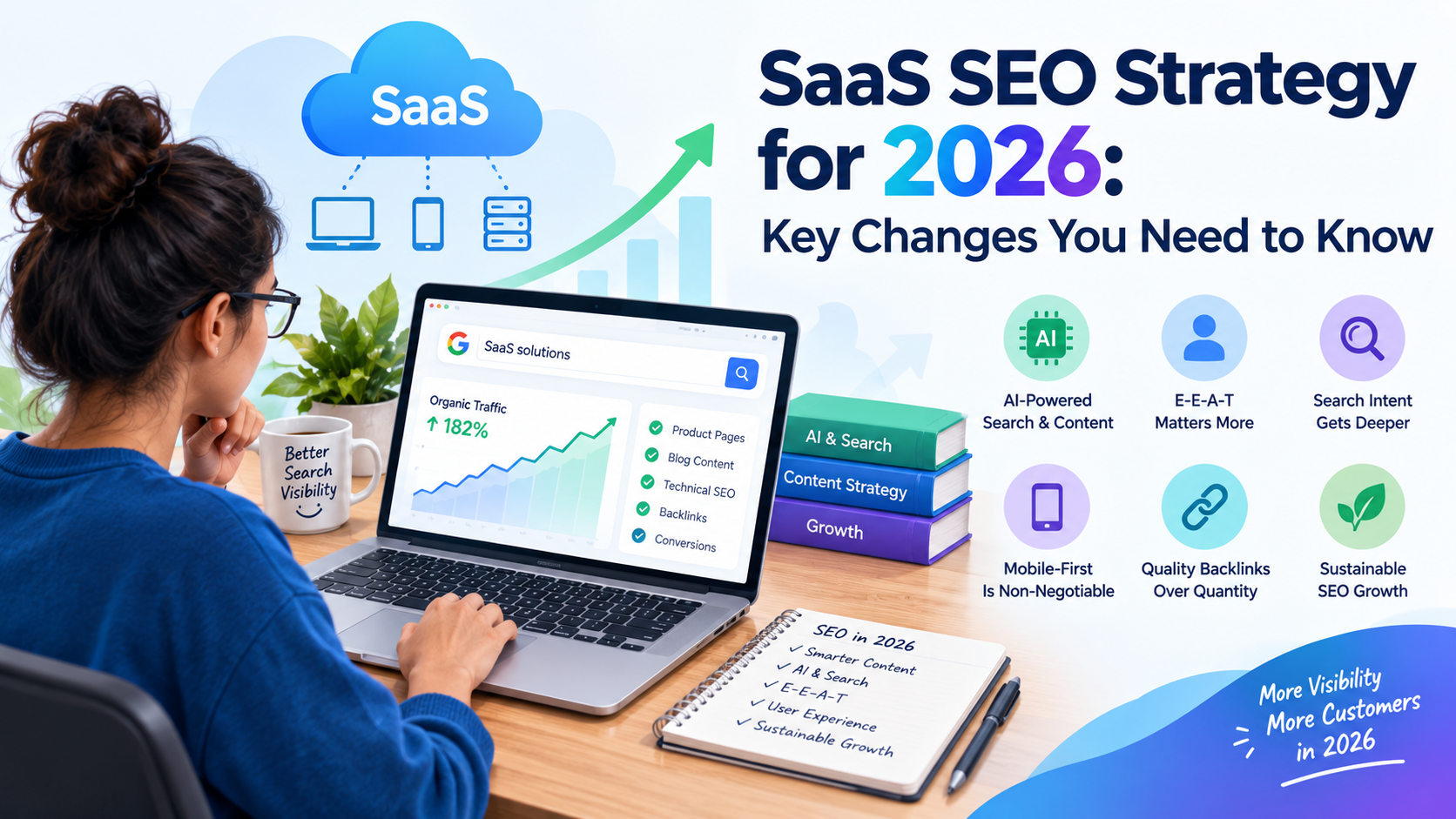
SaaS SEO in 2026 doesn't look like SaaS SEO in 2022. Back then, ranking on page one of Google was the finish line. Today, your buyers are asking ChatGPT for the "best project management tool for agencies" before they ever open a search bar, and Google itself is answering half their queries inside an AI Overview without sending them to your website at all.
If your SaaS SEO strategy still revolves around blog traffic and keyword rankings alone, you're optimizing for a search landscape that's already changed. A modern SaaS SEO strategy 2026 has to account for how AI Overviews summarize your category, how large language models decide which brands to mention, and how buyers now research across five or six surfaces before they ever fill out a demo form.
This guide breaks down what's actually changed in SaaS SEO this year, the frameworks that still work, and the technical, content, and off-page fundamentals your SaaS website needs to stay visible, on Google and inside AI answers.
What Is SaaS SEO?
SaaS SEO is the practice of optimizing a software-as-a-service company's website, content, and technical infrastructure to attract qualified organic traffic and convert it into trials, demos, and paying subscribers. Unlike a one-time ecommerce purchase, a SaaS sale usually involves a longer evaluation cycle, multiple stakeholders, and a subscription-based revenue model, which means SEO for SaaS companies has to account for recurring value, not just a single conversion event.
A complete SaaS SEO program typically includes:
- Keyword research mapped to buyer intent, not just search volume
- SaaS content strategy across the awareness, consideration, and decision stages
- SaaS on-page SEO and SaaS technical SEO to keep product and pricing pages crawlable
- SaaS off-page SEO and link building from relevant, high-authority domains
- AI SEO for SaaS, structuring content so it gets cited in AI Overviews, ChatGPT, and Perplexity
In short, SaaS SEO in 2026 means ranking on Google and being the brand an AI engine recommends when a buyer asks it for options.
Why SaaS SEO Is Different from Traditional SEO
Traditional SEO often optimizes for a single moment: someone searches, clicks, and buys. SaaS buying cycles rarely work that way.
A prospect evaluating a B2B SaaS product might spend weeks or months researching, read comparison pages, check G2 reviews, ask a colleague, prompt an AI assistant, and finally book a demo, often across five or more sessions. This changes what "success" looks like for a SaaS SEO strategy:
| Traditional SEO | SaaS SEO |
|---|---|
| Single-session buying decisions | Multi-touch journeys spanning weeks |
| Search volume drives priority | Buyer intent and stage drive priority |
| Rankings are the KPI | Trials, demos, and pipeline are the KPI |
| Content ends at the sale | Content supports onboarding and retention too |
| One search engine to optimize for | Google, AI Overviews, ChatGPT, and Perplexity |
This is why a SaaS content strategy built purely around high-volume, top-of-funnel keywords tends to under-deliver. It pulls in visitors, but not necessarily the ones who are close to a buying decision.
Key Changes Shaping SaaS SEO Trends in 2026
If you're updating your SaaS SEO strategy this year, these are the shifts that matter most.
1. Generative Engine Optimization for SaaS Is No Longer Optional
Generative Engine Optimization (GEO) is the practice of structuring your content so AI models can understand, summarize, and cite it accurately. A growing share of B2B software research now happens inside AI chat interfaces rather than a traditional search box, and buyers are forming shortlists based on what these tools recommend, often before they visit a single vendor website.
For SaaS companies, this means content can no longer just be written to rank. It has to be written to be quoted. That means:
- Leading each section with a direct, self-contained answer before the elaboration
- Including specific numbers, benchmarks, and named comparisons instead of vague claims
- Structuring pricing, feature, and comparison information in scannable tables and lists
- Avoiding overly promotional language that AI systems tend to deprioritize in favor of neutral, editorial framing
2. AEO for SaaS Companies Is a Core Discipline, Not an Add-On
Answer Engine Optimization (AEO) is closely related to GEO but focused specifically on earning placement in direct-answer formats, AI Overviews, featured snippets, and chatbot responses. For SaaS SEO for AI Overviews specifically, structured data, clear H2/H3 question framing, and concise definitional answers near the top of a page all improve your odds of being the source an AI engine pulls from.
Practically, this means every important page, your homepage, comparison pages, and core feature pages, should answer its primary question in the first two sentences of the relevant section, before going deeper.
3. Topical Authority and Entity SEO Matter More Than Individual Keywords
Search engines and AI models increasingly evaluate whether a domain is a credible, comprehensive source on a subject, not just whether a single page matches a keyword. This is SaaS topical authority and SaaS entity SEO in practice: building a cluster of interlinked content around your core category so that both Google and AI models associate your brand as an entity with that topic.
Rather than publishing isolated blog posts, a stronger SaaS semantic SEO approach groups content into pillar-and-cluster structures, a comprehensive core guide (like this one) supported by narrower, linked articles on keyword research, technical SEO, link building, and content strategy specific to SaaS.
4. Zero-Click Search Means Multi-Surface Visibility Is the New Moat
A large share of searches now end without a single click to any website, because the answer appears directly in the search results or an AI summary. This makes it risky to rely on Google alone for SaaS organic traffic growth. SaaS brands that also show up in third-party listicles, review platforms like G2 and Capterra, YouTube walkthroughs, and community discussions are far more likely to appear inside AI-generated answers, since these are the sources AI models cite most often.
5. E-E-A-T Signals Are Now a Ranking and Citation Factor
Google's Experience, Expertise, Authoritativeness, and Trustworthiness (E-E-A-T) framework has become just as relevant to AI citation as it is to traditional rankings. For SaaS content, that means:
- Experience: first-hand product knowledge, screenshots, and real usage data rather than generic descriptions
- Expertise: author bylines from people with genuine domain knowledge, not anonymous "admin" posts
- Authoritativeness: backlinks and mentions from recognized SaaS and industry publications
- Trustworthiness: transparent, accurate pricing and feature information that matches what's on your product pages
AI models are far more likely to cite content that demonstrates these signals clearly, which makes E-E-A-T a practical SEO lever in 2026, not just a Google guideline.
SaaS Keyword Research and Keyword Strategy for 2026
A strong SaaS keyword strategy starts with intent, not volume. Group your keyword research into four stages:
Problem-Aware Keywords
Buyers here know they have a problem but haven't identified a software category yet. Example: "how to reduce customer churn," "why is my team missing deadlines." These build brand familiarity but rarely convert directly, use them to feed your top-of-funnel content strategy, not your primary SEO budget.
Solution-Aware Keywords
Buyers now understand that software can solve their problem and are researching categories. Example: "best project management software for agencies," "CRM for small business." This is where your SaaS product page SEO and category pages should compete.
Product-Aware Keywords
Buyers are evaluating specific products, including yours. Example: "[product] pricing," "[product] review," "[product] features." These convert at high rates relative to their volume and deserve dedicated, well-optimized landing pages.
Comparison and Alternative Keywords
This is the highest-converting keyword category in SaaS SEO. Example: "[Competitor] alternative," "[Tool A] vs [Tool B]," "best [category] software." Buyers searching these terms are actively deciding, and a well-built comparison page can capture demand your competitors are currently winning.
A Simple Keyword Research Workflow
- List your direct competitors — pull names from sales notes, G2 category pages, and your own comparison requests
- Run a keyword gap analysis in Ahrefs or Semrush against those competitors
- Filter for commercial modifiers — "alternative," "vs," "pricing," "best," "review"
- Check search intent by reviewing what's currently ranking, blog post, product page, or comparison article
- Prioritize by buyer value, not raw volume, a lower-volume keyword with strong commercial intent often outperforms a high-volume informational term
SaaS On-Page SEO, Landing Page SEO, and Product Page SEO
SaaS on-page SEO has a few category-specific nuances beyond standard optimization, and it's worth treating landing pages, product pages, and blog content as three distinct optimization tasks.
SaaS Landing Page SEO
Landing pages, comparison, alternative, and use-case pages, carry the highest commercial intent on a SaaS website, so they deserve the tightest on-page optimization:
Title Tag and Meta Description Formula
A comparison page title should promise a direct answer ("[Product] vs [Competitor]: Which Is Right for You?"), not a generic keyword stuff. Meta descriptions should state the specific comparison angle, pricing, features, or use case, rather than a vague summary.
Use-Case Segmentation
Feature and use-case pages should target specific job titles or industries where relevant ("[Product] for Marketing Teams," "[Product] for Agencies") rather than relying on one generic page trying to rank for everything. Each segment deserves its own URL, headline, and CTA.
SaaS Product Page SEO
Product and feature pages need to balance SEO visibility with conversion clarity:
- Lead with the specific job the feature does, not a marketing tagline
- Include real screenshots or short product clips rather than generic stock imagery, this is an E-E-A-T signal as much as a UX one
- Link each feature page to the pricing page and a relevant case study to shorten the path to conversion
SaaS Blog SEO
For blog content, structure and internal linking matter more than raw word count:
- Internal linking should connect blog posts to relevant product, pricing, and comparison pages, this both distributes authority and moves readers down the funnel
- Structured, scannable content, short paragraphs, bolded key phrases, and tables, improves both user experience and AI extractability
- Question-based subheadings (H2s and H3s phrased as buyer questions) increase the odds of being pulled into featured snippets and AI answers
SaaS Technical SEO Fundamentals
Technical SEO issues are especially costly for SaaS sites because product and pricing pages are often built on JavaScript-heavy frameworks that can be difficult for crawlers to render. Before investing in content or links, confirm:
- Indexability: product, pricing, and comparison pages are not accidentally blocked in robots.txt or marked "noindex"
- Crawlable rendering: single-page applications use server-side rendering or pre-rendering so search engines see full page content, not a blank shell
- Canonical tags: especially important for templated pages like integrations directories, where near-duplicate URLs can split ranking signals
- Structured data (schema markup): software, FAQ, and review schema help both traditional rich results and AI systems understand page content
- Clean redirect chains: consolidate multi-hop redirects (A → B → C) into a single redirect to preserve authority
- Page speed and Core Web Vitals: particularly important on high-intent pages like pricing and comparisons, where slow load times directly hurt conversion
SaaS Content Strategy and Content Marketing
An effective SaaS content marketing strategy prioritizes commercial-intent formats before scaling top-of-funnel volume. The highest-performing SaaS SEO content types, in order of typical impact:
- Comparison pages ("[Product] vs [Competitor]") — high commercial intent, often easier to rank for than broad category terms
- Alternative pages ("Alternatives to [Competitor]") — capture demand from buyers already dissatisfied with a rival tool
- Use-case and industry pages — narrower audiences convert at higher rates than generic homepage traffic
- Problem-solving guides — build trust and topical authority in the middle of the funnel
- Customer case studies — provide concrete proof points that both buyers and AI models respond well to
For SaaS blog SEO specifically, treat evergreen guides as pillar content and support them with narrower, linked posts, this is what builds genuine topical authority rather than a scattered content calendar.
SaaS Off-Page SEO and Link Building
SaaS link building differs from ecommerce or publisher link building because your best link sources often double as your buyers and partners. Effective SaaS off-page SEO tactics for 2026 include:
- Integration and marketplace listings — if you integrate with established platforms, their directory pages are high-authority, highly relevant link opportunities
- Third-party review platforms (G2, Capterra, TrustRadius) — these build both backlinks and buyer trust simultaneously
- Original research and data — proprietary benchmarks or usage statistics attract organic citations from journalists and bloggers over time
- Guest content on genuine industry publications — prioritize editorial quality and topical relevance over raw domain rating
- Digital PR — earning coverage by sharing original data or informed commentary on industry trends
Link building for SaaS pays off doubly in 2026: it improves traditional rankings, and it increases the likelihood your brand appears in the sources AI models pull from when answering category questions.
Measuring SaaS SEO Success in 2026
Traffic and rankings alone don't tell you whether your SaaS SEO strategy is working. Track these instead:
| Metric | Why It Matters |
|---|---|
| Organic-attributed trials/demos | Ties SEO directly to pipeline |
| BOFU keyword rankings | Leading indicator for revenue impact |
| AI citation visibility | Measures presence in ChatGPT, Perplexity, AI Overviews |
| Branded vs. non-branded traffic | Non-branded growth signals real demand generation |
| Page-level conversion rate | Identifies which content actually drives signups |
Deprioritize vanity metrics like total sessions or average ranking position, they look productive in a report but rarely explain revenue outcomes to leadership.
Common SaaS SEO Mistakes to Avoid
- Publishing top-of-funnel content before bottom-of-funnel pages exist. Comparison and pricing pages should be built and optimized first.
- Chasing search volume over intent. A lower-volume, high-intent keyword often converts better than a broad, popular term.
- Ignoring technical SEO fundamentals. No amount of content compensates for pages that aren't indexed.
- Treating AEO and GEO as optional. Buyers researching inside AI tools won't find brands that aren't structured to be cited.
- Letting content go stale. Comparison and pricing pages need regular refreshes as competitors update their offerings.
SaaS SEO Services: In-House Team or Agency?
Whether to build an in-house SaaS SEO function or work with specialized SaaS SEO services depends largely on stage and budget.
An in-house team gives you closer product context but typically requires hiring a strategist, a content writer, and a technical specialist before you see meaningful output, a significant cost before any results appear. A SaaS SEO agency, by contrast, brings an existing team that has already solved the technical SEO, content, and link building challenges specific to software companies, which usually shortens the time to first results.
For early- and growth-stage SaaS companies without an existing SEO function, an agency-led approach is often the more capital-efficient path, especially one experienced in the full stack of SaaS SEO: keyword strategy, technical SEO, content, link building, and increasingly, AEO and GEO for AI visibility.
Frequently Asked Questions
What is the difference between SaaS SEO and traditional SEO?
SaaS SEO accounts for longer buying cycles, subscription-based revenue, and multiple decision-makers, which changes keyword priorities, content formats, and success metrics compared to a standard one-time-purchase SEO strategy.
How long does it take to see results from a SaaS SEO strategy?
Most SaaS companies see meaningful ranking movement within four to six months and measurable pipeline impact within nine to twelve months, depending on the site's existing domain authority and competitive landscape.
What is AEO in the context of SaaS SEO?
Answer Engine Optimization (AEO) is the practice of structuring content so it can be surfaced directly by AI Overviews, chatbots, and featured snippets, rather than relying solely on a traditional search-result click.
What are the most important SaaS SEO keywords to target first?
Comparison and alternative keywords ("[Competitor] alternative," "[Tool A] vs [Tool B]") typically deliver the fastest pipeline impact because they capture buyers who are already in active decision mode.
Do small or early-stage SaaS companies need SEO?
Yes. Organic search compounds over time and typically produces a lower cost per qualified lead than paid channels, making it one of the more defensible long-term acquisition strategies for SaaS companies at any stage.
Conclusion
SaaS SEO in 2026 is no longer just about ranking on Google — it's about being visible and credible everywhere your buyers actually research, from search results to AI-generated answers. The SaaS companies that win this year are the ones building genuine topical authority, structuring content for both readers and AI models, and tying every SEO decision back to pipeline rather than pageviews.
If you're rethinking your SaaS SEO strategy for 2026, working with a team that understands both traditional search and AI-era optimization makes the difference between guessing and compounding. As one of the established SEO companies in Bangalore, Cronbay Tech has helped SaaS and technology companies build organic strategies that hold up across Google and AI search alike.
Ready to Build a SaaS SEO Strategy That Drives Signups?
Let's map out what 2026 should look like for your organic growth and build a strategy focused on qualified traffic and signups.
Get in Touch With Our Team →
.png)