
Every marketing campaign, a Google Ad, an email blast, a LinkedIn post, a QR code on a flyer, eventually points to the same destination: a landing page. And that single page decides whether all the money, time, and effort spent driving traffic actually turns into leads, demos, or sales.
Yet most landing pages underperform. Industry benchmarks put the average landing page conversion rate at somewhere between 2.35% and 5.31%, which means for every 100 visitors, roughly 95 leave without converting. The businesses that consistently beat that average aren't relying on luck, they're following a repeatable system for landing page design, copywriting, and optimization.
In this guide, we'll break down exactly what separates high-converting landing pages from the ones that quietly bleed traffic. Whether you're building your first landing page or trying to fix one that isn't pulling its weight, these landing page best practices apply to SaaS products, service businesses, and e-commerce alike.
What Is a High-Converting Landing Page?
A landing page is a standalone web page created for a single, specific purpose usually to convert a visitor into a lead or customer through one clear call to action (CTA). Unlike your homepage, which serves many goals, a landing page removes distractions like navigation menus and competing links so visitors focus on exactly one action: signing up, requesting a quote, downloading a resource, or making a purchase.
A "high-converting" landing page simply does this job better than average. It matches visitor intent precisely, loads fast, builds trust quickly, and makes the desired action almost effortless to complete. The result is a measurably higher landing page conversion rate compared to industry benchmarks for your niche.
Why Landing Pages Matter for Your Marketing and SEO Strategy
Before getting into tactics, it's worth understanding why a dedicated landing page outperforms sending traffic to a generic homepage or product page.
They boost organic visibility. A well-optimized landing page targeting a specific keyword, say, "CRM software for real estate agents", can rank in search engines independently of your homepage, capturing intent-driven traffic your homepage never would. This is exactly why landing page SEO deserves as much attention as landing page design.
They isolate campaign performance. When every ad, email, and social post links to its own landing page, you can track precisely which channel, message, and audience segment is converting, and which isn't.
They shorten the path to conversion. A homepage asks visitors to explore. A landing page asks them to decide. Removing the choice paradox from the experience is one of the simplest levers for improving conversion rates.
They support paid and organic efforts equally. Whether traffic arrives via PPC, email, or search, a focused landing page increases quality score on ad platforms and improves dwell time and engagement signals that matter for SEO. If you're investing in SEO services to drive traffic, pairing that traffic with a page that isn't built to convert is like filling a bucket with a hole in it.
The Anatomy of a High-Converting Landing Page
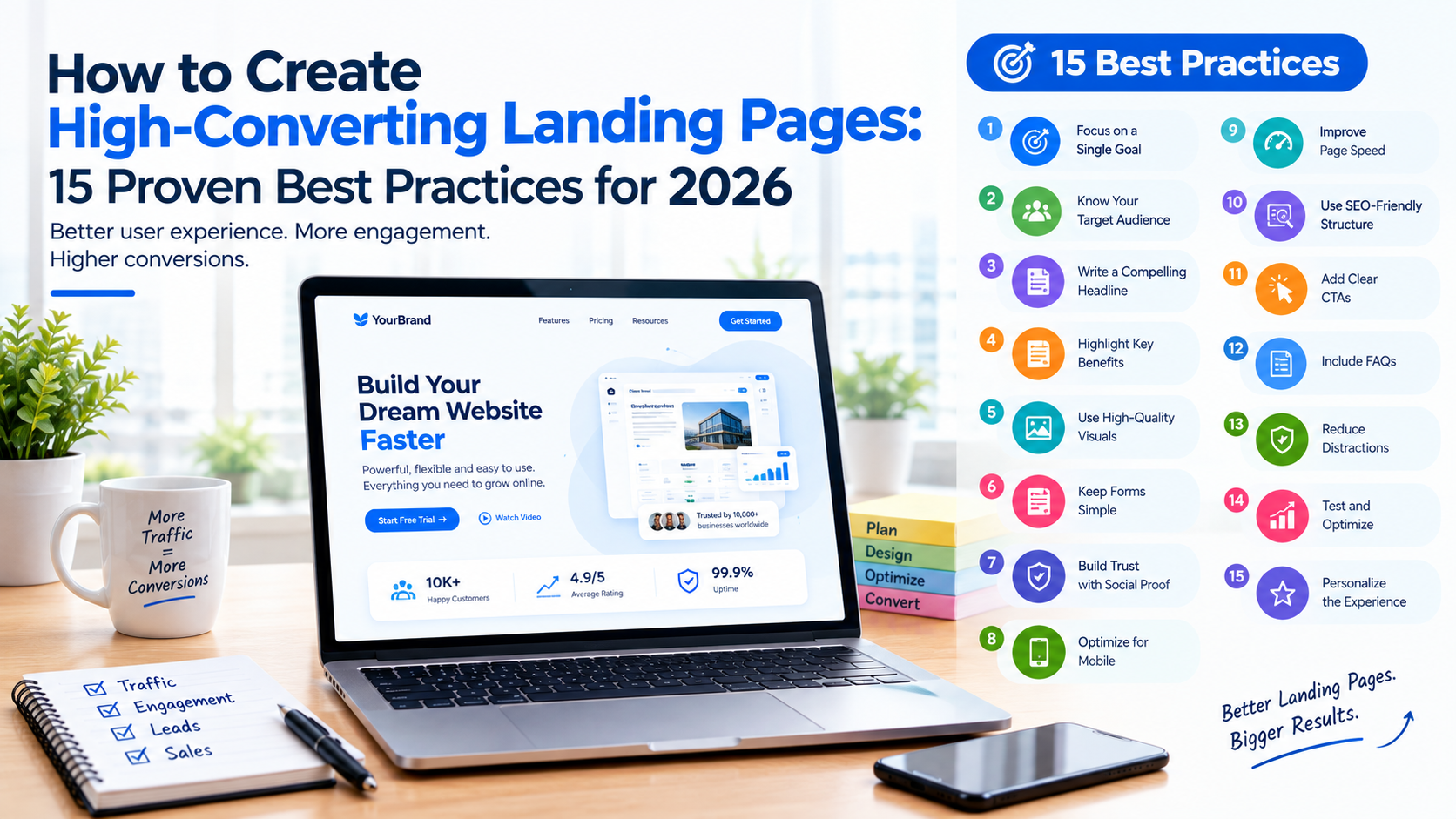
Before diving into the 15 best practices, it helps to know the core building blocks almost every high-performing landing page shares:
- A benefit-driven headline that states the outcome, not just the feature
- A hero section with a supporting subheadline and visual that reinforces the offer
- One primary CTA repeated at logical intervals down the page
- Social proof, testimonials, logos, review scores, case studies
- A short, frictionless lead capture form
- Objection-handling content, FAQs, guarantees, security badges
- Mobile-first responsive layout
- Fast load speed and clean, distraction-free design
Now let's unpack how to execute each of these well.
15 Landing Page Best Practices That Actually Move the Conversion Needle
1. Start With the Job Your Visitor Is Hiring You For
Before writing a single word of copy, understand the specific problem your visitor is trying to solve at the exact moment they land on your page. Someone clicking a "link building services in Bangalore" has a different intent than someone searching "what is link building." Map your landing page copy to that specific job-to-be-done rather than writing generic brand messaging. This single step prevents most of the disconnect that causes high bounce rates.
2. Write One Clear, Benefit-Led Headline
Your headline has roughly eight seconds to earn the rest of the scroll. Lead with the outcome the visitor gets, not a feature list. Compare "Cloud-Based CRM Software" (feature) with "Close More Deals Without Losing Track of a Single Lead" (benefit). The second immediately signals value.
Keep your primary keyword, for example, "high-converting landing pages" or whatever your visitor actually searched, naturally present in the headline or subheadline. This helps both human readers and search engines quickly confirm relevance.
3. Match the Page to the Source (Message Match)
If your ad promises "20% off your first order," the landing page headline should repeat that exact offer within the first few seconds of scroll. This is called message match, and it's one of the most overlooked landing page optimization techniques. A mismatch between what was promised and what's delivered is one of the fastest ways to spike bounce rate and destroy trust.
4. Give Visitors One Action, Not Five
A landing page with a newsletter signup, a free trial CTA, a "contact us" link, and a pricing table in the navigation is asking visitors to make a decision about what to decide, and most will simply leave. Every high-converting landing page commits to a single conversion goal. If you need to promote multiple offers, build multiple landing pages.
5. Make Your CTA Button Impossible to Miss
Your call-to-action button should be visually distinct, using a contrasting color from the rest of the page, and use direct, active language. Landing page CTA best practices favor specific, first-person, low-commitment phrasing over generic text:
- "Start My Free Trial" instead of "Submit"
- "Get My Free Audit" instead of "Click Here"
- "Book a Demo" instead of "Learn More"
Place your primary CTA above the fold, then repeat it after major sections, social proof, features, pricing, so visitors never have to scroll back up once they're convinced.
6. Keep Your Lead Capture Form Short
Every additional form field reduces completion rates. Ask only for what you genuinely need at this stage of the relationship, typically name, email, and maybe one qualifying field. You can always gather more information after the first conversion. Long forms are one of the most common reasons landing page lead capture underperforms, especially on mobile.
7. Lead With Benefits, Support With Features
Borrowing from how top SaaS marketers approach landing page copywriting: explain what the visitor gets to do or feel as a result of your product or service, then back that claim up with the specific feature that makes it possible. "Never miss a follow-up again" (benefit) supported by "automated reminder sequences" (feature) is far more persuasive than a bare feature list.
8. Use Real Social Proof, Placed Strategically
Testimonials, client logos, case study snippets, review scores, and trust badges reduce the perceived risk of converting. Place a testimonial near your first CTA (to reassure early converters) and a stronger case study or logo wall further down the page (for visitors who need more convincing before committing). If you serve a specific city or industry, hyper-local proof, like results for Bangalore-based clients, builds even more credibility than generic praise.
9. Apply Strong Visual Hierarchy and Whitespace
Landing page UX best practices consistently point to the same principle: don't make visitors work to understand what matters. Use size, contrast, and spacing to guide the eye from headline to supporting proof to CTA in a natural top-to-bottom flow. Avoid cramming multiple messages into the same visual weight, if everything is emphasized, nothing is.
10. Choose Text or Video Deliberately, Not by Default
Some offers convert better with a short explainer video; others convert better with clear, scannable text and bullet points. A highly technical B2B audience evaluating a complex service often wants to read specifics before converting, while a broad consumer audience may respond faster to a 30-second video. Test both when you're unsure, but never let video autoplay with sound or slow down page load. Speed matters more than production value.
11. Optimize Ruthlessly for Mobile
More than half of landing page traffic in most industries now arrives from mobile devices. A mobile-friendly landing page isn't optional. It's fundamental. That means:
- Thumb-friendly, full-width CTA buttons
- Forms that use appropriate input types (number pads for phone fields, for example)
- Fonts large enough to read without zooming
- Compressed images and minimal render-blocking scripts
Google's page experience signals also factor mobile usability directly into how your page ranks, so mobile optimization is both a conversion and an SEO lever at once.
12. Build Landing Page SEO In From the Start
If you want your landing page to earn organic traffic, not just paid clicks. Treat it like any other SEO asset:
- Include your primary keyword in the title tag, H1, URL slug, and meta description
- Use secondary and semantically related keywords naturally in subheadings and body copy
- Optimize image alt text and compress files for fast load times
- Add internal links to relevant, authoritative content on your site
- Make sure the page is indexable and included in your sitemap
For a deeper technical breakdown of what modern search engines now expect from optimized pages, our AI SEO checklist for 2026 is a useful companion to this guide. And if you're trying to earn topical relevance for competitive terms, understanding topical authority in SEO will help your landing page rank alongside supporting blog content rather than in isolation.
13. Don't Turn Your Landing Page Into a Blog Post
It's tempting to add extra sections about company history, recent news, or unrelated resources. Resist it. A landing page should stay tightly focused on the offer, the proof, and the action. Long-form educational content belongs on your blog, which then links to the landing page rather than competing with it for the visitor's attention. (For that kind of supporting content strategy, content marketing services can help you build the blog-to-landing-page funnel properly.)
14. Confirm the Action and Set Expectations
Once someone converts, tell them immediately what happens next: "Thanks, check your inbox for your audit report" or "A team member will call you within 24 hours." A dedicated thank-you page is also a low-cost opportunity to offer a secondary, lower-commitment action, such as following your social channels or reading a related guide.
15. Track Everything and Run Structured A/B Tests
You can't improve what you don't measure. Implement analytics and conversion tracking before your landing page goes live, tag every traffic source with UTM parameters, and treat every headline, CTA, and layout choice as a hypothesis rather than a final decision. Run structured landing page A/B testing, one variable at a time, using tools like Google Optimize alternatives, Unbounce, or your CRM's native testing features. Even a single confirmation-worthy test, like button color or headline framing, can move your landing page conversion rate significantly over a few weeks.
Common Landing Page Mistakes That Kill Conversions
Even experienced marketers fall into these traps:
- Too many CTAs competing for attention, pick one goal per page
- Slow load times. Every extra second of load time measurably increases bounce rate
- Generic stock imagery that doesn't reflect the actual product or audience
- Weak or vague headlines that describe the company instead of the outcome
- No mobile testing before launch
- Ignoring post-click experience, sending paid traffic to a page that doesn't match ad messaging
- Never revisiting the page after launch, landing pages are living assets, not one-time projects
How to Measure Landing Page Conversion Rate
Your landing page conversion rate is calculated as:
(Number of conversions ÷ Number of visitors) × 100
A visitor who fills out your form, starts a trial, or completes a purchase counts as a conversion, define this clearly before you start optimizing. Benchmarks vary widely by industry, offer type, and traffic source, so instead of chasing an arbitrary "good" number, track your own page's trend over time and aim to beat your previous best with each iteration.
Landing Page Optimization Checklist for 2026
Use this as a quick pre-launch audit:
- One clear, benefit-driven goal and CTA
- Message matches the source ad, email, or post
- Primary keyword present in title, H1, URL, and meta description
- Form limited to essential fields only
- Mobile layout tested on multiple screen sizes
- Page load time under 3 seconds
- Social proof visible above and below the fold
- Analytics and conversion tracking implemented
- A/B test plan in place for at least one element
- Thank-you page or confirmation message configured
Turning Traffic Into Customers Takes More Than a Template
A high-converting landing page sits at the intersection of copywriting, design, technical SEO, and ongoing testing, which is exactly why so many businesses build a page, watch it underperform, and never diagnose why. The tactics above will get you most of the way there, but pairing a well-built landing page with a genuine organic traffic strategy is what compounds results over time.
If your landing pages are optimized but traffic still isn't showing up, the issue usually sits upstream, in your site's technical SEO, content strategy, or off-page authority. Our guide to off-page SEO techniques for 2026 is a good next read if backlinks and domain authority are part of the gap, and our roundup of top SEO companies in Bangalore for 2026 can help you benchmark what a results-driven SEO partnership should actually look like.
As a full-service SEO company in Bangalore, Cronbay Tech builds landing page and SEO strategies together, not as separate projects, so the traffic you earn actually converts once it arrives. From technical audits to SEO services and ongoing content marketing services, we help businesses turn organic visibility into a predictable pipeline of leads.
Frequently Asked Questions
What makes a landing page "high-converting"?
It's a landing page that converts a meaningfully higher percentage of visitors into leads or customers than the average for its industry, typically by combining a focused offer, strong message match, minimal friction, and credible social proof.
How long should a landing page be?
There's no fixed rule, shorter pages work well for simple, low-commitment offers, while longer pages tend to perform better for higher-consideration purchases where visitors need more information before converting. Test both formats for your specific offer.
How many CTAs should a landing page have?
One goal, repeated multiple times. You can restate the same CTA at the top, middle, and bottom of the page, but avoid introducing a second, competing action.
Does landing page SEO actually matter if I'm only running paid ads?
Yes. SEO-friendly structure improves page load speed, mobile usability, and Google Ads Quality Score, all of which lower your cost per click even for purely paid campaigns.
How often should I update or test my landing pages?
Treat landing pages as ongoing assets. Review performance monthly, and run new A/B tests whenever you introduce a new offer, refresh your brand messaging, or notice a decline in conversion rate.

.png)