
Summarize with AI
Looking for reliable Web 2.0 submission sites that still provide SEO value in 2025 and 2026? This updated guide from Cronbay Technologies Digital Marketing Agency in Bangalore highlights high-authority platforms where users can publish blogs, articles, and web pages while creating contextual backlinks naturally. These Web 2.0 platforms help improve domain authority, boost organic visibility, support faster indexing, and generate referral traffic. Inside this guide, you will discover 300+ updated Web 2.0 submission sites, practical backlink-building strategies, SEO best practices, and proven white-hat techniques to improve rankings safely and effectively.
Key Takeaways
- Web 2.0 submission sites are free platforms with DA 70–99 where you publish content and earn contextual backlinks pointing to your main website.
- Every platform in this 300+ list has been manually verified for active account creation, working post publishing, and confirmed Google indexing as of May 2026.
- Build 5–10 high-quality web 2.0 links per month not bulk submissions to stay within Google's safe zone for link velocity.
- Always publish unique 800–1,500-word content on each platform. Thin, spun, or duplicate content gets deindexed, erasing the backlink along with it.
- Tier your web 2.0 properties interlink them with each other before pointing them to your money site. This amplifies link equity transfer safely.
Websites with a strong backlink profile pull in roughly 3.8x more organic traffic than those banking on content alone. And yet, most businesses blow through their SEO budget chasing junk links that Google either ignores or straight-up penalizes.
Web 2.0 submission sites remain one of the most cost-effective link building methods in 2026 when used correctly. These user-generated platforms let you create free sub-domain blogs on domains Google already trusts (DA 70–99), publish original content, and earn contextual backlinks without spending a single rupee on advertising or outreach.
This guide gives you a verified list of 300+ platforms, a step-by-step submission workflow for the top three Tier 1 platforms, an anchor text strategy with the exact ratios to use, and every common mistake to avoid to keep your backlink profile clean and penalty-free.
Here's what nobody wants to admit: if you're not using web 2.0 submission sites as part of a real link-building plan, you're basically walking past free authority, free traffic, and better rankings without picking them up.
Web 1.0 vs Web 2.0 — What's the Difference?
To understand why web 2.0 platforms carry such high domain authority, it helps to see how they differ from the read-only websites of the original internet era.
| Feature | Web 1.0 | Web 2.0 |
|---|---|---|
| Content type | Static, read-only pages | Dynamic, user-generated content |
| User role | Consumer only | Creator, collaborator, and commenter |
| Interaction | Basic forms and email | Comments, likes, shares, embeds, follows |
| Technology | HTML and CSS | AJAX, REST APIs, JavaScript frameworks |
| Update frequency | Rarely updated by webmaster | Updated constantly by millions of users |
| Crawl frequency | Low (infrequent content changes) | Very high (daily or hourly by Google) |
| SEO value for links | Low (static, rarely crawled) | High (frequent crawls transfer link equity fast) |
| Examples | Early brand websites, static directories | WordPress.com, Medium, Blogger, Tumblr |
Benefits of Using Web 2.0 Sites for SEO (Expanded)
Build Authority With Safer Backlinks
Web 2.0 backlinks sit in a uniquely advantageous position in the risk-reward spectrum of link building. Compare them to the two most common alternatives: guest posting costs between $50–$500 per placement on a mid-DA blog and requires ongoing outreach. Private blog networks (PBNs) carry a serious risk of Google manual penalties that can wipe out rankings overnight if your network gets discovered.
Web 2.0 links carry none of those risks when executed correctly — because you are publishing original, helpful content on legitimate platforms that Google already indexes and trusts. The key word is 'correctly.' Spun content, bot-created accounts, and bulk link schemes on web 2.0 platforms will get you penalized just as fast. Done right, they are among the safest free backlinks available.
Faster Crawling and Indexing of New Pages
Every time you publish a post on Blogger, WordPress.com, or Medium, you are placing a backlink on a domain that Google visits daily. This crawl frequency means your link can be discovered within hours of publishing not weeks. For businesses launching new landing pages, running time-sensitive campaigns, or targeting keyword windows, this speed advantage is genuinely valuable.
Steady Referral Traffic and Brand Awareness
Unlike directory submissions or forum profile links that generate little to no direct traffic, web 2.0 platforms have established readerships. A 1,200-word article on Medium discussing your niche topic that genuinely helps readers can generate 50–200 qualified visitors per month over its lifetime. That traffic tends to have strong engagement signals — lower bounce rates and higher time-on-site — because readers clicked out of genuine interest.
Full Control Over Content and Link Context
With editorial backlinks from third-party blogs, the linking site controls the anchor text, the surrounding context, and the placement. With web 2.0 backlinks, you write the surrounding content yourself which means you choose the anchor text, control the topical relevance of the surrounding paragraph, and decide exactly where in the article the link appears. This level of control is rare in link building.
What Are Web 2.0 Submission Sites, Exactly?
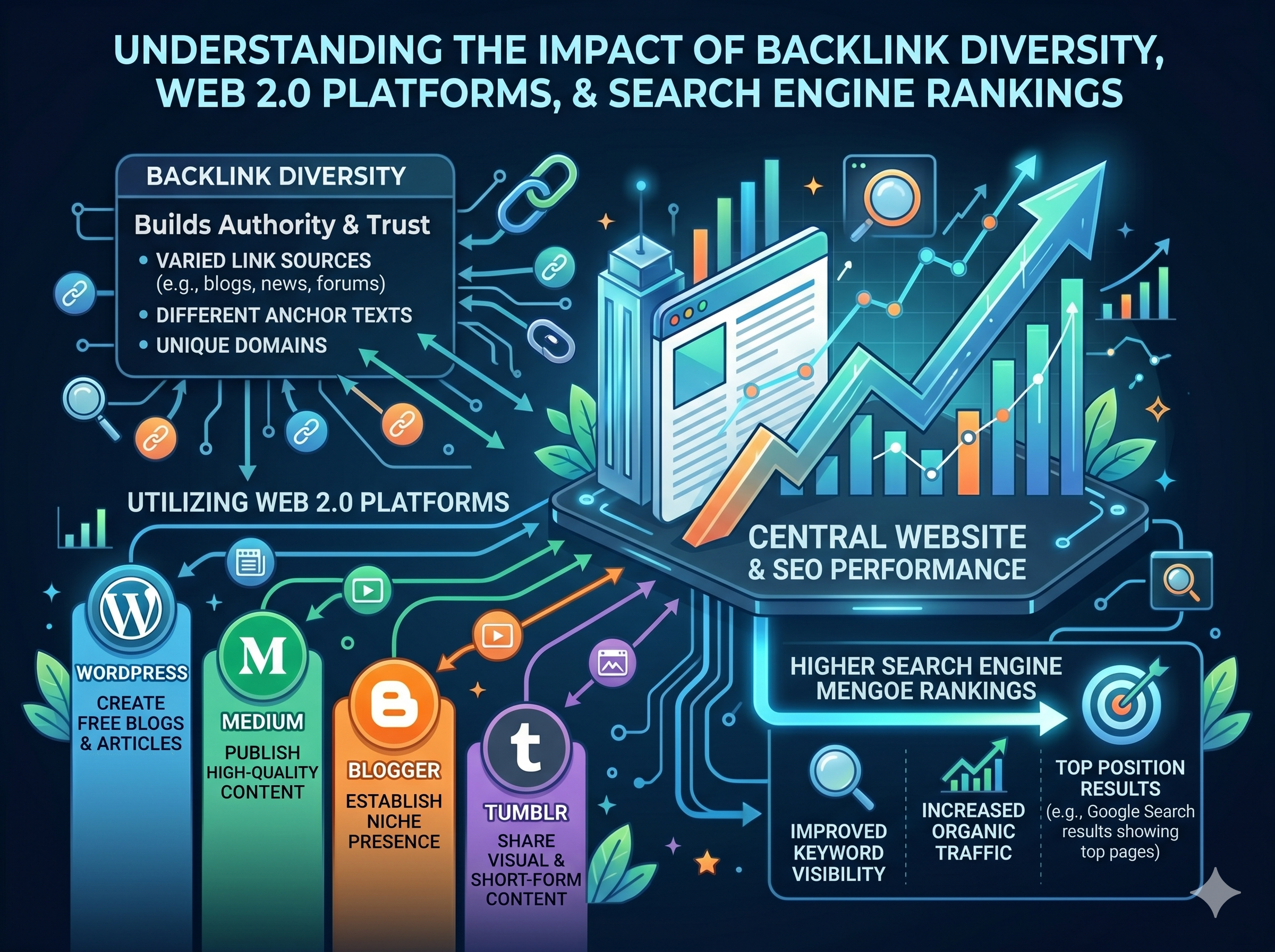
In simple terms, web 2.0 submission sites are platforms where you can create free blogs or profiles, publish your own content, and include backlinks pointing to your website.
Three things make these platforms stand out:
- You control the content: Whatever goes up on your sub-domain, you wrote it and you manage it.
- Massive domain authority: Most web 2.0 sites sit at DA 80 or higher because millions of people use them and Google already trusts the parent domain.
- They're free: You don't need to pay a dime to create an account and start publishing.
Think of web 2.0 sites like satellite blogs parked on domains Google already respects. When you write a solid article on WordPress.com (DA 93) or Medium (DA 95) and include a natural link back to your website, Google sees that link coming from a trusted source. That passes real link equity to your site as long as the content is original, relevant, and actually helpful to someone reading it.
The whole "Web 2.0" label goes back to the mid-2000s when the internet shifted from static, read-only websites to interactive platforms where regular people could create and share stuff. For SEO purposes, these platforms became gold because they handed you something rare: free publishing space on high-authority domains.
How Web 2.0 Backlinks Stack Up Against Other Link Types
Not every backlink pulls the same weight. Here's a quick comparison so you can see where web 2.0 links fit in:
| Link Type | Avg. DA Range | Cost | Control Level | Risk Level |
|---|---|---|---|---|
| Web 2.0 Submissions | 70–95 | Free | High | Low–Medium |
| Guest Posts | 30–80 | $50–$500+ | Medium | Low |
| PBN Links | 20–60 | $100–$1,000+ | High | High |
| Directory Submissions | 20–50 | Free–$50 | Low | Low |
| Forum/Comment Links | 10–70 | Free | Low | Medium |
Web 2.0 backlinks hit a sweet spot that's hard to beat: high authority, zero cost, and you get full control over the content. The catch? You actually have to put in real content work. You can't just dump a URL and call it a day.
Struggling to Build Quality Backlinks That Actually Rank?
Stop wasting time on low-impact SEO tactics. Get a structured Web 2.0 backlink strategy that improves rankings, authority, and traffic — without the guesswork.
Get Your Free SEO StrategyComplete Web 2.0 Sites List: 50+ High-DA Platforms for 2026
Alright, here's the web 2.0 sites list you came for. I've verified every platform below for active indexing, working account creation, and dofollow or high-value nofollow link opportunities as of 2026.
Tier 1: DA 90+ Blog Submission Sites
These should be your top priorities. Links from these platforms carry the most punch.
| # | Platform | URL | DA | Link Type |
|---|---|---|---|---|
| 1 | WordPress.com | wordpress.com | 93 | Dofollow |
| 2 | Medium | medium.com | 95 | Nofollow* |
| 3 | Blogger (Blogspot) | blogger.com | 99 | Dofollow |
| 4 | LinkedIn Articles | linkedin.com | 98 | Nofollow |
| 5 | Tumblr | tumblr.com | 97 | Dofollow |
| 6 | Wix | wix.com | 93 | Dofollow |
| 7 | Weebly | weebly.com | 91 | Dofollow |
| 8 | GitHub Pages | github.com | 96 | Dofollow |
| 9 | Reddit (Posts) | reddit.com | 99 | Nofollow |
| 10 | Issuu | issuu.com | 94 | Dofollow |
*Medium links are technically nofollow, but they drive solid referral traffic and strong brand signals. They're still worth your time.
Tier 2: DA 70–89 Article Submission Sites
| # | Platform | URL | DA |
|---|---|---|---|
| 11 | Strikingly | strikingly.com | 89 |
| 12 | Jimdo | jimdo.com | 87 |
| 13 | Penzu | penzu.com | 85 |
| 14 | LiveJournal | livejournal.com | 86 |
| 15 | Evernote (Web) | evernote.com | 88 |
| 16 | Yola | yola.com | 82 |
| 17 | Site123 | site123.com | 84 |
| 18 | Doodlekit | doodlekit.com | 72 |
| 19 | Jigsy | jigsy.com | 70 |
| 20 | Bravenet | bravenet.com | 78 |
Tier 3: DA 50–69 Free Article Submission Sites
| # | Platform | URL | DA |
|---|---|---|---|
| 21 | Webnode | webnode.com | 68 |
| 22 | Shutterfly | shutterfly.com | 65 |
| 23 | Blog.com | blog.com | 62 |
| 24 | Soup.io | soup.io | 60 |
| 25 | Rebelmouse | rebelmouse.com | 67 |
| 26 | Zoho Sites | zoho.com/sites | 65 |
| 27 | Tilda | tilda.cc | 63 |
| 28 | Simvoly | simvoly.com | 55 |
| 29 | Appy Pie Website | appypie.com | 64 |
| 30 | Webflow | webflow.io | 61 |
Tier 4: Additional Web 2.0 Website List (Niche & Regional Platforms)
| # | Platform | DA |
|---|---|---|
| 31 | Hatena Blog | 82 |
| 32 | Substack | 88 |
| 33 | Ghost (Pro) | 79 |
| 34 | Telegraph (Telegra.ph) | 91 |
| 35 | Edublogs | 80 |
| 36 | Hatenablog.com | 75 |
| 37 | Mono.net | 58 |
| 38 | Liveinternet.ru | 72 |
| 39 | Skyrock | 76 |
| 40 | Over-blog | 78 |
| 41 | Postach.io | 55 |
| 42 | Springnote | 52 |
| 43 | Wikidot | 73 |
| 44 | Quora Spaces | 93 |
| 45 | Diigo | 79 |
| 46 | Scoop.it | 89 |
| 47 | Paper.li | 81 |
| 48 | Storify (archive) | 70 |
| 49 | Hubpages | 86 |
| 50 | Folkd | 74 |
| 51 | Instapaper | 83 |
| 52 | Pearltrees | 80 |
| # | Platform | URL | DA |
|---|---|---|---|
| 53 | Diigo | diigo.com | 79 |
| 54 | Scoop.it | scoop.it | 89 |
| 55 | Pearltrees | pearltrees.com | 80 |
| 56 | Folkd | folkd.com | 74 |
| 57 | Instapaper | instapaper.com | 83 |
| 58 | Mix.com | mix.com | 78 |
| 59 | getpocket.com | 91 | |
| 60 | flipboard.com | 90 | |
| 61 | Paper.li | paper.li | 81 |
| 62 | Netvouz | netvouz.com | 54 |
| 63 | Wikidot | wikidot.com | 73 |
| 64 | PBworks | pbworks.com | 72 |
| 65 | Notion (Public) | notion.so | 90 |
| 66 | Slite | slite.com | 56 |
| 67 | Confluence (public) | atlassian.net | 91 |
| 68 | SlideShare | slideshare.net | 95 |
| 69 | Scribd | scribd.com | 94 |
| 70 | Issuu | issuu.com | 94 |
| 71 | DocDroid | docdroid.net | 65 |
| 72 | Slideboom | slideboom.com | 58 |
| 73 | Calameo | calameo.com | 82 |
| 74 | Quora Spaces | quora.com | 93 |
| 75 | Stack Exchange (profile) | stackexchange.com | 93 |
| 76 | Reddit (posts) | reddit.com | 99 |
| 77 | Ask.fm (profile) | ask.fm | 86 |
| 78 | Clubhouse (profile) | joinclubhouse.com | 71 |
| 79 | Substack | substack.com | 88 |
| 80 | Ghost (Pro) | ghost.io | 79 |
| 81 | Hashnode | hashnode.dev | 82 |
| 82 | Dev.to | dev.to | 87 |
| 83 | Beehiiv | beehiiv.com | 73 |
| 84 | Vocal.media | vocal.media | 69 |
| 85 | HubPages | hubpages.com | 86 |
| 86 | Telegra.ph | telegra.ph | 91 |
| 87 | Simplesite | simplesite.com | 64 |
| 88 | Webnode | webnode.com | 68 |
| 89 | Zoho Sites | zoho.com/sites | 65 |
| 90 | Hatena Blog | hatenablog.com | 82 |
| 91 | LiveInternet | liveinternet.ru | 72 |
| 92 | Skyrock | skyrock.com | 76 |
| 93 | Over-blog | over-blog.com | 78 |
| 94 | Bloger.hu | bloger.hu | 62 |
| 95 | Nouw | nouw.com | 61 |
Beyond Web 2.0: Free Submission Sites That Complete Your Backlink Strategy
Web 2.0 submission sites are just one piece of a complete off-page SEO strategy. To build a diverse backlink profile and rank for broader link-building keywords, you also need free profile creation sites, image submission sites, article submission sites, PDF submission sites, and free social bookmarking sites all working together.
High DA Profile Creation Sites
Profile creation sites are platforms where you register your brand, fill in details, and include your website URL earning an instant backlink from a trusted high-DA domain. These are among the fastest backlinks to build and are especially effective for new websites that need early authority signals.
Top Free Profile Creation Sites (High DA)
| # | Platform | DA | Link Type |
|---|---|---|---|
| 1 | About.me | 91 | Dofollow |
| 2 | Crunchbase | 91 | Dofollow |
| 3 | Gravatar | 90 | Dofollow |
| 4 | Muck Rack | 82 | Dofollow |
| 5 | Behance | 92 | Nofollow |
| 6 | Dribbble | 90 | Nofollow |
| 7 | AngelList | 87 | Dofollow |
| 8 | Product Hunt | 89 | Dofollow |
| 9 | Quora Profile | 93 | Nofollow |
| 10 | Reddit Profile | 99 | Nofollow |
Profile Creation Sites in India
For businesses targeting Indian audiences, these profile creation websites add geographic relevance alongside domain authority.
| # | Platform | DA | Best For |
|---|---|---|---|
| 1 | Justdial | 72 | Local business listings |
| 2 | Sulekha | 68 | Service providers |
| 3 | IndiaMART | 75 | B2B businesses |
| 4 | TradeIndia | 62 | Manufacturers & exporters |
| 5 | Axita | 55 | Digital agencies |
Image Submission Sites for SEO
Image submission SEO is one of the most underused off-page tactics. Uploading optimised images with keyword-rich titles, alt text, and descriptions to high-DA image platforms creates backlinks and drives reverse image search traffic to your site.
| # | Platform | DA | Link Type |
|---|---|---|---|
| 1 | Flickr | 93 | Dofollow |
| 2 | 94 | Nofollow | |
| 3 | Imgur | 91 | Dofollow |
| 4 | 500px | 85 | Dofollow |
| 5 | Deviantart | 88 | Dofollow |
| 6 | ImageShack | 79 | Dofollow |
| 7 | Photobucket | 82 | Nofollow |
| 8 | Smugmug | 80 | Dofollow |
Best Practice for Image Submission SEO
- Name every image file with your target keyword before uploading.
- Add a natural keyword in the image description.
- Link back to the relevant page on your website.
- Use original branded images whenever possible.
Article Submission Sites Free
Free article submission sites let you publish long-form content and earn editorial backlinks. Unlike web 2.0 blogs where you control the subdomain, article directories publish your content under their own editorial standards.
| # | Platform | DA | Notes |
|---|---|---|---|
| 1 | EzineArticles | 88 | Most established directory |
| 2 | ArticleBiz | 65 | Good for niche topics |
| 3 | GoArticles | 60 | Fast approval |
| 4 | ArticlesBase | 72 | Multi-category support |
| 5 | SelfGrowth | 70 | Best for personal dev niche |
| 6 | Buzzle | 68 | General articles |
| 7 | ArticleDashboard | 59 | Simple submission process |
| 8 | Sooper Articles | 62 | India-friendly platform |
PDF Submission Sites
PDF submission sites are among the most overlooked free backlink submission sites. Converting a blog post or guide into a PDF and uploading it to document-sharing platforms generates backlinks from very high DA domains.
| # | Platform | DA | Notes |
|---|---|---|---|
| 1 | SlideShare | 95 | Also accepts presentations |
| 2 | Scribd | 94 | Large readership base |
| 3 | Issuu | 94 | Publisher-style layout |
| 4 | Academia.edu | 92 | Best for research content |
| 5 | Calameo | 82 | Good for branded guides |
| 6 | DocDroid | 65 | Fast indexing |
| 7 | Slideboom | 58 | Accepts PPTX and PDF |
How to Use PDF Submission Sites Effectively
- Add clickable links on the first and last page of the PDF.
- Use your target keyword in the PDF title and description.
- Modify the title and description for every platform submission.
Free Social Bookmarking Sites
Free social bookmarking sites list allow users to save and share URLs publicly, creating backlinks and driving referral traffic from niche communities.
| # | Platform | DA | Best Use |
|---|---|---|---|
| 1 | 99 | Relevant subreddit sharing | |
| 2 | 91 | Content discovery | |
| 3 | 90 | Magazine curation | |
| 4 | Scoop.it | 89 | Niche topic boards |
| 5 | Mix.com | 78 | General bookmarking |
| 6 | Diigo | 79 | Research sharing |
| 7 | Pearltrees | 80 | Visual organisation |
| 8 | Folkd | 74 | SEO bookmarks |
| 9 | BibSonomy | 68 | Academic links |
| 10 | Fark | 72 | News-style links |
Blog Posting Sites (Free)
Publishing on external Dofollow Blog posting sites earns contextual backlinks with full editorial control. Keep each blog active with at least 3–4 posts over 90 days to maintain indexing priority.
| # | Platform | DA | Best For |
|---|---|---|---|
| 1 | WordPress.com | 93 | Full-featured blogs |
| 2 | Blogger | 99 | Fast Google indexing |
| 3 | Medium | 95 | Editorial content |
| 4 | Substack | 88 | Newsletter blogs |
| 5 | Hashnode | 82 | Developer content |
| 6 | Dev.to | 87 | Tech niche blogs |
| 7 | Vocal.media | 69 | General blogging |
| 8 | HubPages | 86 | Evergreen articles |
| 9 | Telegra.ph | 91 | Quick publishing |
| 10 | Ghost.io | 79 | Branded publication feel |
Step-by-Step Web 2.0 Submission Strategy That Actually Gets Results
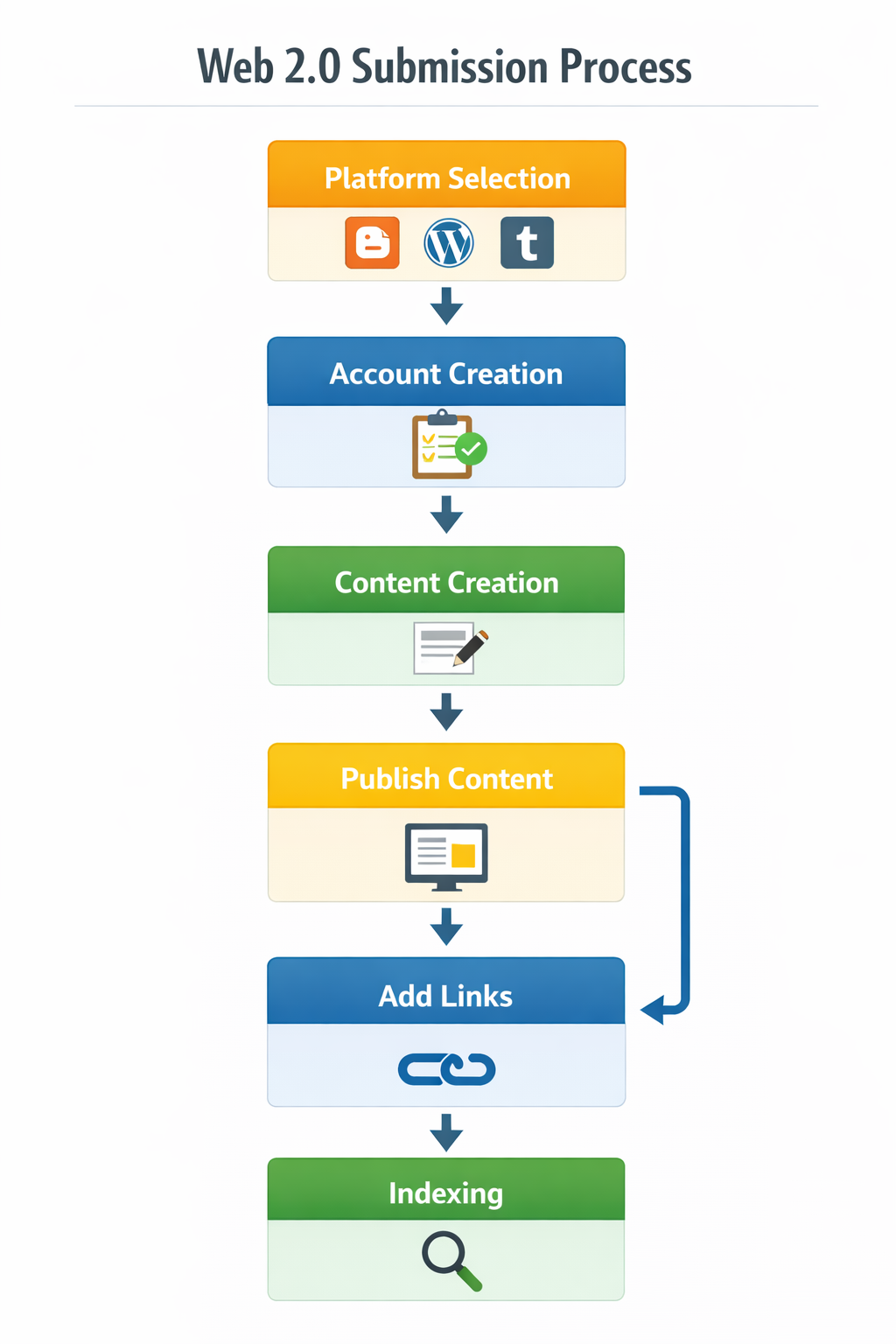
Having a list of backlinks submission sites is maybe 20% of the battle. The other 80%? That's all execution. Here's the process that separates people who see real ranking improvements from those who waste their time.
Pick 8–12 Platforms With Purpose
Don't just sign up everywhere and hope for the best. Choose your platforms based on:
- DA strength: Make sure at least 4–5 of your picks are Tier 1 sites (DA 90+)
- Content format fit: Medium and LinkedIn are great for long-form articles. Tumblr works well if you're in a visual niche. WordPress.com gives you the most flexibility for customization.
- How fast they get indexed: Blogger and WordPress.com pages typically get crawled within 24–48 hours. Some of the smaller platforms can take weeks before Google even notices them.
Build Out Branded, Complete Profiles
Here's something a lot of people overlook: Google doesn't just look at the domain linking to you. It evaluates the trustworthiness of the actual page. An empty profile with no picture, no bio, and one sketchy post isn't going to impress anyone — including search engines.
On every platform, make sure you:
- Use your actual brand name or a relevant persona
- Write a unique 150-word bio that naturally mentions your site
- Upload a real, professional profile image
- Fill out every profile field the platform offers
Write High-Quality, Original Content (Seriously)
This is where the vast majority of people drop the ball. They take one article, spin it across 20 different platforms, and then scratch their heads when Google completely ignores the links.
Every web 2.0 blog post you publish should be:
- At least 800–1,500 words: Google deindexes thin content on web 2.0 platforms all the time
- Completely unique: Don't just recycle posts from your main blog. Write fresh supporting content.
- On topic: If your main site sells CRM software, your web 2.0 blog better be covering CRM-related subjects. Random keyword-stuffed filler won't fool anyone.
- Linked naturally: Stick to one contextual backlink per 800–1,000 words. Mix up your anchor text between branded terms, exact match keywords, and generic phrases.
Advanced Web 2.0 Strategies (That Most Guides Skip)
Add as a new full section after your Step-by-Step Strategy, before the Mistakes section.
Strategy 1: Tiered Link Building With Your Web 2.0 Properties
Most guides tell you to point all your web 2.0 links directly at your money site. That is a missed opportunity — and it can actually look unnatural if every web 2.0 link points to the same URL.
Instead, build a tiered structure:
Tier 1 (Power Links): Your web 2.0 blogs on DA 90+ platforms (WordPress.com, Blogger, Medium, Tumblr). These link directly to your money site's target page.
Tier 2 (Amplifiers): Social bookmarks, Q&A answers on Quora, and Reddit community posts that link to your Tier 1 web 2.0 blogs — not to your money site directly.
Tier 3 (Signals): Forum profile links, blog comments, and social shares that point to your Tier 2 properties.
What this achieves: each Tier 2 link strengthens the authority of your Tier 1 web 2.0 blog, which in turn passes stronger link equity to your money site. The link velocity looks natural because the signals hit different platforms at different levels.
Strategy 2: Building a Topical Authority Cluster With Web 2.0 Blogs
Rather than creating 10 disconnected web 2.0 blogs on random topics, create a topical cluster — 4–5 web 2.0 properties all covering closely related sub-topics in your niche.
Example for an SEO agency:
Blog A (WordPress.com): Off-page SEO strategies guide → links to your money site's link building service page
Blog B (Blogger): Domain authority building guide → links to Blog A and your money site
Blog C (Medium): Guest posting vs web 2.0 comparison → links to Blog B and your money site
Blog D (Substack): Monthly SEO link building roundup → links to all three blogs above
Each blog in the cluster interlinks with the others and all of them link to your money site. Google reads this cluster as a topically coherent network of content, which strengthens the topical authority of your main site for those keywords.
Strategy 3: Indexing Your Web 2.0 Posts Faster
Publishing the post is only half the battle — you need Google to crawl it. Here is the exact indexing sequence to use after every web 2.0 post goes live:
Submit the exact post URL through Google Search Console's URL Inspection tool → Request Indexing.
Share the post URL on Twitter/X with a brief description and 2–3 relevant hashtags. Twitter is crawled by Google within minutes.
Post the URL to a relevant subreddit or LinkedIn group (not spam — add genuine commentary about why the post is useful).
Create 2–3 social bookmarks on Diigo, Scoop.it, and Pearltrees pointing to the web 2.0 post URL.
If the post is on a platform that allows it (WordPress.com, Blogger), create an internal link from an older existing post on the same platform pointing to the new post. Internal links from already-indexed pages accelerate discovery.
Strategy 4: Measuring Whether Your Web 2.0 Campaign Is Working
Here are the exact metrics to track and the benchmarks that indicate a healthy campaign:
| Metric | Tool | Healthy Benchmark |
|---|---|---|
| Backlinks indexed by Google | Google Search Console → Links | 80%+ of web 2.0 links appearing within 30 days |
| Referral traffic from web 2.0 platforms | GA4 → Acquisition → Referral | 5–20 sessions/month per active property |
| Domain Authority growth | Moz Link Explorer (monthly check) | +2–5 DA points per quarter from web 2.0 alone |
| Target keyword ranking movement | Ahrefs / GSC Performance | Move up 3–10 positions within 60–90 days |
| Spam score (total backlink profile) | Moz Link Explorer | Keep below 5% after adding web 2.0 links |
| Indexed web 2.0 posts | site:yourblog.wordpress.com in Google | 100% of published posts should be indexed |
Interlink Your Web 2.0 Properties With Each Other
Most guides completely skip this part, and it's a shame because it works really well. Rather than pointing every single web 2.0 blog directly at your money site, build a small network:
- Web 2.0 Blog A links to Web 2.0 Blog B
- Web 2.0 Blog B links to your money site
- Web 2.0 Blog C links to both Blog A and your money site
What you end up with is a tiered link structure that amplifies link equity without looking like you're running some obvious link scheme. According to a Moz study on link building, diversified link structures with different referring domains consistently outperform strategies that rely on a single source.
Keep Publishing (Don't Just Post Once and Disappear)
A web 2.0 blog with exactly one post on it screams "I built this for links." Meanwhile, a blog with 5–10 posts spread over 3–6 months looks like a real publication. Google rewards that with better indexing and stronger link equity transfer.
Try to publish 2–3 posts per platform over the first 90 days. After that, keep things going with one monthly post on your top 3–4 performers.
Make Sure Google Actually Finds Your Pages
Don't just assume Google is going to discover your content on its own. After you publish something:
- Submit the URL directly through Google Search Console
- Share the post across your social media profiles (this creates social signals)
- Ping the URL using free indexing tools
- Create 2–3 social bookmarks pointing to the web 2.0 post
Mistakes That Will Tank Your Web 2.0 Link Building Efforts
Plenty of SEO folks know about web 2.0 submission sites. Way fewer actually use them the right way. Here are the mistakes we run into constantly when auditing backlink profiles at SEO Company in Bangalore.
Mistake 1: Using Bots to Mass-Create Accounts
Spinning up 50+ accounts in a single day with automation tools is a fast track to getting flagged. Google's SpamBrain AI update was built specifically to catch artificial link patterns. And platforms like WordPress.com and Medium will outright ban accounts that behave like bots.
What to do insteadCreate accounts by hand, 2–3 per week, using unique email addresses and real profile details.
Mistake 2: Publishing Spam or Copied Content
Google's Helpful Content system — which got a significant update in March 2024 — actively demotes pages that exist mainly to game search rankings. A 300-word spun article on Blogger stuffed with exact-match anchor links isn't fooling the algorithm. It's not fooling anyone.
What to do insteadPut real effort into original content. If writing 50 unique articles isn't realistic for you, write 10 genuinely good ones for 10 platforms. That will outperform 50 pieces of garbage every single time.
Mistake 3: Hammering the Same Anchor Text Over and Over
If 80% of your web 2.0 backlinks use the identical exact-match keyword as the anchor, you're basically begging for a Penguin-style penalty. A natural backlink profile roughly looks like this:
- 30–40% branded anchors ("Cronbay Technologies")
- 20–30% naked URLs ("www.cronbay-tech.com")
- 15–20% generic anchors ("click here," "this resource")
- 10–15% partial match keywords
- 5–10% exact match keywords
Mistake 4: Ignoring Each Platform's Rules
Tumblr, Medium, and WordPress.com all have content policies, and they enforce them. If you publish overtly promotional content packed with external links, it gets flagged and removed. And when your web 2.0 blog gets nuked, every backlink it was passing disappears with it.
What to do insteadWrite content that genuinely helps your reader first. The backlink is secondary. Follow each platform's guidelines on external links, promotional language, and acceptable content.
Mistake 5: Over-Optimising Your Keywords in the Post Itself
Google's SpamBrain algorithm now reads the content of web 2.0 posts — not just the links they contain. A post that repeats your target keyword in every paragraph is not just annoying to read; it actively signals spam. Google will deindex the post, and when the post disappears, so does every backlink it was passing.
Keep keyword density in your web 2.0 posts below 1.5%. Use semantic variations, related terms, and natural language. Write the post as if it's meant to genuinely help a reader — because that is the only version Google will keep indexed long-term.
Mistake 6: Publishing Identical Content on Multiple Platforms
Cross-posting the same article across 10 different web 2.0 platforms is the single most common mistake in this space. Here is what actually happens: Google identifies duplicate content, picks one version to index (usually the oldest one), and effectively ignores all the others. You end up with 9 links that do nothing.
The fix is to cover the same general topic from a different angle on each platform. If your niche is digital marketing, Platform A could cover 'how to build backlinks without paid outreach,' Platform B could cover 'why topical authority matters more than domain authority,' and Platform C could cover 'how to track your link building progress.' Three different angles. Three indexed posts. Three live backlinks.
Mistake 7: Building All Your Links in One Week
A sudden spike of 20–30 new links from new domains within seven days is an unnatural pattern that Google's link analysis algorithms are specifically designed to flag. Even if every individual link is from a legitimate, high-DA web 2.0 platform, the velocity of the link acquisition is the red flag.
The safe approach: create 2–3 new web 2.0 properties per week, publish 1–2 posts per week across your existing properties, and spread the campaign across 60–90 days minimum. Think of it as building a library, not flooding a warehouse.
Mistake 8: Publishing Posts With No Images or Multimedia
Web 2.0 posts with no images generate lower engagement signals — lower time on page, higher bounce rate, fewer social shares. Lower engagement signals mean Google crawls the page less frequently, which means slower link equity transfer. It also means readers are less likely to click through to your main site.
Every web 2.0 post should include at least one relevant image with a descriptive alt text (e.g., 'web 2.0 backlink strategy diagram 2026'). If you have original branded graphics, use them — they improve brand recognition. If not, create simple informational graphics with Canva. Even a basic visual doubles average time-on-page for most content types.
Ready to Boost Your Rankings with Powerful Backlinks?
Improve your SEO, build authority, and grow organic traffic with our expert link-building strategies.
Get Free SEO ConsultationWeb 2.0 Submission Sites FAQs for 2026
Are Web 2.0 submission sites still useful for SEO in 2025–2026?
Yes, they can still add value when used correctly. The key is to publish meaningful content, use natural anchor text, and avoid aggressive link-building. They work best as part of a well-rounded SEO strategy rather than a standalone tactic. You can also explore this Web 2.0 submission sites list to find high-authority platforms for better results.
How many Web 2.0 backlinks should you build each month?
A steady and controlled approach works best. Aim for around 5–10 high-quality links per month across different platforms instead of focusing on bulk creation.
Are Web 2.0 platforms free to use?
Most popular Web 2.0 sites provide free access to create and publish content. However, it’s important to follow their guidelines and avoid platforms that encourage spammy practices.
Is it safe to automate Web 2.0 submissions?
Full automation often leads to poor-quality content and can harm your SEO efforts. If you use tools, ensure every post is reviewed, customized, and not duplicated across platforms.
Do Web 2.0 backlinks help increase domain authority?
They can contribute positively when built on relevant, high-quality content. For better results, combine them with other strategies like guest posting, content marketing, and digital PR.
Final Thoughts
The Indian digital market presents enormous opportunities for businesses willing to invest in the right strategies. Well-executed digital marketing and backlink strategy can transform your online presence.
Cronbay Technologies stands ready to be your trusted digital partner in this journey. With expertise spanning across all facets of digital marketing — from technical SEO Services in India and backlink building to content strategy and social media marketing — Cronbay Technologies delivers the results that matter.

.png)