
Introduction
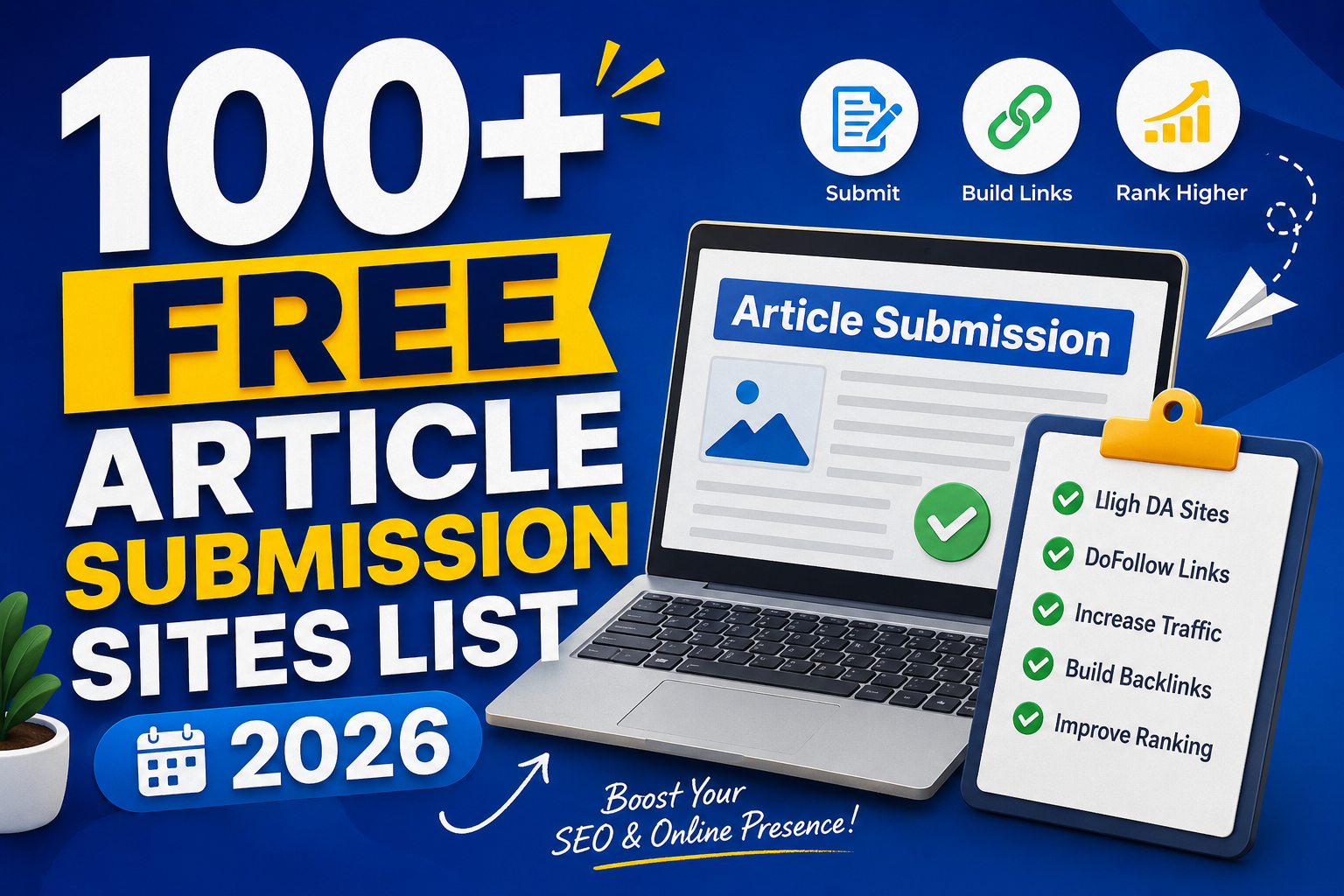
Looking to boost your website's SEO through article submission? You're not alone. Article submission remains one of the most effective off-page SEO strategies for building quality backlinks, increasing domain authority, and driving targeted traffic to your website.
But not all article submission sites are created equal. Some offer high domain authority (DA) with dofollow links, while others provide quick approval but minimal SEO benefit. Finding the right mix of platforms is crucial for sustainable ranking growth.
Whether you're working with a top digital marketing agency in Bangalore or managing SEO in-house, having a reliable list of article submission sites gives your off-page strategy a serious edge.
In this comprehensive guide, we'll provide you with:
- 100+ verified article submission sites sorted by DA and PA
- Word count guidelines per platform to maximize acceptance rates
- Submission tips and best practices that actually work
- The critical difference between article submission and web 2.0 submission sites (often confused!)
- Updated metrics and approval timelines for 2026
Let's dive in.
What is Article Submission?
Article submission is the process of publishing articles on third-party websites (directories, platforms, or content hubs) outside your own domain. This off-page SEO tactic serves multiple purposes:
Core Benefits:
- Generates high-quality backlinks to your website
- Drives referral traffic from relevant audiences
- Establishes authority and credibility in your niche
- Improves search engine rankings through diverse link profiles
- Creates brand awareness across multiple platforms
- Generates leads from readers interested in your content
Unlike guest posting on random blogs, article submission sites follow structured guidelines and typically offer instant or fast approval. The best platforms provide both authority and relevance, making them valuable for long-term SEO growth.
Businesses working with a trusted SEO company in Bangalore often use article submission as a core component of their link-building strategy, especially in competitive local markets.
Article Submission vs. Web 2.0 Submission Sites: Understanding the Key Difference
This is the most important distinction that most marketers get wrong. Many confuse these two tactics, but they serve different purposes in your SEO strategy. Understanding the difference is critical for building a sustainable, effective backlink profile.
What is Article Submission?
Article Submission Sites are content directories that publish original articles from contributors. They work like online publications or content repositories.
Characteristics:
- Accept long-form, original content (600-1200 words)
- Provide byline with author bio and website link
- Focus on quality content and relevance
- Typically offer dofollow links (with high-authority sites)
- Content remains published indefinitely
- Reader audience already exists on the platform
- Examples: EzineArticles, ArticleBase, Medium, LinkedIn Articles
SEO Value: High-quality backlinks + Referral traffic + Authority building
What is Web 2.0 Submission?
Web 2.0 Submission Sites are user-generated platforms where you create your own mini-sites or blog properties (sub-domains or sub-folders on authority domains).
Characteristics:
- You create accounts and mini-sites on existing platforms
- You control the content, design, and links (within limits)
- Links are typically dofollow from the main domain
- Fast indexing due to high domain authority
- Full control over anchor text and link placement
- Examples: WordPress.com, Blogger.com, Medium.com, Wix.com, Weebly.com
SEO Value: Authority link building + Content hubs + Faster indexing
Quick Comparison Table
| Aspect | Article Submission | Web 2.0 Submission |
|---|---|---|
| Content Type | Single articles | Full mini-sites/blogs |
| Link Control | Limited (fixed author bio) | Full control over anchor text |
| Setup Time | 5-10 minutes per article | 30-60 minutes per property |
| Indexing Speed | 2-14 days | 1-3 days |
| Link Placement | Only in author bio | Multiple contextual links |
| Content Updates | Article remains static | You can update anytime |
| Best For | Quick authority + traffic | Building link networks |
| Maintenance | Minimal | Ongoing |
| SEO Impact | Medium (single links) | High (contextual network) |
Bottom Line: Use article submission for quick, quality backlinks. Use Web 2.0 submission for building authority hubs and link networks. Together, they create a powerful, diverse backlink profile.
For a deeper dive into Web 2.0 sites, read our complete guide: Web 2.0 Submission Sites: 300+ High DA Properties for Link Building
Why Quality Article Submission Still Matters in 2026
Google's emphasis on content quality means that articles published on authority platforms carry more weight than ever. Here's why article submission remains effective:
1. Authority Transfer When you publish on domains with DA 60+, some of that authority transfers to your site via the backlink.
2. Relevance and Context High-quality directories categorize articles by topic, ensuring topical relevance. This contextual link is worth more than random links.
3. Referral Traffic Unlike private blog networks, legitimate article sites bring real, human traffic. This user engagement signals quality to Google.
4. Diverse Link Profile Publishing across 50+ different platforms looks natural to search engines. It's not concentrated on a few domains.
5. Long-Term Asset Unlike PBNs (private blog networks), articles remain published indefinitely, providing lasting link equity.
If you're unsure how to use these platforms effectively, partnering with the best digital marketing agency in India can help you build a scalable, penalty-free backlink strategy.
Word Count Guidelines by Platform Category
This is crucial: Different platforms have different content expectations. Following their guidelines improves approval rates and maximizes SEO value.
High-Authority Platforms (DA 70+)
- Recommended Word Count: 800-1200 words
- Why: Expect more editorial review. Comprehensive content shows quality.
- Examples: Medium (1000-1500), LinkedIn Articles (1000+)
- Approval Time: 3-7 days
- Link Type: Mostly dofollow
Medium-Authority Directories (DA 50-70)
- Recommended Word Count: 600-900 words
- Why: Sweet spot for fast approval + quality perception
- Examples: EzineArticles (600-1000), ArticleBase (500-1000)
- Approval Time: 1-3 days
- Link Type: Mostly dofollow
Fast-Approval Platforms (DA 40-50)
- Recommended Word Count: 400-700 words
- Why: Minimal editorial review. Shorter content gets published faster.
- Examples: ArticleBiz (300+), Sooper Articles (300+)
- Approval Time: Instant-24 hours
- Link Type: Mixed (dofollow + nofollow)
Instant-Approval Platforms (DA <40)
- Recommended Word Count: 300-500 words
- Why: Automated publishing with minimal requirements
- Examples: Write.as, Penzu, StorieBoard
- Approval Time: Instant
- Link Type: Often nofollow
Top 50 High-Authority Article Submission Sites (DA 60+)
| Rank | Website | DA | PA | Approval Time | Word Count |
|---|---|---|---|---|---|
| 1 | LinkedIn.com | 99 | 100 | 3-5 days | 1000-2000 |
| 2 | Medium.com | 95 | 85 | 1-3 days | 1000-1500 |
| 3 | Academia.edu | 93 | 76 | 1-2 days | 800-1200 |
| 4 | Blogger.com | 92 | 75 | 1 day | 600-1000 |
| 5 | Quora.com | 93 | 79 | Instant | 300-500 |
| 6 | EzineArticles.com | 87 | 70 | 2-5 days | 600-1000 |
| 7 | ArticleBase.com | 76 | 67 | 1-3 days | 500-900 |
| 8 | Wattpad.com | 92 | 75 | 1 day | 1000+ |
| 9 | YoursStory.com | 87 | 57 | 2-4 days | 800-1200 |
| 10 | Issuu.com | 91 | 68 | 1-2 days | 1000+ |
| 11 | LiveJournal.com | 93 | 99 | 1 day | 500-1000 |
| 12 | Evernote.com | 92 | 77 | Instant | 300-800 |
| 13 | Tumblr.com | 86 | 100 | Instant | 300-1000 |
| 14 | Reddit.com | 92 | 91 | Instant | 200-500 |
| 15 | DZone.com | 84 | 65 | 2-3 days | 600-1000 |
| 16 | GitHub.com | 96 | 83 | Instant | 500+ |
| 17 | SelfGrowth.com | 64 | 64 | 1-2 days | 500-900 |
| 18 | MyTrendingStories.com | 75 | 52 | 1 day | 400-800 |
| 19 | Gumroad.com | 91 | 72 | 1 day | 300-1000 |
| 20 | Telegra.ph | 93 | 73 | Instant | 300-2000 |
| 21 | APSense.com | 80 | 63 | 1-2 days | 400-800 |
| 22 | MerchantCircle.com | 77 | 67 | 2-3 days | 500-900 |
| 23 | Penzu.com | 76 | 68 | Instant | 300-1000 |
| 24 | Wakelet.com | 71 | 68 | Instant | 500-1500 |
| 25 | Write.as | 69 | 61 | Instant | 300-2000 |
| 26 | Vingle.net | 77 | 63 | 1 day | 300-1000 |
| 27 | TheOmniBuzz.com | 57 | 52 | Instant | 300-800 |
| 28 | Nouw.com | 59 | 58 | Instant | 300-1000 |
| 29 | InfoBarrel.com | 62 | 60 | 1-2 days | 400-1000 |
| 30 | JustPaste.it | 91 | 67 | Instant | 300-2000 |
| 31 | KLusster.com | 48 | 52 | 1 day | 300-600 |
| 32 | StorieBoard.com | 63 | 63 | Instant | 300-1000 |
| 33 | ArticlesNeed.com | 52 | 41 | Instant | 300-600 |
| 34 | ArticleCad.com | 45 | 55 | 1-2 days | 400-800 |
| 35 | Teletype.in | 62 | 60 | Instant | 300-2000 |
| 36 | BookBaby.com | 72 | 65 | 2-4 days | 800-1500 |
| 37 | SooperArticles.com | 54 | 59 | Instant | 300-900 |
| 38 | E27.co | 72 | 58 | 2-3 days | 600-1200 |
| 39 | Uberant.com | 52 | 57 | 1-2 days | 300-800 |
| 40 | AnoteePad.com | 50 | 64 | Instant | 300-2000 |
| 41 | WritePad.com | 65 | 55 | 1 day | 300-1000 |
| 42 | TripAdvisor.com (Reviews) | 88 | 70 | 1-2 days | 100-500 |
| 43 | HubPages.com | 49 | 56 | 2-3 days | 600-1000 |
| 44 | Substack.com | 78 | 72 | Instant | 500-2000 |
| 45 | Dev.to | 79 | 68 | 1 day | 500-1000 |
| 46 | TheFreelibrary.com | 82 | 58 | 1-2 days | 400-1000 |
| 47 | Crunchbase.com | 91 | 68 | 2-3 days | 200-500 |
| 48 | AngelList.com | 88 | 72 | 1-3 days | 300-800 |
| 49 | Scribd.com | 91 | 70 | 2-3 days | 1000+ |
| 50 | Wix.com (Free Blogs) | 91 | 75 | Instant | 500-2000 |
Submission Tips for Maximum Approval & SEO Impact
1. Follow Platform-Specific Guidelines
Each site has unique requirements. Read the submission guidelines completely before submitting.
2. Use Unique Content
Never submit the same article to multiple sites. Rewrite or rework content for each platform.
3. Natural Link Placement
- Place your link in the body text (not just author bio)
- Use varied anchor text (brand name, URL, generic, partial match)
- Limit to 1-2 links per article
- Link to relevant, contextual pages on your site
4. Optimize for the Platform's Audience
Research what content performs well on each site. Tailor your article to that audience's interests.
5. Quality Over Quantity
One high-quality article on a DA 80+ site beats 10 articles on DA 30 sites.
6. Include Media
Add relevant images, infographics, or videos where allowed. Media increases approval chances and engagement.
7. Proofread Thoroughly
Typos and grammatical errors trigger rejection. Use Grammarly or manual review.
8. Build a Submission Schedule
Don't submit to 50 sites at once. Space submissions over 4-8 weeks for natural-looking link growth.
A performance marketing agency in Bangalore can help you align your article submission schedule with your paid and organic campaigns for maximum SERP visibility and ROI.
Key Article Submission Metrics for 2026
| Metric | What It Means | Minimum Target |
|---|---|---|
| Domain Authority (DA) | Overall strength of the domain | 40+ (60+ preferred) |
| Page Authority (PA) | Strength of the specific page | 40+ |
| Dofollow Links | Links that pass authority to your site | ✅ Essential |
| Traffic | Monthly visitors to the directory | 1000+ |
| Approval Rate | % of submissions that get approved | 80%+ |
| Indexing Time | How fast Google indexes the article | <14 days |
| Link Permanence | How long articles stay published | Indefinite |
Dofollow vs. Nofollow: Does It Matter?
Yes. Dofollow links pass authority; nofollow links don't.
For SEO purposes, prioritize high-DA sites with dofollow links. However, even nofollow links have value:
- They drive referral traffic
- They increase brand visibility
- They contribute to a natural link profile (mixing dofollow and nofollow looks more organic)
Focus 70% of efforts on dofollow, high-DA sites. Use remaining 30% on mix of nofollow and lower-DA (but still relevant) platforms.
An experienced SEO company in India will always recommend a healthy mix of dofollow and nofollow links to ensure your backlink profile appears organic to Google's algorithms.
Common Mistakes to Avoid
1. Submitting Poor-Quality Content Thin, keyword-stuffed articles get rejected. Quality always wins.
2. Using Exact-Match Anchors Everywhere This looks unnatural and triggers spam filters. Vary your anchor text.
3. Submitting Too Fast Submitting to 50 sites in one week looks like spam. Space submissions over 4-8 weeks.
4. Ignoring Niche Relevance Publishing a fitness article on a tech-only directory wastes effort. Match content to platform focus.
5. Duplicating Content Across Sites Google detects duplicate content. Each submission should be unique or significantly rewritten.
6. Ignoring Author Bio Optimization Your author bio is prime real estate for your best anchor text. Craft it carefully.
Article Submission Checklist
- Research 20-30 high-DA article directories relevant to your niche
- Create unique 600-1200 word articles for each submission
- Optimize anchor text for target keywords (varied, natural)
- Include relevant images or media
- Proofread for grammar and spelling
- Craft compelling headlines that encourage clicks
- Write detailed author bios with optimized links
- Follow each platform's submission guidelines exactly
- Submit at a pace of 3-5 articles per week (max)
- Track submissions in a spreadsheet (URL, date, DA, PA, anchor text)
- Monitor approval status and approvals
- Request indexing where applicable (Google Search Console)
- Re-visit and update top-performing articles after 3 months
FAQ: Article Submission in 2026
Conclusion
Article submission remains a powerful, white-hat SEO strategy for 2026. By publishing quality content on high-authority platforms, you build backlinks, drive traffic, and establish topical authority.
Key Takeaways:
- Focus on quality over quantity50 articles on DA 70+ sites beat 500 on spammy directories
- Use varied anchor text and space submissions naturally
- Follow platform-specific guidelines and word count recommendations
- Combine article submission with Web 2.0 properties for maximum impact
- Track everything in a spreadsheet for long-term analysis
Start with 10-15 high-DA platforms from this list. Master those, then expand gradually. Consistency and quality are your path to sustainable first-page rankings.
Whether you manage SEO internally or work with a reliable SEO company in india, article submission when done right it remains one of the most cost-effective off-page tactics available in 2026.
Ready to scale your backlink strategy? Combine article submission with our guide on Web 2.0 Submission Sites for a complete off-page SEO approach.

.png)