
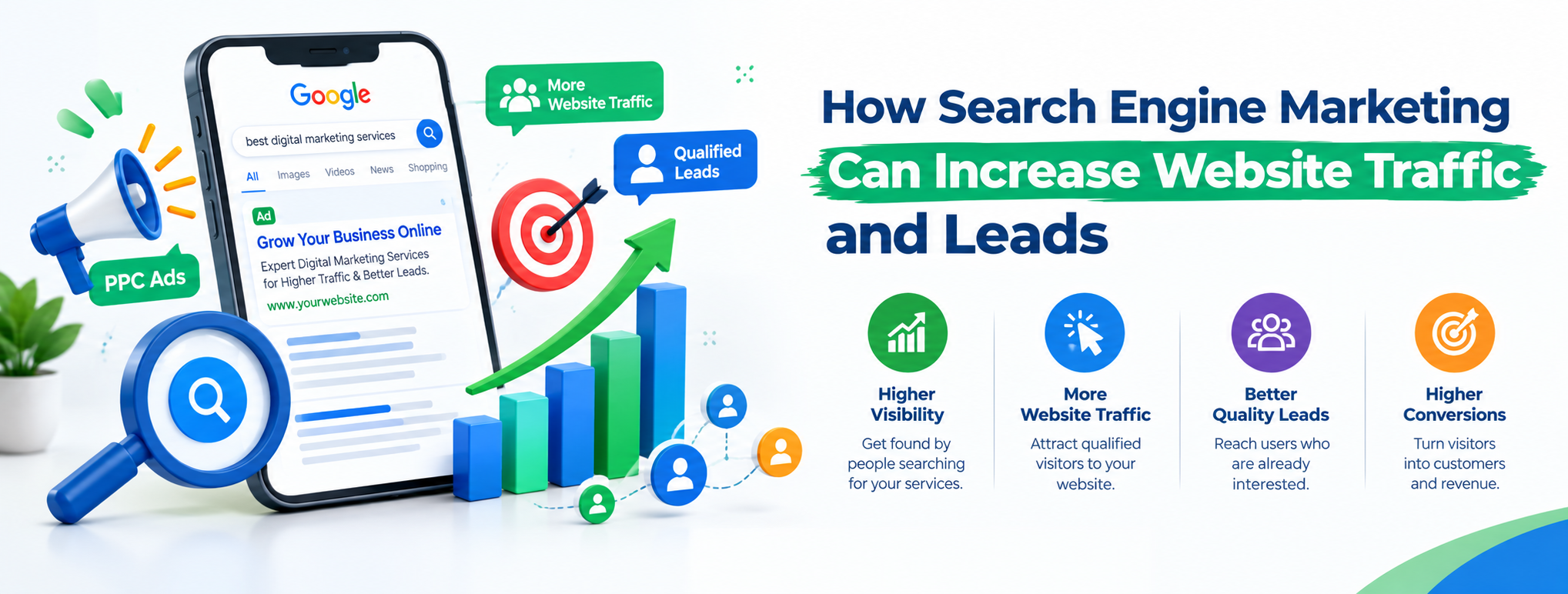
Every day, millions of people turn to Google and Bing with a problem to solve or a product to buy. Some are browsing. Many are ready to act. The businesses that appear in front of these people at the right moment win the click, the inquiry, and often the sale.
That is what search engine marketing does. Waiting for customers to discover your website is slow and unpredictable. Search engine marketing (SEM) puts your business directly in front of people who are already searching for what you offer.
This guide explains how SEM works, how it increases website traffic, how it generates leads, and how to build a campaign that delivers a measurable return. It is written for business owners, marketing managers, and small business teams.
What Is Search Engine Marketing?
Search engine marketing is a digital marketing approach that increases your visibility on search engine results pages (SERPs). Most of the time this means paid search advertising, where you bid on keywords so your ads appear when someone searches for them. Some definitions also include organic techniques like SEO, so the term is used a little differently across the industry.
In practice, search engine marketing usually looks like this:
- A person searches "emergency plumber in Bengaluru" or "best CRM software for startups."
- Ads appear at the top or bottom of the results page, marked as sponsored.
- The searcher clicks the ad that best matches their need.
- You pay only when someone clicks, which is why the model is called pay-per-click (PPC).
Because SEM is built on search intent, it works differently from social media ads or display banners. Someone searching on Google is actively looking. You are not interrupting them. You are answering a question they just asked.
The most widely used platform for this is Google Ads, followed by Microsoft Advertising, which covers Bing and its partner networks. When people say "Google Ads marketing," they are usually talking about this form of search engine advertising.
How Search Engine Marketing Works
SEM looks simple from the outside but runs on a few important mechanics.
1. Keyword research and selection
Everything starts with keywords, the words and phrases people type into search engines. You choose the keywords you want to trigger your ads, such as "accounting software for small business" or "dental implants near me." Good SEM keyword targeting balances three things:
- Relevance: the keyword closely matches your product or service.
- Search volume: enough people are searching for it.
- Intent: the searcher is close to taking action.
Broad terms like "shoes" bring volume but vague intent. Specific phrases like "waterproof running shoes for women size 7" bring fewer searches and much higher buying intent.
2. The ad auction
Each time someone searches a keyword you are bidding on, the search engine runs a split-second auction. It does not simply give the top spot to the highest bidder. The result depends on:
- Your maximum bid
- Your ad quality and relevance
- The experience your landing page provides
- The searcher's context, such as location, device, and time of day
This is good news for smaller advertisers. A well-built campaign with relevant ads and a strong landing page can outrank a competitor who spends more but targets poorly.
3. Quality Score and ad rank
Google uses a Quality Score, based on expected click-through rate, ad relevance, and landing page experience, to judge how useful your ad is. A higher score usually means a lower cost per click and better positions. Strong quality signals let you pay less and perform better.
4. Pay-per-click billing
You are charged when a person clicks your ad, not when it merely appears. The cost per click varies widely by industry and competition. Coursera's SEM guide cites Statista data showing an average Google Ads cost per click across US industries of about $2.13 as of December 2024, with insurance far higher at roughly $16.54. Your own costs will depend on your market, your keywords, and the quality of your campaigns.
How SEM Increases Website Traffic
If your goal is more visitors, few channels move as quickly as paid search. Here is how SEM increases website traffic.
Immediate visibility
A new page can take months to rank through SEO. A search engine marketing campaign can send traffic within hours of approval. For a new business, a product launch, or a seasonal promotion, that speed matters.
Top-of-page positioning
Paid ads appear above and below organic results. Even if your site does not yet rank organically for a competitive keyword, you can still show up in prime space.
Targeted rather than random traffic
Raw traffic numbers can be misleading. Ten thousand irrelevant visitors help nobody. SEM lets you narrow who sees your ads by:
- Keyword: only people searching specific terms
- Location: a city, a postal code, or a radius around your store
- Device: mobile, desktop, or tablet
- Schedule: specific days or hours
- Audience: past visitors, in-market audiences, or customer lists
That precision is why many businesses use SEM to increase website traffic that actually converts, rather than just inflating visitor counts.
Negative keywords that protect your budget
Negative keywords tell the search engine which searches should not trigger your ad. A company selling premium laptops might exclude "free," "cheap," and "repair." This keeps your budget focused on qualified clicks and improves the overall quality of your traffic.
Remarketing brings visitors back
Most first-time visitors do not convert. Remarketing lets you show tailored ads to people who have already visited your site, which keeps your brand in front of warm prospects and brings them back to finish what they started.
How SEM Generates Leads
Traffic is only a means to an end. For most businesses the real goal is SEM lead generation: enquiries, calls, form submissions, demo bookings, and purchases. Here is how SEM generates leads across the funnel.
Reaching people at the moment of need
Searchers type specific problems into Google. When your ad matches that problem, the click carries intent. Compare a person who scrolls past a social media ad with someone who searches "book a corporate catering service for 50 people." The second person is far closer to buying.
Matching keywords to funnel stages
Different searches reflect different stages of the buyer journey:
- Awareness: "how to reduce employee turnover"
- Consideration: "best HR software for small teams"
- Decision: "HR software pricing" or "buy [brand name] HR software"
Strong SEM campaigns for lead generation weigh decision-stage keywords most heavily, and use consideration and awareness keywords to nurture a larger audience.
Dedicated landing pages
Sending ad clicks to a homepage is one of the most common ways to waste money. A dedicated landing page that mirrors the ad's promise, offers one clear action, and loads quickly dramatically improves the chance that a click becomes a lead.
Lead-focused ad extensions
Ad extensions add extra information and action options to your ads. Useful ones for lead generation include:
- Call extensions: a tap-to-call button for mobile users
- Lead form extensions: forms completed directly from the ad
- Sitelink extensions: links to specific pages like pricing or contact
- Location extensions: your address and directions
- Callout extensions: short value statements like "Free quote" or "24/7 support"
Conversion tracking
SEM makes it possible to see exactly which keywords, ads, and campaigns produce leads. By tracking form submissions, calls, and purchases, you stop guessing and start investing in what works.
Key Benefits of Search Engine Marketing for Businesses
Here are the main benefits of SEM for businesses, and why so many companies include it in their marketing mix.
1. Fast results. Campaigns can generate traffic and leads within days rather than months.
2. Highly targeted reach. You choose who sees your ads, based on search terms, location, device, and audience.
3. Cost control. You set daily budgets and bid limits. You can pause, scale, or adjust spend at any time.
4. Measurable performance. Impressions, clicks, click-through rate, cost per click, conversions, and cost per lead are all trackable, so every rupee or dollar can be accounted for.
5. Pay for engagement. Under the pay-per-click model, you pay when someone shows interest by clicking, not when your ad is displayed.
6. Brand visibility. Even searchers who do not click see your name, which builds familiarity over time.
7. Level playing field. Strong relevance and well-run campaigns let smaller companies compete against larger ones.
8. Flexibility. You can test new offers, adjust messaging, and respond to market changes quickly.
SEM vs SEO: What's the Difference?
Search engine marketing and search engine optimization are often confused, and they are often discussed together. Here is the practical difference when comparing SEM vs SEO.
| Factor | SEM (Paid Search) | SEO |
|---|---|---|
| Cost model | Pay per click | No direct payment per click, but needs time and resources |
| Speed | Results within days | Results typically take months |
| Position | Sponsored placements | Organic listings |
| Control | High control over targeting, budget, and messaging | Less control; dependent on algorithms |
| Longevity | Traffic stops when spend stops | Benefits can compound and last |
| Best for | Fast leads, launches, promotions | Long-term authority and steady traffic |
Some sources, like Coursera, treat SEO as part of SEM. Others, like GeeksforGeeks, separate the two. In most business conversations, SEM means paid search, and SEO means organic optimization.
The best approach is usually to use both. SEM delivers speed and precision now. SEO builds lasting visibility. Keyword data from your paid campaigns can also reveal which terms convert best, so you can prioritize them in your SEO content.
PPC and SEM: How They Relate
You will often hear "PPC and SEM" used as if they mean the same thing. They are closely related, but not identical.
- PPC (pay-per-click) is a payment model used across platforms, including search, social media, and display networks.
- SEM specifically concerns promoting your business on search engines, usually through PPC.
Every paid search campaign is PPC, but not every PPC campaign is SEM. A Facebook ad billed per click is PPC, but it is not search engine marketing.
How to Build a Search Engine Marketing Strategy
A strong search engine marketing strategy is a repeatable process that you can measure, learn from, and improve. Here is a practical framework.
Step 1: Define clear goals
Decide what success looks like before spending a rupee. Typical goals include:
- Generate 100 qualified leads per month
- Achieve a cost per lead under a set amount
- Increase online sales by a target percentage
- Drive more calls to a local branch
Specific goals determine your keywords, your landing pages, and how you judge performance.
Step 2: Know your audience
Build simple buyer personas covering who they are, what problems they face, where they are located, and the words they use to search. The better you understand them, the more precisely you can target them.
Step 3: Research keywords
Use tools such as Google Keyword Planner, Google Trends, Semrush, or Moz to find keywords with real demand and commercial intent. Group them by theme, such as product type or service category, so each ad group stays tightly focused.
Step 4: Structure your account
Organize your campaign into campaigns, ad groups, keywords, and ads. Tight structure lets you write relevant ad copy for each keyword group, which improves Quality Score and lowers costs.
Step 5: Write compelling ad copy
Strong ads usually include:
- The target keyword in the headline
- A specific benefit, not generic claims
- Proof such as ratings, years of experience, or guarantees
- A clear call to action like "Get a Free Quote" or "Book a Demo"
Test multiple variations. Small copy changes can noticeably alter click-through rates.
Step 6: Build conversion-focused landing pages
Make sure each ad leads to a page that delivers on its promise. Keep the headline consistent with the ad, show a single clear action, minimize distractions, and make forms short.
Step 7: Set budgets and bidding strategies
Start with a budget you can afford to test. Choose a bidding approach aligned with your goal, such as maximizing clicks for traffic or maximizing conversions for leads. Automated bidding can help once you have enough conversion data.
Step 8: Launch, monitor, and refine
Your first version is rarely your best. Review performance regularly and adjust bids, pause weak keywords, add negatives, and test new ads.
Search Engine Marketing Techniques That Work
Once your foundation is in place, these search engine marketing techniques can improve results.
Use a mix of keyword match types
Broad match reaches more people, phrase match gives balanced control, and exact match targets precise searches. Combining them thoughtfully lets you explore new queries without losing control of spend.
Segment by device and location
People behave differently on mobile and desktop. A mobile searcher may want to call, while a desktop user may want to compare options. Adjusting bids and messaging by device and geography helps you respond to those differences.
Take advantage of ad scheduling
If your leads mostly come during business hours, or your sales team can only answer calls at certain times, schedule ads accordingly.
Layer audiences on top of keywords
Combine keyword targeting with audience signals such as past visitors, customer match lists, or in-market segments to prioritize your most promising prospects.
Study competitor ads
Review how competitors position their offers, pricing, and calls to action. Look for gaps you can use, whether that is faster delivery, better support, or clearer pricing.
Use responsive search ads wisely
Responsive search ads let the platform mix and match headlines and descriptions. Give it varied, high-quality inputs, and check which combinations perform best.
Search Engine Marketing Tips for Better Results
Here are practical search engine marketing tips you can apply right away:
- Start narrow. Begin with a small set of high-intent keywords, then expand as you learn.
- Add negative keywords early. Review search term reports weekly in the first month.
- Match message to intent. The ad, keyword, and landing page should all tell the same story.
- Optimize for mobile. A slow or awkward mobile page can quietly kill conversions.
- Use every relevant extension. Extensions improve visibility and click-through rates.
- Test one variable at a time. Change headlines, offers, or calls to action separately so you know what made the difference.
- Track real conversions. Clicks are not the goal. Calls, forms, and sales are.
- Be patient with data. Give tests enough time and volume before drawing conclusions.
- Watch for click fraud and low-quality placements. Monitor unusual patterns and use platform protections.
- Review regularly. Markets, competitors, and costs change, so a campaign left on autopilot will drift.
SEM Conversion Optimization: Turning Clicks Into Customers
Driving visitors is only half the job. SEM conversion optimization focuses on what happens after the click, and small improvements here can transform your results.
Consider two campaigns that send the same number of clicks. If one converts at 2% and the other at 4%, the second produces twice as many leads for the same ad spend. Your cost per lead effectively halves.
Ways to improve conversion rates include:
- Speed up your pages. Slow loading is a leading cause of abandonment.
- Clarify your offer. Visitors should understand what you do and what to do next within seconds.
- Reduce form friction. Ask only for essential information.
- Add trust signals. Testimonials, reviews, certifications, client logos, and guarantees reduce hesitation.
- Make calls to action prominent. Use clear button text like "Get My Free Quote."
- Test continuously. Try different headlines, images, layouts, and offers.
Optimize the landing page and the ad together. A great ad that leads to a weak page wastes money, and a great page with a mismatched ad never gets the right visitors.
Measuring Search Engine Marketing ROI
Businesses invest in SEM to earn more than they spend, so tracking search engine marketing ROI is essential.
Key metrics to track
- Impressions: how often your ad is shown
- Click-through rate (CTR): clicks divided by impressions
- Cost per click (CPC): average price of each click
- Conversion rate: the percentage of clicks that become leads or sales
- Cost per lead (CPL) or cost per acquisition (CPA): what you pay for each result
- Return on ad spend (ROAS): revenue generated per unit of ad spend
- Lead quality: how many leads become paying customers
A simple ROI example
Suppose you spend ₹50,000 on a campaign that produces 100 leads, and 10 become customers worth ₹20,000 each. That is ₹2,00,000 in revenue. Your cost per lead is ₹500, your cost per customer is ₹5,000, and your return on ad spend is 4 to 1. These numbers are illustrative, but the method applies to any business.
Look beyond the first sale
If customers return or stay for months, the value of each lead is higher than the first transaction suggests. Factor customer lifetime value into your decisions, so you do not cut campaigns that look expensive upfront but are profitable over time.
Search Engine Marketing for Small Businesses
You do not need a huge budget to benefit from SEM. Search engine marketing for small businesses works best when it is focused.
- Go local. Use location targeting and local keywords like "near me" or your city name.
- Choose specific keywords. Long, specific phrases cost less and attract serious buyers.
- Start small and scale. A modest daily budget lets you test and learn before expanding.
- Use call and location extensions. These make it easy for nearby customers to reach you.
- Keep your Google Business Profile updated. It supports local visibility alongside paid campaigns.
- Prioritize offers that convert. Free consultations, quotes, or demos give hesitant prospects a low-risk first step.
Small teams often succeed by being sharper rather than bigger, targeting niches and delivering clear value.
Common SEM Mistakes to Avoid
Even well-intentioned campaigns can underperform. Watch for these pitfalls:
- Sending traffic to the homepage instead of a tailored landing page
- Using only broad keywords and attracting irrelevant clicks
- Ignoring negative keywords and paying for unqualified searches
- Failing to track conversions, which leaves performance unclear
- Setting and forgetting campaigns without regular optimization
- Neglecting mobile users when most searches occur on phones
- Chasing clicks instead of leads, which can inflate costs without improving results
- Expecting instant perfection instead of treating the first weeks as a learning period
Digital Marketing and SEM: Where It Fits
SEM is one part of a wider digital marketing approach. It works best when it connects with other channels:
- SEO and content marketing build lasting authority and support paid campaigns.
- Email marketing nurtures leads once they have been captured.
- Social media builds awareness and community.
- Analytics and CRM tools show how leads progress to customers.
For example, a prospect might discover you through a paid search ad, read your blog, join your email list, and buy weeks later after a remarketing ad. SEM can start many of these journeys.
When to Consider Search Engine Marketing Services
Running a campaign yourself is possible, but it takes time and expertise. Search engine marketing services from an agency or specialist can help when:
- You lack in-house time or experience
- Your campaigns are spending money without clear results
- You operate in a competitive market with rising costs
- You want to scale across multiple platforms or locations
- You need expert help with tracking, reporting, and landing page optimization
When evaluating a provider, ask about their process, how they report results, which metrics they prioritize, and how they handle optimization. Look for transparency, not vague promises. A good partner explains what is working, what is not, and what they will change.
Final Thoughts
Search engine marketing gives businesses something rare: the chance to meet customers at the exact moment they are looking for a solution. With the right keywords, compelling ads, optimized landing pages, and consistent measurement, SEM can steadily increase website traffic and turn that traffic into leads and customers.
The businesses that get the most from search engine marketing treat it as an ongoing process of testing and improving. Start with clear goals, target high-intent searches, track what matters, and refine as you learn. Combined with SEO and the rest of your digital marketing, SEM becomes a dependable engine for growth.
Ready to attract more qualified visitors and convert them into leads?
Speak With Our Team →Frequently Asked Questions
What is search engine marketing in simple terms?
It is the practice of promoting your business through search engines, mainly with paid ads that appear when people search for relevant keywords.
How does SEM increase website traffic?
By showing your ads to people actively searching for your products or services, SEM sends targeted visitors to your site quickly and consistently.
How long does SEM take to show results?
Traffic can begin within hours or days of launch. Meaningful optimization and lead quality improvements usually take several weeks of data and testing.
Is SEM better than SEO?
Neither is universally better. SEM is faster and more controllable, while SEO builds long-term organic visibility. Most businesses benefit from both.
How much does search engine marketing cost?
It depends on your industry, keywords, competition, and goals. You set your own budget and pay when users click.
Can small businesses use SEM?
Yes. With local targeting, specific keywords, and modest starting budgets, small businesses can compete effectively.

.png)