
Introduction
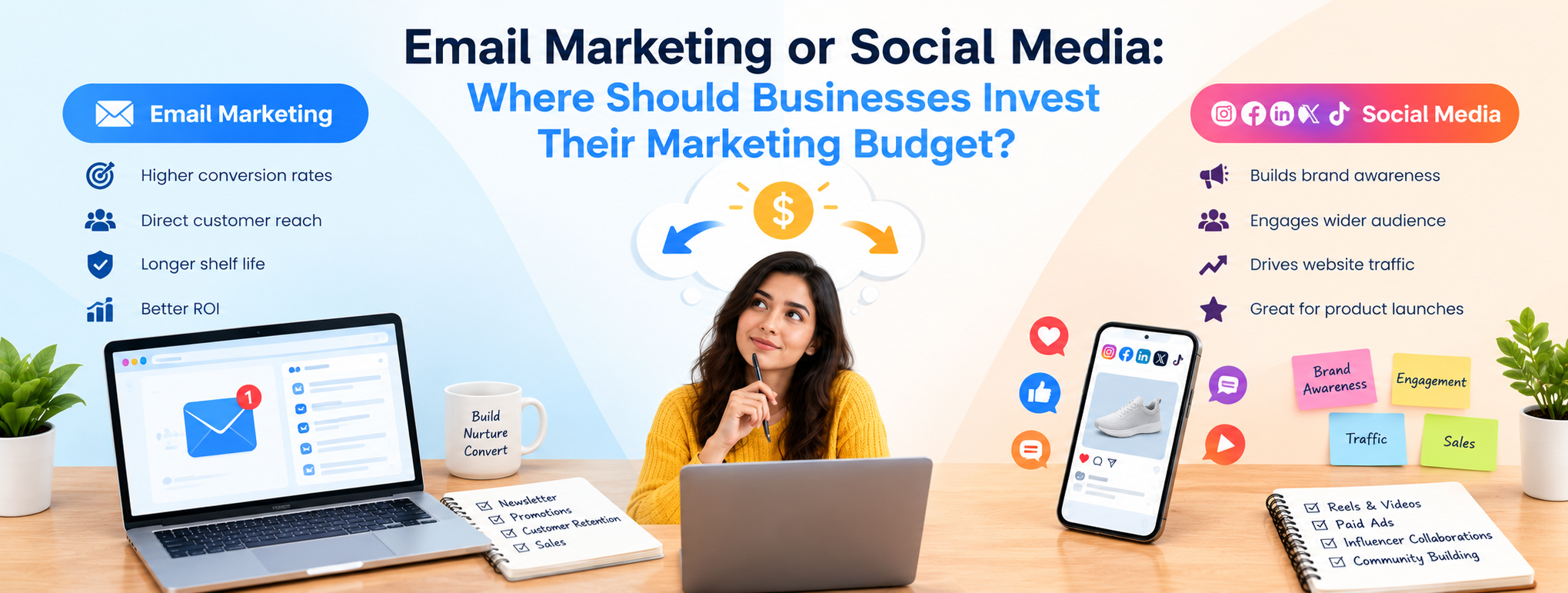
Every business owner eventually asks the same question: should marketing dollars go into email or social media? The email marketing vs social media marketing debate has been running for years, and most businesses still get the answer wrong, not because they pick the "worse" channel, but because they expect both channels to do the same job.
Here's the short version: email marketing consistently delivers a higher direct return, while social media marketing wins at getting your brand discovered by new audiences. Treating them as rivals fighting for the same rupee is the real budgeting mistake. In this guide, we'll break down real ROI numbers, engagement data, and a practical framework so you can decide, with confidence, exactly where your marketing budget should go.
Email Marketing vs Social Media Marketing: What's the Real Difference?
Before comparing numbers, it helps to understand what each channel is actually designed to do. They aren't interchangeable tools, they solve different problems in the customer journey.
What Is Email Marketing?
Email marketing is a direct, permission-based channel where businesses send messages straight to a subscriber's inbox. Because the recipient has already opted in, email marketing for small businesses tends to reach people who already know the brand and have shown some level of interest, making it a strong channel for driving action rather than just visibility.
What Is Social Media Marketing?
Social media marketing uses platforms like Instagram, Facebook, and LinkedIn to reach audiences through organic posts and paid ads. It works on interest and behavior signals rather than explicit permission. Someone scrolling their feed isn't necessarily looking to buy, they're browsing, and a well-placed post or ad can spark curiosity that leads to a future purchase.
Understanding this distinction is the foundation of any sound digital marketing budget allocation strategy. One channel opens the relationship; the other closes it.
Email Marketing Benefits for Businesses
When businesses evaluate email marketing benefits for businesses, a few advantages stand out consistently:
- Direct ownership of the audience — your subscriber list belongs to you, not a platform algorithm that can change overnight.
- Higher intent recipients — subscribers already opted in, so messages land with people who chose to hear from you.
- Low, predictable cost — most email platforms charge based on list size or send volume, not per click or impression.
- Strong personalization and segmentation — you can tailor messages by purchase history, location, or behavior.
- Automation that compounds — welcome series, cart-recovery emails, and post-purchase flows keep working long after setup.
- Measurable performance — opens, clicks, and conversions are trackable at an individual level.
For businesses running email campaigns for businesses at scale, these advantages translate into a channel that rewards consistency far more than constant ad spend does.
Social Media Marketing Benefits for Businesses
That doesn't mean social media doesn't earn its place. The social media marketing benefits for businesses are different but genuinely valuable:
- Massive discovery potential - you reach people who've never heard of your brand.
- Visual storytelling - products, culture, and personality come through in ways email can't easily replicate.
- Community and real-time engagement - comments, shares, and DMs build relationships in public view.
- Targeting precision on paid campaigns - interest, behavior, and lookalike targeting narrow your audience effectively.
- Brand awareness at scale - even without a purchase, repeated exposure builds recognition and trust over time.
Social media advertising for businesses is particularly effective for reaching cold audiences who wouldn't find you through search or referral. It's the top of the funnel that eventually feeds your email list, not a replacement for it.
Email Marketing ROI vs Social Media ROI: The Numbers That Matter
This is where the email marketing vs social media ROI comparison gets concrete. Multiple industry studies point in the same direction: email marketing consistently outperforms social media on direct return.
| Metric | Email Marketing | Social Media Marketing |
|---|---|---|
| Average ROI | Roughly ₹36–₹42 back for every ₹1 spent | Roughly ₹2–₹3 back for every ₹1 spent (paid) |
| Average conversion rate | Around 4% | Around 0.5%–0.6% |
| Organic reach | Near-total (deliverability aside) | Typically 2%–9% of followers |
| Cost structure | Low, mostly fixed platform fee | Scales directly with ad spend |
| Audience ownership | Fully owned by the business | Controlled by the platform |
| Core strength | Conversion, retention, repeat revenue | Discovery, awareness, reach |
The email marketing ROI advantage comes down to trust and access. Subscribers already gave permission to be contacted, so there's no algorithm to fight for visibility, the message lands directly where people check multiple times a day.
Social media marketing ROI, on the other hand, is harder to measure in pure revenue terms because much of its value shows up indirectly: brand recall, new followers, and future website visits that convert weeks or months later. Judging social purely on immediate sales undersells what it actually does well.
Customer Engagement: Email vs Social Media
Customer engagement through email tends to be quieter but more consistent. A well-timed email with a relevant offer or update gets read, clicked, and acted on by people who already trust the brand. Segmentation makes this even more effective, a returning customer gets a different message than a first-time visitor.
Customer engagement through social media is louder and more public. Comments, shares, tags, and reactions create visible social proof that email can't replicate. A single viral post can generate more brand exposure in a day than months of email sends. But that engagement is often shallow, a like doesn't equal a sale the way an email click-through often does.
The two forms of engagement complement each other. Social media sparks initial interest; email deepens the relationship and moves people toward a decision.
Lead Generation: Email Marketing vs Social Media Marketing
When it comes to email marketing lead generation, the channel shines at nurturing leads who are already partway down the funnel, think newsletter sign-ups, downloaded resources, or cart abandoners who need one more nudge.
Social media lead generation works differently. Lead ads, gated content promotions, and interactive posts pull in cold traffic that hasn't engaged with the brand before. This is genuinely valuable, but those leads usually need further nurturing (often through email) before they convert.
In practice, the strongest lead-generation systems use social media to capture attention and email to convert it. Treating them as separate, competing strategies leaves conversions on the table.
Customer Retention vs Customer Acquisition
Here's a distinction many businesses miss: email tends to excel at email marketing customer retention, while social media often drives social media customer acquisition.
Retention through email happens through:
- Loyalty and repeat-purchase campaigns
- Personalized product recommendations based on past behavior
- Win-back sequences for inactive customers
Acquisition through social media happens through:
- Paid ads targeting new, relevant audiences
- Influencer and creator partnerships
- Shareable, algorithm-friendly content formats
A business that only acquires through social media but never retains through email is constantly paying to refill a leaky bucket. Pairing acquisition with retention is what actually compounds growth over time.
How to Decide: Digital Marketing Budget Allocation for Small Businesses
So how should a business actually decide? Here's a practical step-by-step approach to digital marketing budget allocation:
Step 1: Audit What You Already Have
Check whether email automations (welcome series, abandoned cart, post-purchase) already exist. If not, this is usually the highest-return gap to fix first, regardless of total budget.
Step 2: Assess Your Discovery Need
If your brand already has strong word-of-mouth or search visibility, social media can run leaner. If you're newer or in a competitive category, society deserves a larger share to build initial awareness.
Step 3: Set Different Success Metrics for Each Channel
Judge email on conversions and revenue attributed. Judge social media on reach, engagement, and new leads generated, not immediate sales.
Step 4: Start With a Reasonable Split
A commonly recommended starting point for marketing budget for small businesses is to fully fund core email automations first, since they're typically the highest-ROI and most under-resourced asset, before scaling paid social spend.
Step 5: Revisit Quarterly
As your email list grows and social following builds, the ideal split shifts. Businesses with thin lists should temporarily lean toward social to build reach; businesses with a large, underused list should shift dollars toward email.
Marketing Budget for Small Businesses: A Practical Example
Consider a small D2C brand with a modest monthly marketing budget. A workable starting email marketing strategy and social media marketing strategy combination might look like this:
- 50–60% to email marketing - building segmented lists, setting up automation flows, and running regular campaigns.
- 30–40% to social media marketing - a mix of organic content and small, targeted paid campaigns focused on discovery.
- 10% held back for testing - new formats, offers, or channels based on quarterly performance review.
This isn't a universal formula, an early-stage business with almost no email list may need to temporarily flip this ratio to build an audience first. The principle that matters more than the exact numbers is this: fund the channel that's underbuilt relative to its potential return.
Best Marketing Channel for Businesses: Is There a Clear Winner?
If you're searching for the single best marketing channel for businesses, the honest answer is that there isn't one, because email and social media aren't solving the same problem. Email wins on direct ROI and retention. Social media wins on reach and discovery. A business that picks only one is deliberately leaving half the customer journey unaddressed.
The businesses that grow fastest treat email and social as a connected system: social media brings people in, email keeps them engaged and converts them, and the data from both channels informs the next campaign on either side.
Common Mistakes Businesses Make with Email and Social Media Budgets
- Expecting social media to behave like email. Judging a discovery channel by direct sales alone leads to premature budget cuts.
- Building a list and never emailing it. An inactive list is a wasted asset sitting idle.
- Ignoring automation. Manual, one-off email campaigns underperform automated flows by a wide margin.
- Treating the split as permanent. Budget allocation should shift as your list, following, and business stage change.
- Measuring everything by vanity metrics. Followers and likes look good but don't always translate into revenue, track what actually converts.
Getting this balance right is exactly the kind of strategic work a well-planned content marketing services approach can support, aligning email and social content so they reinforce each other instead of competing for attention.
Why This Comparison Matters for Your Business
Understanding the email marketing vs social media advertising trade-off isn't just an academic exercise, it directly affects how efficiently your marketing budget turns into revenue. Businesses that split spend based on actual channel strengths, rather than trends or guesswork, consistently see better cost-per-acquisition and stronger long-term retention. This kind of budget clarity is especially valuable for Indian businesses balancing tight marketing budgets against the need to compete with larger, better-funded competitors online.
FAQs About Email Marketing vs Social Media Marketing
Q1: Should businesses choose only one channel, email or social media?
No. Email typically delivers stronger direct ROI, but social media does the discovery and awareness work that eventually feeds your email list. Most businesses benefit from running both, with a budget split based on their current goals.
Q2: Which has better ROI, email marketing or social media marketing?
Email marketing generally delivers a significantly higher average ROI than social media, largely because it reaches an audience that has already opted in, avoiding the cost of competing for algorithmic visibility.
Q3: How much of my marketing budget should go toward email marketing?
There's no fixed percentage that works for every business, but a good starting principle is to fully fund core email automations first, since they're usually the highest-return, most underused asset, before scaling social ad spend.
Q4: Is social media marketing still worth it if organic reach has dropped?
Yes. Organic reach has declined across most platforms, but social media still plays a key role in awareness and lead generation. It should be measured on engagement and new audience growth, not direct sales alone.
Q5: What's the biggest mistake businesses make when comparing these two channels?
Judging both channels by the same metric. Email is a conversion tool; social media is a discovery tool. Measuring social media by immediate sales, the way you'd measure email, almost always makes it look like it's underperforming.
Q6: How do I know if my business needs more email or more social media investment right now?
If you have a sizable email list that you rarely message and no automated flows, fix email first. If your list is small and brand awareness is low, social media deserves a bigger share of the budget to build the audience email will later convert.
Conclusion
The email marketing vs social media marketing question isn't really about picking a winner, it's about understanding what each channel is built to do and funding it accordingly. Email converts and retains; social media discovers and builds awareness. Businesses that split their budget based on these strengths, rather than trends or assumptions, consistently get more value from every rupee spent.
If you're unsure how to structure your digital marketing budget allocation or want a data-backed strategy tailored to your business, our team at Cronbay Tech, a trusted SEO company in Bangalore, can help you build a channel mix that actually drives measurable growth.

.png)