
You have written the perfect subject line, polished the copy and tested every link. Then the campaign goes out, and the open rate is nowhere near what you hoped for. Often the problem isn't the email. It's when you sent it.
Finding the best time to send marketing emails is one of the cheapest ways to lift performance, because it costs nothing to change a schedule. The right slot puts your message at the top of the inbox, when subscribers are ready to read. The wrong slot buries it under everything that arrived after.
There is no universal answer, though. Large studies disagree, and the "best" time depends on your audience, your goal and your list. This guide gives you data-backed starting points, then shows you how to find the optimal send time for your subscribers.
In this guide:
- The short answer
- Why send time matters
- Best day to send marketing emails
- Best hour to send marketing emails
- B2B vs B2C timing
- Timing by industry
- Timing by email type
- Time zones, devices and Apple Mail Privacy Protection
- How to find your best send time (5 steps)
- Common mistakes
- FAQs
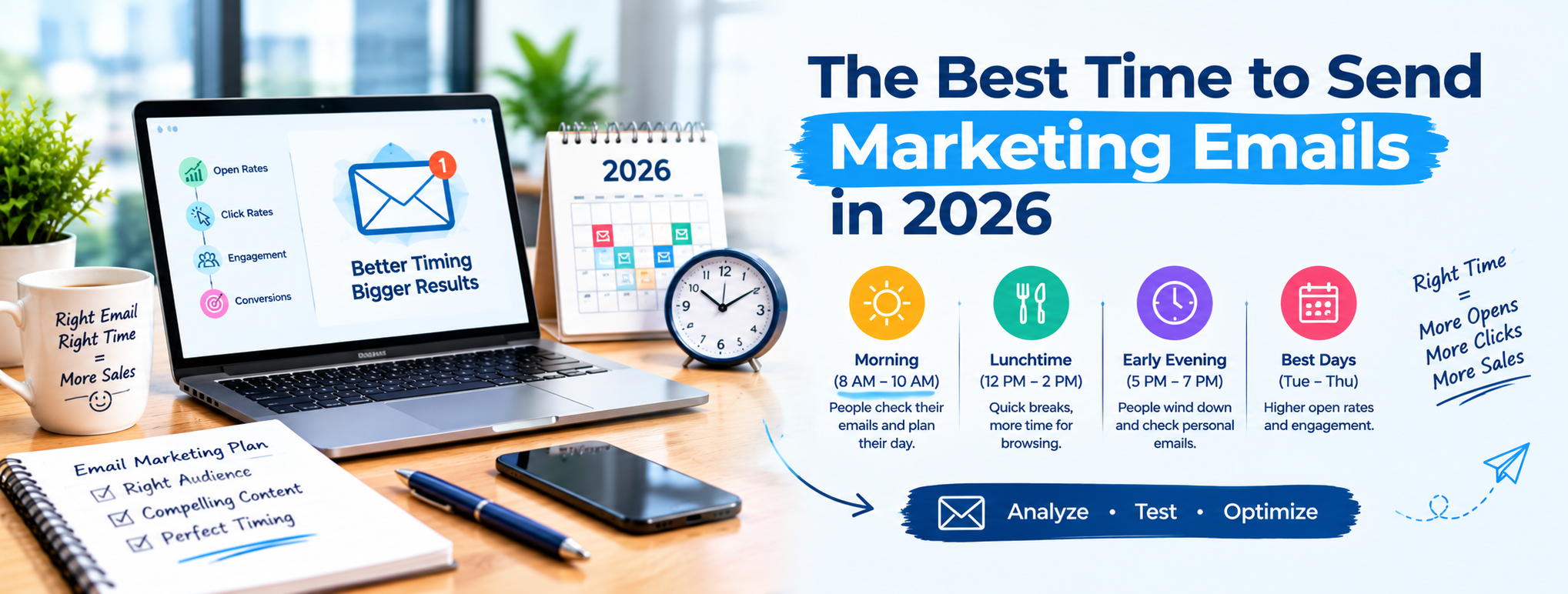
Tuesday to Thursday, between 9 AM and 11 AM in the recipient's local time.
Every major benchmark points to this window opening. Mailchimp's send-time data puts its system-wide peak at 10 AM. MailerLite's analysis of more than two million campaigns shows weekday opens peaking between 8 AM and 11 AM. Mailjet's research, drawn from billions of emails, finds midweek dominating both opens and clicks.
The catch is that opens and clicks peak at different times. In MailerLite's data, clicks cluster in the evening, around 8 to 9 PM. Omnisend's ecommerce-focused data points to early morning (7 to 8 AM) and mid-afternoon (4 PM) for clicks. So the best time for marketing emails depends on what you want the email to do.
| Your goal | Best days | Best window (recipient's local time) |
|---|---|---|
| Newsletters (get read) | Tue to Thu | 9 to 11 AM |
| Promotions (get clicks) | Tue, Fri | Test 6 to 8 AM vs 6 to 9 PM |
| B2B campaigns | Tue to Thu | 9 AM to 12 PM |
| B2C and ecommerce | Tue to Fri | 9 to 11 AM or 5 to 8 PM |
| Cold and sales outreach | Tue to Thu | 8 to 10 AM |
| Automated emails | Not clock-based | Minutes to days after the trigger |
Treat this table as a hypothesis, not a rule. The rest of this guide explains why, and how to prove it on your own list.
Why email send time matters
Timing affects results through inbox position. Subscribers who open their inbox see the newest messages first. If your email arrives while they're active, it sits near the top. If it lands overnight, it sits below everything that followed, and many people skim or bulk-delete in the morning.
MailerLite reports that most openings for a campaign happen within the first hour of delivery. That is why the hour usually matters more than the day. Sending at the right moment influences three core metrics:
- Email open rate: The first hurdle. A message near the top of the inbox is far more likely to be seen.
- Email click-through rate: Even if people open, they need the time and attention to act. Sending when subscribers are rushed or distracted suppresses clicks.
- Email engagement over time: Consistently poor timing teaches subscribers to ignore you. Consistently good timing builds the habit of opening.
Good timing also feeds deliverability. Inbox providers watch how people interact with your messages, and steady engagement helps future emails land in the primary tab instead of the promotions folder or spam.
Timing is only one piece of a wider email marketing strategy. It won't rescue a weak offer or an irrelevant list. It will help a good campaign perform better.
Best day to send marketing emails
Tuesday, Wednesday and Thursday lead
Across major datasets, midweek days win. Mailjet's analysis found that Tuesday through Thursday delivered the highest open and click rates, with Tuesday and Thursday slightly ahead and Wednesday a strong second.
The gap between weekdays is small, though. Sender's comparison of MailerLite and Omnisend data shows weekday open rates within about two percentage points of each other. So the best day to send marketing emails matters less than the hour and the audience.
Friday beats Monday
Marketers often assume both days are bad. The data disagrees. Mailjet found Friday outperforming Monday on open and click rates. MailerLite's 2025 data shows Friday with a marginally higher average open rate than Monday. Omnisend's 2026 data gives Friday a higher conversion rate than Monday.
Monday inboxes are crowded with weekend backlog, and people are planning their week. Friday can work well for promotional offers, especially if you want subscribers thinking about the weekend.
Weekends: usually weaker, sometimes useful
Saturday and Sunday generally show the weakest engagement for action. Emails aren't a priority when people are socialising or running errands. Two exceptions:
- Lighter content, like newsletters and inspiration, can suit weekends.
- Low competition can help. Fewer brands send on Saturdays and Sundays, so your email faces less inbox clutter.
Avoid the same-day trap
Thursday tends to carry the highest volume from marketers, so inbox competition is heavy. If your list is large enough to test, try Tuesday or Wednesday against Thursday and compare.
If you send twice a week, Mailjet suggests spacing the sends (Tuesday and Thursday rather than back-to-back days) so subscribers don't feel overwhelmed.
Key takeaway: For an unsegmented list, Tuesday to Thursday is the safest default. Then test Friday and the weekend for specific content types.
Best hour to send marketing emails
The best hour to send marketing emails is where the benchmarks diverge most, so here is how each window tends to behave.
6 to 8 AM: early risers and commuters. This works if your audience reads at the start of the day or on mobile while commuting. Omnisend's 2026 data shows click and conversion peaks in the early morning for ecommerce. Avoid sending before 6 AM, when your email lands under the overnight backlog.
9 to 11 AM: the reliable default. Mailchimp, MailerLite, Omnisend and HubSpot's survey all point to this window for opens. In Mailjet's survey, more users said they check email in the morning than at any other time. People are at their desks and have started clearing their inbox.
12 to 2 PM: lunch-break browsing. Good for B2C content people read on a break, and workable for B2B.
3 to 6 PM: the afternoon window. Mailjet's data shows this range performing well, and Omnisend records 4 PM as a strong click hour. It's useful for reaching audiences across several time zones.
7 to 9 PM: evening clicks. MailerLite's data shows clicks peaking at 8 to 9 PM. Evening suits B2C audiences browsing at home, but it is a poor slot for B2B, where your email would sit unread until the next morning.
After 9 PM: usually avoid. The email is unlikely to be read immediately and will be buried by morning.
Opens and clicks peak at different times
This is the most useful insight in the research. A 10 AM send maximises visibility, while an early-morning or evening send may maximise action.
- If the email's job is to be read (newsletter, announcement), send mid-morning.
- If its job is to be clicked (sale, launch, event), test the click windows: early morning against late afternoon and evening.
Use click-through rate and click-to-open rate, not open rate alone, to decide.
B2B vs B2C: how your audience changes the answer
People use work and personal inboxes differently, so when to send marketing emails depends heavily on who receives them.
B2B marketing emails
Business audiences engage during working hours.
- Best days: Tuesday to Thursday. Mondays are for catching up, and Fridays for wrapping up.
- Best times: 9 AM to 12 PM, with a secondary window after lunch.
- Avoid: Evenings and weekends, when emails sink to the bottom of Monday's inbox.
HubSpot's 2025 survey found that a large share of B2B marketers see their best engagement in the morning. That is survey data from marketers, not send logs, so treat it as directional.
B2C marketing emails
Consumers read on their own schedule.
- Best days: Tuesday to Friday, with weekends worth testing for promotions.
- Best times: Mid-morning (9 to 11 AM) or after work (5 to 8 PM).
- Behaviour: Consumers often browse on mobile during commutes, lunch and evenings.
Salesforce notes that retail and leisure audiences often respond in the late afternoon and evening, including Thursday evenings, when people begin planning the weekend.
Ask yourself: Are your subscribers on work or personal addresses? Do they read on phones during commutes or at desks? Answering these questions narrows your test windows quickly.
Best time to send marketing emails by industry
Industry benchmarks are a starting point. Your own data always wins. With that caveat, patterns from Mailchimp, MailerLite and Salesforce suggest:
- Retail and ecommerce: Late morning to early afternoon, Thursday to Saturday (Mailchimp), or late afternoon and early evening on weekdays (Salesforce). MailerLite's ecommerce data shows Tuesday 4 PM as a strong click slot. Open peaks in this segment are scattered, so judge by clicks and orders.
- B2B and SaaS: Tuesday and Wednesday mornings.
- Healthcare: Professionals work long, irregular shifts, so early mornings or late evenings, outside peak working hours, may catch them.
- Education, government and nonprofits: MailerLite's institutional segment peaked early on Friday mornings. Mailchimp suggests evenings and weekends for nonprofits when supporters have free time.
- Creators and newsletters: Evening clicks stand out in MailerLite's creator segment, particularly Sunday to Tuesday nights.
- Travel and leisure: Weekends and evenings, when people plan trips.
These segments come from different platforms with different audiences, so numbers aren't directly comparable. Pick the benchmark that most resembles your list.
Best time to send marketing emails by email type
The type of email sets your timing before the calendar does.
Promotional campaigns and newsletters
Newsletters suit Tuesday and Wednesday mornings. Promotions are judged on clicks and revenue, so test the click windows. A useful trick is to resend to non-openers 24 to 48 hours later with a new subject line. Exclude people who clicked, not just those who opened, because Apple's privacy features inflate.
Cold and sales emails
Tuesday to Thursday, 8 to 10 AM in the recipient's local time. Measure replies, not opens. The classic mistake is scheduling in your own time zone, so an 8 AM send from one coast lands at 5 AM on the other.
Welcome emails
Send within minutes of signup, while interest is highest. This is a trigger, not a scheduled slot.
Abandoned cart emails
A common sequence is one email about an hour after abandonment, a second after 24 hours, and a final one several days later with an incentive. These are practitioner conventions rather than proven optima, so test them. Add a delivery window so a 24-hour delay doesn't fire at 2 AM.
Follow-ups
Wait three to four days after an unanswered message, and adjust based on your sales cycle.
The rule: automated emails are timed by delays, campaigns by the clock. Don't apply day-of-week benchmarks to triggered flows.
Time zones, devices and Apple Mail Privacy Protection
Three factors quietly distort send-time decisions.
1. Time zones
A 10 AM send from Bengaluru is early morning in London and the middle of the night on the US East Coast. If your list spans regions, use time-zone-based delivery, or segment by country and schedule separately. Mailjet's survey shows habits differ by culture: German respondents were far more likely to check email in the early evening than Spanish respondents, who leaned toward late evening.
For an India-focused list, start by testing 9 to 11 AM IST, then early evening after working hours. For a global list, split by region rather than choosing one compromise time.
2. Devices
According to Litmus data cited by Sender, mobile clients account for around 42% of opens, webmail for around 41% and desktop for around 16%. Mobile readers tend to open on commutes and in the evening but defer longer tasks. Desktop readers complete forms and purchases more readily. If your list is mostly mobile, test evening sends and keep the email to a single clear action.
3. Apple Mail Privacy Protection
Since Apple's privacy update in September 2021, Apple's servers preload tracking pixels for users who opt in. That registers an "open" whether or not the person reads anything. It's why open rates across platforms look inflated and unreliable.
What to do: When judging send-time tests, weight click rate, click-to-open rate and conversions above raw opens. This matters most if a large share of your subscribers use Apple Mail.
How to find your best send time: a 5-step framework
Benchmarks give you a starting point. Your own data gives you the answer.
Step 1: Audit your baseline
Review three to six months of campaigns. Note opens, clicks and conversions by day and hour, and separate newsletters from promotions. Most email platforms show hourly engagement, so you can see when your audience interacts. Record your current send times so you can measure improvement later.
Step 2: Run send-time A/B tests
Change only the send time. Keep the subject line, content and audience identical. Start broad (morning vs afternoon, or weekday vs weekend) before narrowing to specific hours. A simple test: send at 10 AM one week, 1 PM the next and 7 PM the week after. Or split your list in half and send the same email at two different times on the same day.
Aim for roughly 1,000 recipients per group so results aren't just noise. If your list is smaller, use the Tuesday to Thursday morning default and keep collecting data.
Step 3: Use send-time optimisation where available
Many platforms, including Mailchimp, HubSpot, Klaviyo and Brevo, offer send-time optimisation (STO). It predicts the best moment for each subscriber based on their history. Vendors often report gains of around 10 to 25% in engagement, though that varies and comes from the tools' own claims. Use STO for evergreen campaigns, and manual timing for launches where everyone needs the message at once.
Step 4: Verify across multiple sends
One winning send proves little. Repeat the comparison across at least three sends to the same segment. If nothing improves after several rounds, timing may not be your bottleneck. Check subject lines, list quality, unsubscribe rates and inbox placement instead.
Step 5: Retest seasonally
Habits change around holidays, sale seasons and industry cycles. Review monthly and retest quarterly. Don't over-optimise: the difference between 9:00 and 9:15 AM rarely matters.
Measuring what matters
Track these metrics to see whether timing changes are working:
- Open rate: Interest in your subject line, but unreliable on its own because of Apple MPP.
- Click-through rate (CTR): Clicks divided by delivered emails.
- Click-to-open rate (CTOR): Clicks divided by opens. A high open rate with a low CTOR means people saw your email but deferred acting on it.
- Conversion rate: The share who completes your goal, such as a purchase or signup.
- Unsubscribe and bounce rates: Early warnings that timing or frequency is off.
Benchmarks vary widely. HubSpot's cited averages put open rates around 21%, clicks near 7.8% and conversion around 1.33%, but your industry and audience will shift these. Compare against your own history first.
Common mistakes to avoid
Sending everything at once in one time zone. This is the fastest way to reach half your list at the wrong hour.
Trusting one benchmark blindly. Studies disagree because they measure different audiences. Use them to form hypotheses.
Judging tests by open rate alone. Apple's privacy features inflate. Look at clicks and conversions.
Changing the schedule constantly. Mailjet advises sending recurring newsletters on the same day each week, building anticipation. Break the pattern only for holidays or special events.
Ignoring inbox competition. Black Friday and major sale days flood inboxes. Consider earlier sends or unusual slots.
Testing too small. With only a few hundred subscribers per group, differences are mostly noise.
Forgetting frequency. The best time won't help if you send too often. Watch unsubscribe rates when you increase volume.
Turn email timing into a growth system
Send-time optimization works best when your emails are worth opening. That depends on strong content, a healthy list and traffic that keeps it growing.
Email and search reinforce each other. Search brings in people who join your list, and email brings readers back to your content, which lifts engagement signals across your site. To make that loop work, build content around clusters of related topics instead of isolated posts. Our guide to topical authority in SEO shows how. Promoting those pieces beyond your own list, through off-page SEO techniques, widens the pool of subscribers you can email in the first place.
Search is also changing how audiences find you. If you want your content to surface in AI-driven results as well as classic search, run through our AI SEO checklist for 2026 before you publish.
Frequently Asked Questions
What is the best time to send marketing emails?
For most lists, Tuesday to Thursday between 9 and 11 AM in the recipient's local time. Treat this as a starting hypothesis and test against your own data.
What is the best day to send marketing emails?
Tuesday through Thursday perform best in most studies, and the gap between weekdays is small. Friday often outperforms Monday.
Is it better to send emails in the morning or evening?
Mornings tend to win for opens. Clicks may peak in the early morning or evening depending on your audience. Test both.
What is the worst time to send marketing emails?
Late night and the small hours, roughly before 6 AM and after 9 PM. Emails sent then are buried by the time people wake.
How often should I send marketing emails?
It depends on your audience and content. Start with a consistent weekly or fortnightly cadence, and watch unsubscribe rates before increasing frequency.
Does send time affect deliverability?
Indirectly. Better engagement sends positive signals to inbox providers. Sending very large batches at once can also trigger throttling, so consider staggering big sends.
Should I use send-time optimization?
Usually yes for regular campaigns, provided your platform offers it and your list is large enough. Use fixed timing for time-critical announcements.
Conclusion: your best time is the one your data proves
The best time to send marketing emails isn't one magic hour. It's a mid-morning weekday default, refined by your audience, your goal, your time zones and your test results.
To recap:
- Start with Tuesday to Thursday, 9 to 11 AM local time.
- Match timing to the goal. Read-focused emails go mid-morning, and click-focused emails deserve a morning vs evening test.
- Segment by time zone, B2B vs B2C and device.
- Judge tests by clicks and conversions, not opens alone.
- Retest regularly. Audience habits change.
Once your send times are dialled in, the next lever is growing the audience you're emailing. At Cronbay Technologies, our SEO company in Bangalore team helps businesses attract qualified visitors who turn into subscribers and customers. Our full range of SEO services covers strategy, on-page work and link building. If your site has crawl, speed or indexing problems holding back traffic, our technical SEO services in Bangalore can fix the foundations. Online stores can grow product-page visibility with our ecommerce SEO services in Bangalore, and our content marketing services build the content your emails and search rankings both depend on.
Still choosing a partner? Compare your options in our roundup of the top 10 SEO companies in Bangalore for 2026.

.png)