
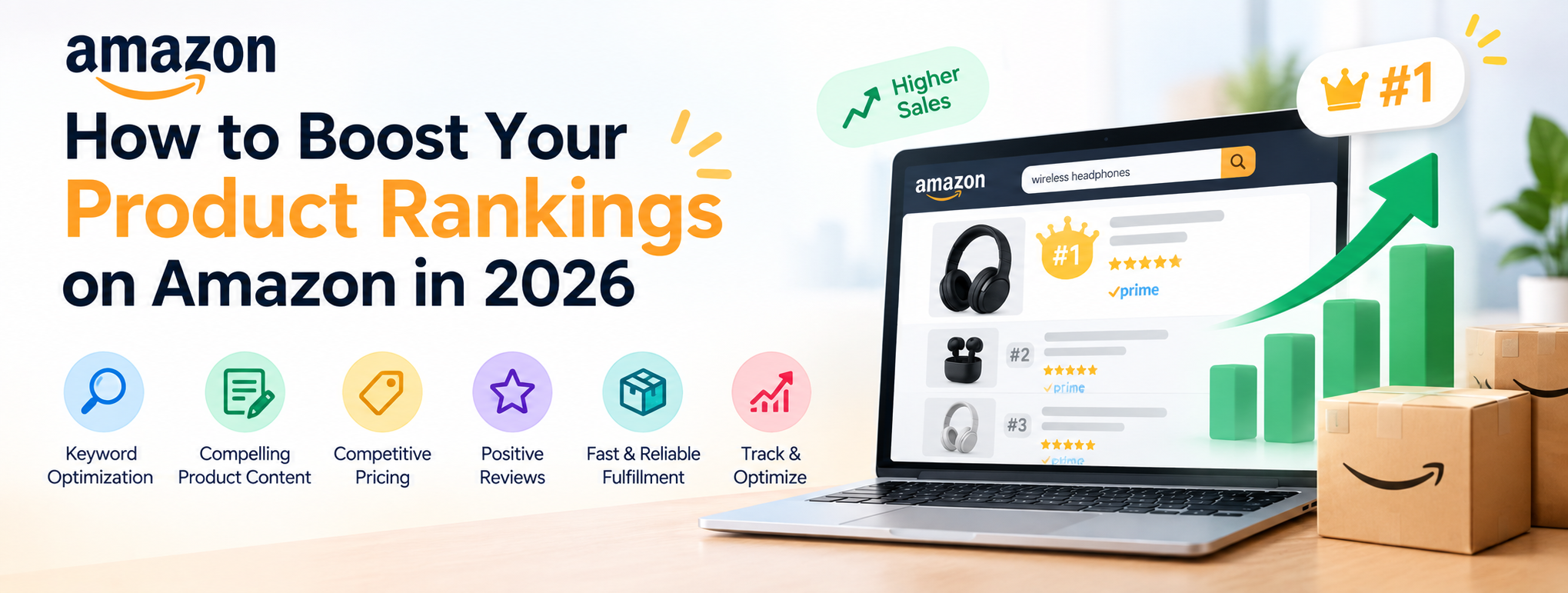
If your product isn't on the first page of Amazon search results, most shoppers will never see it. Amazon product ranking decides which listings get visibility, clicks and orders. In 2026, competition is heavier than ever, and shoppers compare, filter and buy in seconds.
The good news is that Amazon ranking is not a mystery. It follows a clear logic: show shoppers the products most relevant to their search and most likely to result in a purchase. Every tactic in this guide serves one of those two goals.
This guide covers how the Amazon search algorithm works, which ranking factors matter, and how to optimize each part of your listing. It also covers how to build sales momentum and what results to expect.
What Is Amazon Product Ranking?
Amazon product ranking is the position your listing holds in search results for a given keyword. Rank #3 for "stainless steel water bottle" and you get a large share of that keyword's traffic. Rank #43 and you get almost none.
There are two kinds of ranking to track:
- Search rank: where you appear for a specific keyword.
- Best Sellers Rank (BSR): how well you sell within your category compared to competitors.
Amazon SEO 2026 is the practice of improving both, so your products earn organic visibility without depending entirely on paid ads. If you know how Google's search intent and topical relevance work, you'll recognize the parallels. Amazon is a search engine, but one that is built to sell.
How the Amazon Search Algorithm Works in 2026
Amazon's search algorithm is often called A9 or A10 in the seller community. Amazon doesn't publish its ranking formula, so treat any exact percentage weights you see online as estimates. What we do know from Amazon's own guidance and seller data is that ranking rests on two pillars:
- Relevance: does your listing match what the shopper typed? This is driven by your title, bullets, description and backend keywords.
- Performance: does your listing turn views into sales? This is driven by click-through rate, conversion rate, sales history, reviews, price and availability.
A product with perfect keywords but poor conversion will slip. A product that converts well but isn't indexed for the right keywords will never get seen. You need both.
Amazon's search also increasingly rewards shopper satisfaction signals: fast delivery, low return rates, good reviews and strong account health. Amazon wants shoppers to buy, be happy, and come back.
Amazon Ranking Factors That Matter Most
Here are the Amazon ranking factors that consistently influence organic position, roughly in order of impact:
1. Keyword relevance. Your listing must contain the terms shoppers actually use, in the right places. This is the entry ticket: without indexing, you can't rank.
2. Sales velocity. Products that sell steadily rank higher. Consistency matters more than one-day spikes.
3. Conversion rate. If a high share of visitors buy, Amazon sees your listing as a good result and pushes it up. Amazon conversion rate optimization is therefore a ranking tactic, not just a sales tactic.
4. Click-through rate (CTR). Your main image, title, price and star rating decide whether a shopper clicks from the results page.
5. Reviews and ratings. Quantity, recency and star average all build trust and lift conversion.
6. Price competitiveness. Your price relative to similar products affects both clicks and purchases.
7. Availability and fulfillment. Stock-outs hurt ranking. Fast, reliable delivery (such as Fulfilled by Amazon) improves both conversion and Buy Box chances.
8. Content quality. Strong images, video and A+ Content improve conversion.
9. Seller performance. Order defect rate, cancellations and late shipments affect account health and visibility.
10. Off-Amazon traffic. Shoppers arriving from social media, blogs and search engines signal demand for your product.
The rest of this guide shows how to improve each one.
Step 1: Build Your Amazon Keyword Research Foundation
Amazon keyword research is the base of everything else. Get it wrong and every later optimization is aimed at the wrong target.
Where to find keywords:
- Amazon search suggestions. Type your product into the search bar and note the autocomplete phrases. These are real shopper queries.
- Competitor listings. Study titles and bullets of the top five to ten products in your niche. Note recurring terms, features and phrases.
- Amazon's own tools. Product Opportunity Explorer shows search trends and demand. Brand-registered sellers can use Brand Analytics, including Search Query Performance and Top Search Terms reports.
- Your own data. Once you're live, Sponsored Products search-term reports show exactly which queries led to clicks and sales.
- Third-party keyword tools, for search volume estimates and reverse ASIN lookups.
Sort keywords by intent. Short-tail keywords like "shoes" have high volume and high competition. Long-tail keywords like "waterproof trekking shoes for men size 9" have lower volume but far higher buying intent and less competition. New products should lean on long-tail phrases first, then move up. Our long-tail keyword strategy guide explains how to find and prioritize these.
Build a keyword map. Assign your one or two most important keywords to the title, your next tier to bullets, and the rest to the description and backend fields. Don't repeat the same phrase everywhere. Spread your coverage.
Think in your market's language. If you sell in India, include regional spellings, Hindi transliterations and common shorthand. Shoppers may type "kurta set for women" or "kurti set" for the same product, and your listing should cover both.
Step 2: Master Amazon Title Optimization
Your title is the highest-impact text on the listing. It affects both indexing and click-through rate.
A reliable structure:
Brand + Primary Keyword + Key Feature + Material/Size/Quantity + Color/Variant
Example: "Aurora Stainless Steel Water Bottle, 1 Litre, Leak-Proof, Insulated for 24 Hours, Matte Black"
Amazon product title optimization tips:
- Lead with what matters. Put your brand and primary keyword early, since truncated titles on mobile show only the first part.
- Mind the character limits. Amazon allows up to 200 characters in many categories, but its own guidance recommends staying much shorter for readability. Check your category's rules.
- Write for humans first. A title stuffed with repeated keywords reads badly, lowers CTR and can violate Amazon's style guidelines.
- Avoid promotional claims. Terms like "best seller" or "free shipping" are typically not allowed.
- Test variations. Brand-registered sellers can use Manage Your Experiments to A/B test titles and other content.
Step 3: Write Bullet Points That Rank and Convert
Bullets are read by both the algorithm and the shopper deciding whether to buy. They're often the last thing a customer reads before clicking "Add to Cart."
Best practices for Amazon bullet point optimization:
- Lead with the benefit. Start each bullet with a short capitalized phrase such as "24-HOUR INSULATION" and follow with detail.
- One idea per bullet. Cover material, key features, sizing, use cases, compatibility and what's in the box.
- Weave in secondary keywords naturally. Use them where they make sense, not in forced lists.
- Answer objections. Use bullets to address doubts that appear in questions and negative reviews: fit, durability, cleaning, warranty.
- Keep them scannable. Long paragraphs in bullets are skipped, especially on mobile.
Step 4: Optimize Descriptions and A+ Content
Amazon product description optimization is a chance to add depth, long-tail keywords and use-case scenarios that don't fit in bullets. Cover materials, dimensions, care instructions, warranty and who the product is best for. Write naturally, since keyword stuffing can hurt both readability and rankings.
Amazon A+ Content adds rich images, comparison charts, lifestyle visuals and brand storytelling to the page. It's available to brand-registered sellers and is one of the most effective ways to raise conversion rate. Use it to:
- Show the product in real-life use.
- Add a comparison chart against your other variants.
- Explain differentiators that plain text can't convey.
- Reinforce trust with certifications, materials and guarantees.
A higher conversion rate feeds back into ranking, so A+ Content is an indirect but powerful SEO tool.
Step 5: Use Amazon Backend Keywords Correctly
Amazon backend keywords (also called search terms or generic keywords) are hidden fields in Seller Central. Shoppers never see them, but they help your listing index for additional searches.
How to use them well:
- Add synonyms, alternate names, abbreviations, common misspellings and regional variants.
- Don't repeat words already in your title or bullets. Repetition adds nothing.
- Skip brand names of competitors, subjective claims and irrelevant terms.
- Separate words with spaces, without commas.
- Stay inside the byte limit for your marketplace and category. On Amazon India this is commonly around 250 bytes, and exceeding it can cause the whole field to be ignored. Verify in Seller Central for your category.
Check your indexing. Search Amazon for your ASIN plus a target keyword. If your product doesn't appear, that keyword isn't indexed, so revisit your content and backend field.
Step 6: Invest in High-Quality Images and Video
Your main image is what wins the click in search results. Follow Amazon's image guidelines and go beyond them.
- Main image: pure white background, product filling roughly 85% of the frame, sharp and well-lit.
- Secondary images: show different angles, close-ups of key features, scale with a hand or common object, and lifestyle context.
- Infographics: highlight dimensions, materials and benefits.
- Video: short demos reduce uncertainty and raise conversion.
- Alt text: where available, add a simple descriptive sentence with one or two relevant keywords.
Look at your top competitors' results page. If every main image looks the same, find a compliant way to stand out through angle, lighting or product presentation.
Step 7: Price Competitively and Win the Buy Box
Price influences rankings through both CTR and conversion. Shoppers compare quickly, and a listing that looks overpriced loses clicks before the algorithm even sees a purchase.
- Research your competition. Track similar products and understand the accepted price range.
- Know your margins. Use the seller revenue calculator to account for referral fees, fulfillment and shipping before you discount.
- Use deals and coupons strategically. Coupons and promotions can raise CTR and give sales momentum, especially at launch.
- Protect your Buy Box. When multiple sellers offer the same product, the Featured Offer gets most of the orders. Competitive pricing, fast delivery, strong seller metrics and steady stock all help you win it.
Step 8: Improve Conversion Rate
Amazon conversion rate optimization is where many listings quietly win or lose. Two listings can have identical traffic, and the one that converts better will climb.
A quick conversion checklist:
- Clear, benefit-led title, bullets and images.
- Star rating of about 4 or higher.
- Competitive price and visible discounts.
- Answers to common questions in your content and Q&A.
- Fast delivery promise.
- A+ Content and video.
- Variants that cover the sizes and colors shoppers want.
Read your negative reviews and return feedback closely. They show you exactly where expectations and reality don't match, and fixing those gaps raises both conversion and ratings.
Step 9: Build Reviews and Social Proof
Reviews affect conversion, click-through and trust. Build them through legitimate means only.
- Deliver a product that matches its listing. This is the single best review strategy.
- Use Amazon's "Request a Review" button on eligible orders.
- Consider Amazon Vine if you're brand-registered and eligible.
- Include clear packaging inserts that help customers use the product, without asking for or incentivizing reviews in ways that break Amazon's policies.
Never buy reviews, offer incentives for positive ones, or manipulate ratings. Amazon actively enforces these rules and can suspend accounts.
Step 10: Balance Paid Ads and Organic Growth
Sponsored Products ads can jump-start visibility for new listings. They give you impressions, clicks and early sales, and the data they generate feeds your keyword research.
Use ads strategically:
- Start with a mix of broad, phrase and exact match campaigns.
- Review search-term reports weekly, adding winning terms to your listing and negating wasteful ones.
- Focus on keywords you also want to rank organically for.
- Gradually reduce dependence on ads as organic sales grow.
Ads are not a replacement for listing quality. If a listing has weak content and poor conversion, more ad spend just amplifies the problem.
Step 11: Drive External Traffic to Your Listing
Traffic from outside Amazon signals real demand and brings new shoppers to your listing. Options include:
- Blog and landing pages targeting purchase-intent searches, linking to your Amazon listing.
- Social media and influencer content with trackable links (Amazon Attribution can help measure results).
- Email and WhatsApp campaigns to existing customers.
- YouTube reviews and demonstrations.
A well-optimized site supports this. Solid technical SEO makes sure your landing pages load fast and get crawled properly, and off-page SEO techniques help those pages earn the authority to rank on Google. Also keep in mind that AI search tools are changing how shoppers discover products, so our AI SEO checklist for 2026 is worth a read.
Realistic Timeline for Improving Amazon Product Ranking
Results vary widely by category, competition and budget, so treat these as general expectations rather than guarantees:
| Phase | Typical Timeframe | Focus |
|---|---|---|
| Launch and indexing | Weeks 1–2 | Complete listing, verify keyword indexing |
| Momentum building | Weeks 3–8 | Ads, promotions, first reviews, conversion tuning |
| Organic growth | Months 3–6 | Long-tail page-one rankings, less ad dependence |
| Consolidation | Months 6–12 | Competing for primary keywords, protecting rank |
Highly competitive categories often take longer. Consistency, not shortcuts, is what wins.
Common Amazon Ranking Mistakes to Avoid
- Keyword stuffing titles and bullets until they're unreadable.
- Ignoring backend fields or filling them with repeated words.
- Running out of stock, which can erase hard-won ranking.
- Chasing only high-volume keywords with no chance of ranking.
- Poor images that look like every other listing.
- Neglecting reviews and returning feedback.
- Relying only on ads without fixing the listing.
- Never updating the listing. Search behavior changes, so review keywords and content regularly.
How to Track Your Amazon Search Ranking
Improvement needs measurement. Track these regularly:
- Keyword positions for your top 10–20 target terms.
- Impressions, clicks and CTR (Brand Analytics for eligible sellers).
- Conversion rate and unit session percentage.
- Best Sellers Rank over time.
- Ad search-term reports.
- Review count, rating and return reasons.
Review these monthly, and make one change at a time when you can, so you know what worked.
Frequently Asked Questions
Start with the basics: fix keyword gaps in your title, bullets and backend fields, improve your main image, and check your price against competitors. Then use ads and promotions to build early sales. Sustainable ranking still takes weeks to months.
Relevance and sales performance work together. Keywords get you into the results, and sales velocity and conversion decide how high you stay.
Ads can help by driving impressions and sales, which supports organic visibility. Organic sales usually matter more for long-term ranking, so use ads as a launchpad, not a permanent crutch.
Focus on a small set of primary keywords in the title, a broader set of secondary terms in bullets and description, and use backend fields for synonyms and variants. Relevance matters more than count.
Review it at least quarterly, and sooner if your rankings drop, competitors change or search trends shift.
Yes. An experienced team can handle keyword research, content optimization, technical setup and off-Amazon traffic. Look for agencies with real e-commerce experience.
Conclusion
Boosting your Amazon product ranking in 2026 comes down to a repeatable process. Research the right keywords, build a listing that's relevant and persuasive, and convert visitors into buyers. Then keep building momentum with reviews, smart advertising and off-Amazon traffic. Ranking is never finished, because competitors and algorithms keep moving.
If you'd rather have experts do the heavy lifting, Cronbay Tech can help. As an SEO company in Bangalore, we build Amazon SEO strategy and e-commerce SEO services that improve visibility, traffic and sales. You can also see how we compare in our roundup of the top 10 SEO companies in Bangalore.

.png)