
AI Search Visibility Tracking: How to Monitor Your Brand in ChatGPT & Google AI Overviews (2026 Guide)
Learn AI search visibility tracking step by step. See how to track brand mentions in ChatGPT and Google AI Overviews, the right tools, and how to improve GEO rankings.
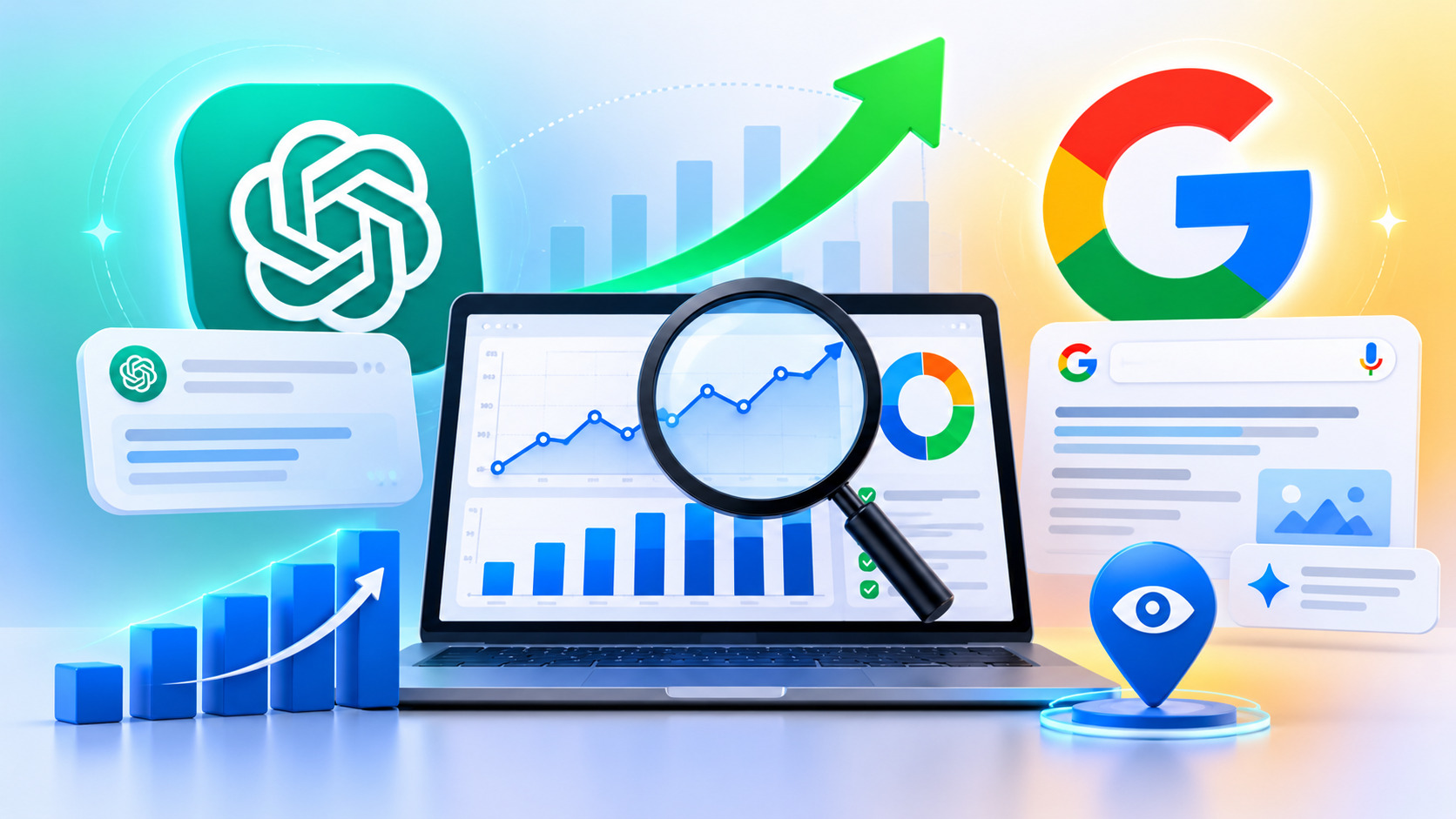
More buyers now ask ChatGPT or Google's AI Overviews a question before they ever type a normal search query. As a seo company in bangalore, we watch this shift happen in real client accounts every week, brands that used to show up on page one are suddenly invisible inside AI-generated answers. That is exactly what AI search visibility tracking solves. It is the practice of measuring whether, where, and how often your brand appears when people ask AI tools about your industry, your products, or your competitors.
If your team still only checks Google rankings, you are missing half the picture. This guide breaks down exactly how to track brand visibility in ChatGPT and Google AI Overviews, which metrics actually matter, which tools are worth paying for, and how to start improving your AI search rankings this quarter.
What Is AI Search Visibility Tracking?
AI search visibility tracking is the process of monitoring how often, how accurately, and how favorably a brand is mentioned, cited, or recommended inside AI-generated answers, including ChatGPT, Google AI Overviews, Google AI Mode, Gemini, Perplexity, and Microsoft Copilot.
Unlike classic rank tracking, which watches a position (#1, #4, #10) on a search results page, AI search monitoring looks at different signals:
- Mention rate — how often your brand name appears across a set of test prompts
- Citation rate — how often your website is linked as a source
- Share of voice — your mentions compared to competitors on the same prompts
- Sentiment — whether the AI describes your brand positively, neutrally, or negatively
- Position in the answer — mentioned first, buried in a list, or missing entirely
This discipline sits under the wider umbrella of Generative Engine Optimization (GEO), the practice of optimizing content so AI systems choose to cite it.
Why Brand Visibility in ChatGPT and Google AI Overviews Matters in 2026
This isn't a side trend anymore. A few numbers make the case:
- Google AI Overviews now appear on roughly 43–50% of US search queries, up sharply from around 15% just a year earlier, according to Similarweb and BrightEdge data cited widely across the SEO industry in 2026.
- Google's AI Overviews reach an estimated 2 billion monthly users, per Semrush research.
- Comparison-style queries ("X vs Y") trigger an AI overview over 95% of the time, and question-format queries trigger one close to 86% of the time, per Seer Interactive's query analysis.
- Pages that get cited inside an AI Overview have reportedly seen a meaningful bump in branded searches within 30 days, per Search Engine Journal research.
The pattern is simple: when a buyer asks an AI tool "best SEO company in Bangalore" or "how do I fix a core web vitals issue," the brand that gets named becomes the default answer, often before the user ever opens a browser tab. If you can't see whether you're being mentioned, you can't manage it, and that is the core argument for AI search monitoring as a permanent part of any digital marketing stack.
How Google AI Overviews and ChatGPT Decide What to Cite
Before tracking visibility, it helps to understand why AI systems pick certain sources over others. Three factors matter most:
- Clear, structured answers. Content written in a direct, FAQ-style format gets extracted more easily than long, meandering paragraphs.
- Specific data. Pages with real numbers, dates, and named sources are cited more than pages full of vague claims.
- Demonstrated expertise (EEAT). Author bylines, case studies, original research, and a track record of accurate content all raise the odds of being trusted as a citation source.
This is why a solid technical and content foundation, the same foundation used in traditional SEO services, still underpins AI search performance. GEO does not replace SEO; it builds on it.
How to Track Brand Visibility in ChatGPT
Step 1: Build a Prompt List
Start with 20–50 real prompts your buyers are likely to type, mixing categories:
- Branded ("Is [Brand] good for ecommerce SEO?")
- Category ("best SEO company in Bangalore")
- Comparison ("[Brand] vs [Competitor]")
- Problem-based ("how do I track my brand in AI search")
Step 2: Run the Prompts Manually (Free Method)
Ask each prompt in ChatGPT, note whether your brand appears, where it ranks in the list, and whether a link is included. Repeat weekly, since answers shift as models and data update.
Step 3: Use a Dedicated ChatGPT Brand Mentions Tool
Manual checks don't scale past a handful of prompts. Dedicated AI SEO tracking tools automate the process by re-running your prompt set on a schedule and logging results over time. Based on current market research, the tools worth shortlisting in 2026 include:
| Tool | What It's Best For |
|---|---|
| Profound | Enterprise-grade coverage across ChatGPT, Perplexity, Claude, Gemini, and AI Overviews |
| Otterly.ai | Startups and SMBs needing a simple, affordable starting point |
| Ahrefs Brand Radar | Teams already using Ahrefs for SEO who want AI visibility in the same dashboard |
| Semrush AI Visibility Toolkit | Agencies wanting AI tracking bundled with existing SEO reporting |
| SE Visible (SE Ranking) | Multi-brand or multi-client reporting at a mid-range budget |
| ZipTie | Focused, usage-based tracking across AI Overviews, ChatGPT, and Perplexity |
Most of these report on share of voice in AI search, citation sources, and sentiment, which gives you a repeatable scorecard instead of a one-off snapshot.
How to Track Brand Visibility in Google AI Overviews
Google AI Overview visibility tracking follows a similar logic but with one extra layer: Overviews are tied to live search queries, so you can cross-check against your existing keyword rankings.
Step-by-step process:
- Pull your top 50–100 keywords from Google Search Console or your rank tracker.
- Check which queries currently trigger an AI Overview. Informational, question-based, and "vs" queries are the most likely.
- Record whether your page is cited inside the overview and in what position among the linked sources.
- Track changes weekly. AI Overviews change faster than organic rankings, so a monthly check will miss a lot.
- Benchmark against competitors appearing in the same overviews to understand your real AI search ranking, not just your blue-link ranking.
Tools such as Ahrefs Brand Radar, Semrush's AI Visibility Toolkit, and SE Ranking's AI Search Toolkit can automate most of this, flagging new AI Overview triggers and citation changes without manual checking.
Key Metrics for AI Search Performance Tracking
When you're reporting results to a manager or client, these are the numbers that matter most:
- AI Visibility Score — a composite score most tools provide (0–100) summarizing overall presence
- Citation rate — percentage of relevant prompts where your URL is linked as a source
- Share of voice — your mentions versus named competitors on the same prompt set
- Sentiment score — positive, neutral, or negative framing in the AI's response
- Query coverage — how many of your target topics actually trigger an AI answer at all
Treat these the same way you'd treat organic traffic and keyword rankings: track monthly, compare period over period, and tie changes back to specific content or technical updates.
GEO vs Traditional SEO: What Actually Changes
| Traditional SEO | Generative Engine Optimization (GEO) |
|---|---|
| Goal: rank in blue links | Goal: get mentioned/cited in AI answers |
| Tracked via SERP position | Tracked via mention rate, citation rate, and sentiment |
| Driven by backlinks + keywords | Driven by structured answers and EEAT signals |
| Click-through is the main outcome. | Brand recall and citation are the main outcomes. |
GEO doesn't replace SEO, it depends on it. A technically weak, poorly structured website is unlikely to earn citations from any AI system, no matter how much you optimize prompts.
How to Improve Your AI Search Visibility
Once you know where you stand, here's how to move the numbers:
- Answer questions directly. Open sections with a clear, one- or two-sentence answer before adding detail, this is the format AI systems extract most easily.
- Add real statistics and sources. Vague claims get skipped; specific numbers get cited.
- Strengthen EEAT signals. Named authors, clear credentials, and a consistent publishing history build the trust AI models look for.
- Use structured data. FAQ schema, HowTo schema, and clean heading hierarchy help both Google AI Overviews and crawlers understand your content.
- Keep an llms.txt file current so AI crawlers can find your most authoritative pages; our llms.txt guide for AI crawlers covers the setup.
- Build topical authority, not just isolated pages, see our topical authority guide for the full framework.
- Earn mentions on third-party sites (review platforms, comparison articles, forums) since AI models pull heavily from sources beyond your own domain.
Most of these overlap directly with a solid Answer Engine Optimization strategy, which is worth reading alongside this guide.
A Real-World Pattern We See With Clients
Across the Bangalore and India-based clients we work with, the same pattern shows up: brands with strong on-page structure, clear service pages, and consistent blog publishing start appearing in ChatGPT and AI Overview answers within weeks of a GEO-focused content push, well before any ranking movement shows up in traditional SEO tools. That lag is exactly why tracking AI visibility separately matters; if you only watch classic rankings, you'll miss the shift until a competitor is already the default AI answer in your category.
Why Cronbay Technologies Is a Trusted Partner for AI Search Visibility
As a seo company in bangalore built around measurable results, Cronbay Technologies treats AI search visibility as a core deliverable, not an afterthought. Here's how we help:
- We set up AI visibility tracking from day one — mapping your branded, category, and comparison prompts before building any content plan.
- We fix the technical and EEAT gaps that block citations, using the same audit process behind our AI SEO services in Bangalore.
- We run ongoing competitor benchmarking, so you always know your share of voice against named rivals, the same approach detailed in our SEO competitor analysis guide.
- We report in plain numbers, not jargon, citation rate, sentiment, and share of voice, tracked monthly alongside your regular SEO reporting.
If your brand is invisible in ChatGPT or Google AI Overviews today, that is a fixable problem, not a permanent one.
FAQs
1. What is AI search visibility tracking?
It's the process of monitoring how often and how accurately a brand is mentioned or cited inside AI-generated answers from tools like ChatGPT, Google AI Overviews, Gemini, and Perplexity.
2. How do I check if my brand appears in ChatGPT?
Ask ChatGPT a set of relevant prompts (branded, category, and comparison queries) and note whether your brand is mentioned, in what position, and whether a source link is included. For scale, use a dedicated AI visibility tool.
3. Is Google AI Overview tracking different from normal SEO rank tracking?
Yes. Rank tracking watches a position on the results page, while AI Overview tracking watches whether your page is cited as a source inside the generated answer, regardless of your normal organic ranking for that query.
4. What is Generative Engine Optimization (GEO)?
GEO is the practice of structuring content so AI systems are more likely to extract, cite, or recommend it in their generated answers. It builds on traditional SEO rather than replacing it.
5. Which tools track brand mentions in AI search?
Commonly used options in 2026 include Profound, Otterly.ai, Ahrefs Brand Radar, Semrush's AI Visibility Toolkit, SE Visible, and ZipTie, each covering different combinations of ChatGPT, Gemini, Perplexity, and Google AI Overviews.
6. How often should I track AI search visibility?
Weekly ChatGPT and AI Overview checks is ideal, since AI-generated answers can change faster than traditional search rankings.
Conclusion
AI search visibility tracking is no longer optional for any brand that wants to stay visible as search shifts from blue links to AI-generated answers. Start by building a prompt list, choose a tracking method that fits your budget, and treat citation rate and share of voice as seriously as you treat keyword rankings today.
If you'd rather have a team already doing this for Bangalore and India-based brands handle it for you, talk to Cronbay Technologies and we'll show you exactly where your brand stands in ChatGPT and Google AI Overviews right now.