
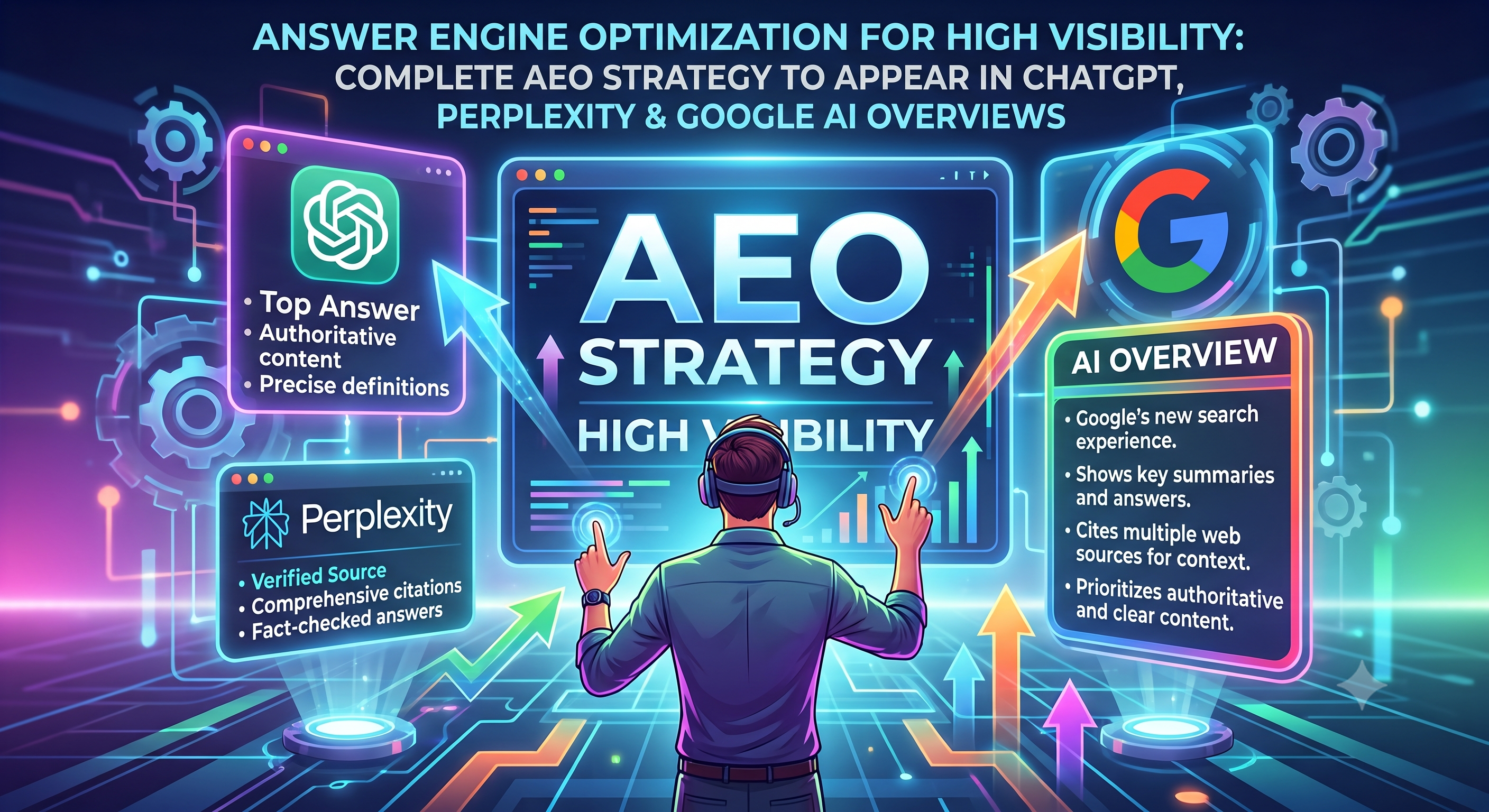
If your brand isn't showing up in ChatGPT recommendations, Google AI Overviews, or Perplexity answers, you're invisible to the fastest-growing search channel there is — and it's already costing you customers. Brands cited in AI responses see roughly 35% more clicks to their organic listings and convert visitors at up to 5X the rate of traditional organic search. Brands that aren't cited simply become interchangeable options nobody remembers asking about.
This guide walks through exactly how to become the brand AI systems cite, using a 7-step framework we use with clients across B2B SaaS, e-commerce, and professional services. It includes a free audit checklist, platform-specific tactics, and three real case studies with the numbers behind them.
See Exactly Which AI Platforms Are Citing Your Competitors
Get a free AEO audit. We'll show you:
- Which platforms cite your competitors — but not you
- Your biggest AI visibility opportunities
- Specific 30-day quick wins you can act on immediately
Learn how to appear in ChatGPT, Google AI Overviews & Perplexity.
Why AI Platforms Are Replacing Traditional Search And What It Means For Your Brand
AI Overviews and chat-based answer engines increasingly resolve a user's question before they ever reach a results page. Users who do click through an AI answer are further along in their decision-making, which is exactly why AI-referred visitors convert at multiples of standard organic traffic. The brands winning this channel right now are the ones treating it as a distinct discipline not an SEO afterthought.
In this guide you'll learn what Answer Engine Optimization actually is, why it's financially urgent in 2026, how ChatGPT, Perplexity, and Google AI Overviews each decide who to cite, and the exact 7-step framework to move from invisible to cited. We'll also walk through three real case studies a B2B SaaS platform, a D2C e-commerce brand, and a B2B services firm so you can see what the framework looks like against your own category, not just in the abstract.
What Is Answer Engine Optimization (AEO)?
How Is AEO Different From SEO?
| Dimension | SEO | AEO |
|---|---|---|
| Main goal | Rank in search results | Get cited in AI-generated answers |
| What gets measured | Rankings, clicks, traffic | Citations, mentions, share of voice |
| How content is found | Keyword matching | Semantic understanding + authority |
| Content structure | Keyword-optimized | Question-and-answer, extractable |
| Time to payoff | 6-12 months | 4-8 weeks |
The two disciplines aren't in competition they're sequential. Google AI Overviews, in particular, still require a strong organic ranking as a prerequisite, which we cover in detail in our breakdown of which metrics actually matter for each discipline.
The Financial Reality: Why AEO Is Urgent in 2026
The Conversion Premium
AI-referred visitors convert at roughly 5X the rate of traditional organic search traffic. Across a benchmark set of B2B technology firms, organic search conversion sat around 2.8%, while AI-referred conversion reached 14.2% a premium of roughly 500%. This isn't because AI visitors are fundamentally different people. It's because by the time they click through, they've already compared options and resolved most of their objections. They arrive further along in the buyer journey than a typical organic click.
The Traffic Opportunity
AI search traffic has grown from under 1% of total sessions in early 2025 to roughly 6.4% by early 2026, with projections putting it at 15-20% of sessions by the end of the year. The more interesting number is the gap between volume and value: that same 6.4% of sessions has been responsible for close to 19% of qualified inbound pipeline in benchmark studies. That's a channel that's still early, still underserved, and disproportionately valuable relative to its size.
The Citation Advantage
Being cited compounds in a few specific ways: your brand appears across four to six major AI platforms simultaneously, the AI's implicit endorsement transfers some of its trust to you, the traffic you get is higher-intent by nature, and every citation your brand receives is effectively a citation a competitor didn't get. Brands appearing in AI Overviews see roughly 35% more clicks to their organic listings even when their traditional ranking position hasn't moved at all.
How Different AI Platforms Work And Why Your Strategy Must Differ By Platform
Most AEO advice treats "AI search" as one channel. It isn't. ChatGPT, Perplexity, and Google AI Overviews each weigh different signals, and a strategy built for one will underperform on the others.
ChatGPT Optimization
ChatGPT represents roughly 60% of generative AI search volume. It favors recency, authority (being linked to by other authoritative sites), content depth, clear structure, and strong entity recognition. Our full ChatGPT-specific optimization tactics go deeper, but the priorities are: publish original research on a quarterly cadence, format headings as the actual questions users ask, add FAQPage schema with specific data points rather than vague claims, and pursue mentions on authority publications, since ChatGPT is measurably more likely to cite brands it has seen referenced elsewhere. Expect first citations in 30-60 days if you're executing consistently.
Perplexity Optimization
Perplexity pulls from the live web rather than a fixed training cutoff, so freshness matters more here than almost anywhere else. It also shows its sources transparently and tends to pull three to five sources per answer, weighting niche authority heavily. Our guide to Perplexity-specific tactics for getting cited covers cadence and formatting in depth in short: publish at least twice monthly, write standalone 40-60 word answer paragraphs that make sense out of context, and prioritize backlinks from niche trade publications over generic ones. Perplexity citations often show up within 2-4 weeks, faster than ChatGPT, because of its real-time indexing.
Google AI Overviews
Google AI Overviews appear on a meaningful and growing share of search queries, but citation here works differently: you generally need to already rank in the top 10 usually top 3 before AI Overview citation becomes realistic. Our complete Google AI Overview ranking guide covers this end to end. The short version: use your existing SEO foundation to get pages from position 5-10 into the top 3, implement FAQPage and Article schema with a live dateModified tag, write direct 40-60 word answers near the top of each section, and build topical authority through deliberate internal linking. Because ranking is a prerequisite, results here typically take 12-16 weeks slower than ChatGPT or Perplexity, but often the highest-volume of the three once achieved.
Gemini and Microsoft Copilot
Once ChatGPT, Perplexity, and Google AI Overviews are handled, Gemini (which leans on similar signals to ChatGPT, with a bias toward Google properties) and Microsoft Copilot (integrated with Bing, less mature citation patterns) are worth adding as a secondary phase. A sensible sequence: weeks 1-4 on ChatGPT and Google AI Overviews, weeks 5-8 adding Perplexity, weeks 9+ expanding to Gemini and Copilot if the ROI on the first three justifies it.
Download the Platform-Specific Optimization Guides
Stop guessing which tactics apply where. Get step-by-step guides for:
- ChatGPT optimization (specific tactics)
- Perplexity optimization (real-time strategy)
- Google AI Overviews (ranking requirements)
Free. No email required.
The Complete 7-Step AEO Implementation Framework
Step 1: Audit Your Current AI Visibility
Before optimizing anything, you need a baseline. Choose 20 high-value queries your ideal customers actually ask, run each one through ChatGPT, Perplexity, Google AI Overviews, and Gemini, and document whether you're mentioned, at what position, and which competitor is cited instead. Our walks through the full process, including how to categorize each result as a win, an opportunity, or lower priority. Budget around two hours for this it's the one step you shouldn't skip.
Step 2: Map Question-Based Keywords
Start from 3-5 core topics your business covers, pull "People Also Ask" questions for each from Google, run them through a keyword tool's questions filter, and interview 5-10 existing customers about what they wondered before buying. The goal is a prioritized list of roughly 100 real questions, organized by buying stage: awareness ("what is X"), consideration ("how do I solve X"), and decision ("which is better, A or B"). Ourcovers tooling in more detail.
Step 3: Restructure Content for Extractability
Take your 10 highest-traffic, most question-relevant pages and rebuild each around a consistent formula: a question as the H2, a direct standalone answer in the first 50 words, 3-5 supporting bullet points, a sentence on why it matters, an example or statistic, and an internal link to related content. This is the single highest-leverage change most sites can make, and it typically takes about an hour per page once the pattern is established.
Step 4: Implement Schema Markup Technical Implementation
Add FAQPage schema (8-10 Q A pairs per page), HowTo schema for process content, Article schema with a live dateModified tag, and Organization schema for brand-level signals. FAQPage schema is the highest-impact addition for AI Overview citation specifically. Our schema markup implementation guide includes copy-paste templates and validation steps using Google's Rich Results Test.
Step 5: Build Topic Authority Through Internal Linking
AI systems evaluate expertise partly by analyzing how your content connects to itself. Build one comprehensive pillar page, several cluster articles that go deep on subtopics, and link them deliberately: the pillar links to every cluster, clusters link back to the pillar, and clusters link to each other where topics genuinely overlap. Use descriptive anchor text throughout "ChatGPT-specific optimization tactics" rather than "learn more" since anchor text is one of the signals AI systems use to understand topic relationships. Our content clustering strategy for building topic authority includes a full architecture template.
Step 6: Develop Original Content & Research
Original research, proprietary data, and primary sources get cited disproportionately more often than curated summaries of other people's work. Pick an angle nobody else has published a original survey, an analysis of category leaders, or your own conversion data publish it with a press push and outreach to relevant publications, then update your pillar article to cite it. Our guide to creating citable original research for AEO covers format and distribution in more detail.
Step 7: Monitor & Continuously Iterate
AEO isn't set-and-forget. Run your 20 test queries weekly, tally results monthly to spot new platforms citing you or ones that have stopped, and refresh your content quarterly with new data and links. Our AEO monitoring tools and dashboard guide covers what to track and how to set up a simple reporting cadence, even without enterprise tooling.
Don't Implement AEO Alone We've Done This 150+ Times
Get a personalized AEO roadmap from our team:
- Exact opportunities specific to your business
- A 90-day implementation timeline
- Expected ROI and conversion impact
- Common pitfalls to avoid
30 minutes. Free. No obligation.
AEO in Action: Real Results From Brands Using This Framework
B2B SaaS: Marketing Analytics Platform
A mid-market analytics SaaS company was entirely absent from ChatGPT's "best marketing analytics tools" recommendations, while four direct competitors appeared consistently. After an eight-week sprint restructuring 10 key pages, adding FAQPage schema, publishing original research, and pursuing targeted PR the picture changed measurably.
The single highest-leverage tactic was publishing original research on choosing a marketing analytics tool, which earned dozens of backlinks and became the primary source AI systems pulled from. Read the full B2B SaaS AEO case study.
E-Commerce: D2C Fitness Equipment Brand
A direct-to-consumer treadmill brand was losing "best treadmill for small spaces" queries entirely to established big-box brands on ChatGPT. The team restructured product pages around comparison and specification formats, added Product and HowTo schema, and built out original buyer's guides framed as plain questions rather than marketing copy.
Buyer's guides written as genuine question-and-answer content, rather than sales copy, ended up mentioned in nearly half of relevant ChatGPT comparison responses. Read the full e-commerce AEO case study.
B2B Services: Data Science Consulting Firm
A boutique data science consultancy was invisible in "data science implementation consultants" queries, with AI systems defaulting to household-name firms instead. Over 20 weeks, the firm documented 10 detailed case studies, published an original "state of the industry" study, and built strategic backlinks from industry partnerships.
Publishing original research made the firm citable as a primary authority source, and case studies with specific, quantified outcomes became the type of content AI systems reached for when asked to justify a recommendation. Read the full B2B services AEO case study.
Your Industry Has Different Dynamics See the Proof
Browse detailed AEO case studies in your vertical: B2B SaaS conversion lift, e-commerce revenue growth, and services-sector deal wins, each with exact metrics and tactics.
View Case Studies →7 AEO Mistakes Brands Make (And How to Avoid Them)
AEO Tools & Resources That Actually Work
Monitoring AI Visibility
Semrush AI Visibility Toolkit for competitive tracking, or a manual testing spreadsheet if you're starting free.
Tracking Citations
Google Search Console for AI Overview impressions, plus a simple recurring spreadsheet and weekly ChatGPT test queries.
Content Optimization
A schema markup generator, Yoast or Rank Math for WordPress, and Screaming Frog for technical audits.
Keyword & Topic Research
A keyword tool's Questions filter, Google's "People Also Ask," and your own customer interviews often the most-overlooked source.
Ready to Implement? Download These Resources
AEO Audit Checklist
A 50-point self-assessment with prioritization scoring and an action roadmap.
AEO Implementation Roadmap
A 12-week action plan with weekly tasks and a measurement framework.
AI Platform Optimization Guide
One page each for ChatGPT, Perplexity, and Google AI Overviews for quick reference during implementation.
AEO Tracking Spreadsheet
A monthly template for monitoring AI citations against competitors.
Your 30-Day AEO Quick-Start Plan
If you only have a month before the next planning cycle, here's the compressed version of the 7-step framework, ordered for fastest visible movement:
| Week | Focus | Deliverable |
|---|---|---|
| Week 1 | Audit & keyword mapping | 20-query AI visibility baseline, prioritized question list |
| Week 2 | Content restructuring | 10 key pages rebuilt around question-first, extractable formatting |
| Week 3 | Technical implementation | FAQPage, Article, and HowTo schema live on all 10 pages |
| Week 4 | Authority & linking | Pillar-cluster internal linking in place, first original-research angle scoped |
This won't get you cited across every platform in 30 days Google AI Overviews especially depend on ranking, which takes longer but it's usually enough to see the first Perplexity citations and to put ChatGPT citations within reach over the following month. Treat it as the foundation the rest of the framework builds on, not the finish line.
Frequently Asked Questions
Is AEO really different from SEO?
Yes SEO optimizes for rankings and traffic using keyword matching; AEO optimizes for citations and mentions using semantic understanding and authority. See our complete AEO vs SEO comparison for the full breakdown.
Can I just copy Semrush's or a competitor's AEO approach?
Not effectively. Duplicated structure without original insight is treated as exactly the kind of duplicate content Google's systems are built to deprioritize, and AI systems specifically favor unique data and frameworks.
How do I measure AEO success?
Track citations, mentions, and share of voice rather than only rankings. Our guide to measuring AEO success covers the specific metrics and a simple weekly tracking cadence.
How long does AEO take to show results?
Perplexity citations can appear in 2-4 weeks, ChatGPT in 30-60 days, and Google AI Overviews in 12-16 weeks since they require a top-3 organic ranking first.
Do I need a big budget to start?
No. The highest-leverage first steps the visibility audit, schema markup, and content restructuring are mostly time investments rather than spend, and can be done in-house before adding paid promotion or PR.
Stop Leaving a 5X Conversion Opportunity on the Table
The window to establish AI platform authority is open now. In the next six months, citation patterns will conhttps://www.cronbay-tech.com/contact-us/solidate around a smaller set of leaders in every category the goal is making sure your brand is one of them.
- We'll audit your current AI visibility
- Show you exactly where competitors are winning
- Give you a specific 90-day roadmap
- Identify your fastest wins
Get Your Business Featured in AI Search
Increase your visibility across ChatGPT, Google AI Overviews, and Perplexity with a customized Answer Engine Optimization strategy.

.png)