

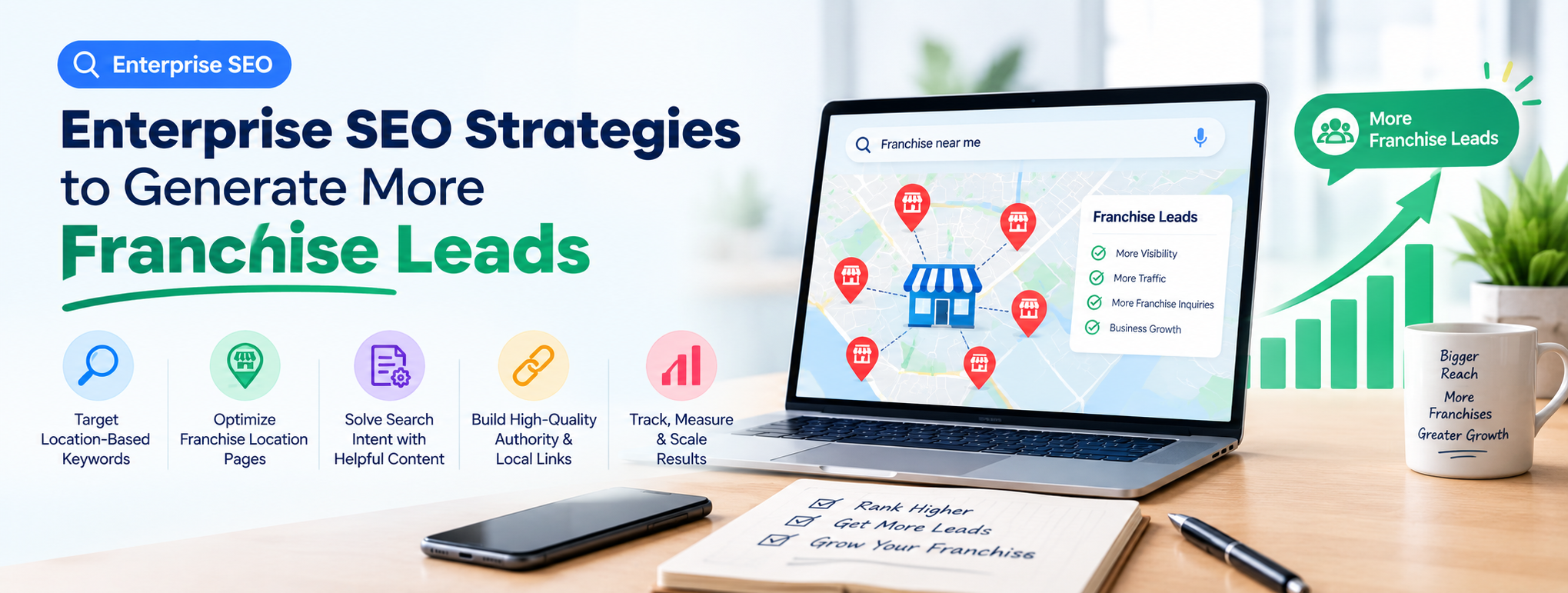
Enterprise SEO for franchise businesses is the practice of optimizing hundreds, sometimes thousands, of location-based web pages so that every franchise outlet ranks for the searches that matter to it, without losing brand consistency at the corporate level. Unlike a single-location business, a franchise brand has to solve two problems at once: protect national brand visibility while making sure each individual location wins local search results in its own city or neighborhood. Get this balance right, and franchise lead generation becomes a compounding, low-cost-per-lead engine instead of a constant paid-media expense.
If you're a franchisor trying to attract new franchisees, or a franchisee trying to fill your calendar with local customers, this guide breaks down exactly how an enterprise SEO strategy for franchises works, from technical foundations to content, local SEO, link building, and conversion optimization, so you can start generating qualified franchise leads on autopilot.
What Is Enterprise SEO for Franchise Businesses?
Enterprise SEO refers to large-scale search optimization for organizations with extensive website architecture, typically businesses with hundreds of pages, multiple stakeholders, and complex technical requirements. A franchise network fits this definition almost by default: a brand with 50, 200, or 2,000 locations needs an enterprise SEO strategy simply because of the sheer number of pages, listings, and local markets it has to manage simultaneously.
How Enterprise SEO Differs from Traditional SEO
Traditional SEO strategy usually optimizes a handful of pages for a single set of business goals. An enterprise SEO strategy for franchises, on the other hand, has to:
- Optimize hundreds of nearly identical location pages without triggering duplicate content issues
- Balance corporate brand guidelines with locally relevant content
- Manage separate Google Business Profiles, citations, and reviews for every outlet
- Coordinate keyword research, technical SEO, and link building at scale rather than page by page
Why Multi-Location Businesses Need a Dedicated SEO Strategy
A multi-location SEO strategy isn't optional once a brand crosses more than a handful of outlets. Search engines evaluate each location independently, meaning a franchise's SEO performance in one city has almost no bearing on its performance in another unless the underlying strategy, site structure, local SEO signals, and content, is deliberately replicated and localized across every market.
Why Franchise Lead Generation Depends on a Strong SEO Strategy
Franchise lead generation strategies built around SEO consistently outperform channels that rely purely on paid spend, because organic search captures people at the exact moment they're looking for a nearby location, service, or franchise opportunity.
The Local Search Behavior of Franchise Customers
Most people searching for a franchise product or service are hyper-local and high-intent, they're typing things like "near me," a city name, or a neighborhood alongside the service they need. Ranking well in these local SEO franchise searches puts you in front of customers who are ready to visit, call, or book, not just browse.
Organic Traffic vs Paid Traffic for Franchise Businesses
Paid ads can generate quick visibility, but the cost scales linearly with every new location you add. Organic traffic for franchise businesses, once built, compounds, a well-optimized location page keeps generating leads month after month without an incremental ad spend for every new city you enter.
Core Elements of an Enterprise SEO Strategy for Franchises
A complete enterprise SEO strategy for franchises rests on three pillars: technical SEO, on-page SEO, and off-page SEO. Skipping any one of these limits how far your franchise SEO strategy can scale.
Technical SEO for Franchises
Technical SEO for franchises ensures that search engines can efficiently crawl, index, and understand hundreds of location pages without confusion or duplication.
Site Architecture and Crawl Budget
With hundreds of location URLs, crawl budget becomes a real constraint. A clean site architecture, organized by region, state, and city, helps search engines discover and prioritize your most important pages instead of wasting crawl budgets on thin or duplicate URLs.
Page Speed and Core Web Vitals Across Locations
Every location page should meet the same performance standard. A slow-loading page in one city hurts that location's rankings independently of how fast your other pages load, so page speed audits need to run site-wide, not just on the homepage.
On-Page SEO for Franchises
On-page SEO for franchises is where franchise keyword research and content strategy come together to make each location page relevant to its local audience.
Franchise Keyword Research
Franchise keyword research should map keywords to intent and location simultaneously. This typically includes:
- Branded keywords - searches for your franchise name directly
- Service + location keywords - e.g., "SEO services in Bangalore"
- Long-tail local keywords - highly specific queries with strong buying intent
Content Marketing for Franchise Pages
Franchise content marketing means writing unique, locally relevant copy for every location page rather than duplicating a single template across the network. Even small localized details, nearby landmarks, service-area neighborhoods, local testimonials, meaningfully improve rankings and relevance.
Off-Page SEO for Franchises
Off-page SEO for franchises builds authority and trust signals outside your own website.
Franchise Link Building
Franchise link building involves earning backlinks both at the corporate domain level and, where possible, for individual location pages, through local press mentions, sponsorships, partnerships, and community involvement in each market.
Local Citations and Directory Consistency
Citations, mentions of your business name, address, and phone number (NAP) across directories, review platforms, and local databases, reinforce to search engines that each location is a legitimate, verifiable business.
Local SEO Strategy for Franchise Businesses (Multi-Location SEO)
A local SEO franchise strategy is the single biggest lever for franchise lead generation because it directly determines whether your locations show up in Google's local map results and "near me" searches.
Building Location Pages That Rank
Every outlet needs its own indexable page, not a shared page with a location dropdown. Each location page should include the local address, phone number, service area, hours, unique content, and embedded map.
URL Structure Best Practices
Keep your multi-location SEO strategy's URL structure logical and consistent, for example:
- example.com/locations/ - full list of all locations
- example.com/locations/karnataka/ - all locations in a state
- example.com/locations/karnataka/bangalore/ - a specific city page
A predictable hierarchy makes navigation easier for users and indexing more efficient for search engines.
Google Business Profile Optimization for Every Location
Since local map results dominate the top of local search pages, every single location needs its own claimed, fully optimized Google Business Profile, correct categories, updated hours, local photos, and a description that reflects that specific outlet rather than the brand in general.
NAP Consistency Across Locations
Inconsistent name, address, or phone number formatting across your website, directories, and citations erodes Google's confidence in your business data. A locked, uniform NAP format across every platform is non-negotiable for franchise website SEO.
How to Structure Franchise Location Pages for SEO and Conversions
Franchise Website SEO Best Practices
Beyond individual location pages, the overall franchise website needs a strong information architecture: a location hub, clear internal linking between the homepage, service pages, and city pages, and structured data (LocalBusiness schema) so search engines can parse each location's details accurately.
Franchise Conversion Optimization Tips
Ranking is only half the job, franchise conversion optimization turns that traffic into leads. Effective location pages typically include:
- A visible click-to-call number and "Get Directions" button above the fold
- A simple lead form requesting only essential information
- Local reviews and star ratings displayed prominently
- Clear, location-specific calls to action rather than generic corporate messaging
Franchise Keyword Research: Finding the Right Terms for Each Location
Branded vs Non-Branded Franchise Keywords
Branded keywords capture people who already know your business; non-branded keywords capture new prospects searching by service or need. A mature franchise SEO strategy invests in both, branded terms protect existing demand, while non-branded terms expand your reach in every local market.
Long-Tail Local Keywords for Franchise Lead Generation
Long-tail, hyper-specific searches ("affordable SEO company near Koramangala Bangalore") convert at a much higher rate than short, broad keywords because they reflect a searcher who already knows exactly what they want. Building these into your franchise SEO services strategy captures leads competitors often overlook.
Franchise Content Marketing Strategy to Drive Organic Leads
Localized Blog Content
A blog built around local topics, community events, and location-specific FAQs helps each market build topical relevance and gives you fresh internal linking opportunities back to your location pages.
Reviews, Testimonials, and Social Proof Content
Reviews double as both a trust signal and an SEO signal. Actively requesting reviews after every transaction, responding to them publicly, and featuring the best ones on location pages strengthens both rankings and conversion rates.
Franchise Digital Marketing: Combining SEO With Other Channels
While SEO is the long-term engine, a complete franchise marketing strategy layers in local paid search, social media, and email marketing to support new location launches or seasonal promotions. SEO compounds the value of every other channel by ensuring that anyone who later searches for your brand directly finds a well-optimized, trustworthy page waiting for them.
Measuring the Success of Your Enterprise SEO Strategy for Franchises
Track these metrics at both the network level and the individual location level:
- Organic traffic and keyword rankings per location
- Local map pack visibility (3-pack rankings) by city
- Google Business Profile engagement (calls, direction requests, website clicks)
- Conversion rate from organic traffic to leads per page
- Review volume and average rating per location
- Backlink growth for the corporate domain and key location pages
Common Mistakes to Avoid in Franchise SEO
- Using one generic template for every location page with no unique content
- Letting NAP details drift out of sync across directories and citations
- Ignoring page speed and technical SEO issues that compound across hundreds of URLs
- Failing to claim or optimize Google Business Profiles for newer locations
- Treating link building as a corporate-only activity instead of building local authority too
Why Partner With a Professional Enterprise SEO Agency for Franchises
Running an enterprise SEO strategy across dozens or hundreds of locations requires coordinated keyword research, technical audits, content production, local SEO management, and link building, all at once, and all kept consistent with brand guidelines. This is exactly the kind of large-scale execution an experienced SEO company in Bangalore is built to handle, bringing structured processes and specialist teams to what would otherwise be an overwhelming, fragmented effort for an in-house team.
Conclusion
Franchise lead generation isn't about picking one tactic, it's about aligning technical SEO, on-page optimization, local SEO, content, and link building into a single coordinated enterprise SEO strategy that scales across every location. Brands that invest in this approach consistently outperform competitors relying on paid ads alone, because every optimized location page keeps generating organic, high-intent leads long after the work is done. If you're ready to build a franchise SEO strategy that actually moves the needle across your entire network, explore how our SEO company in Bangalore approaches enterprise and franchise SEO at scale.
Ready to Generate More Franchise Leads?
Get a customized enterprise SEO strategy designed to improve local visibility, strengthen franchise locations, and generate more qualified leads for your brand.
Contact Our Team Today →FAQs
What is enterprise SEO for franchise businesses?
Enterprise SEO for franchise businesses is the practice of optimizing a large network of location pages so each individual outlet ranks well in local search, while maintaining consistent branding and technical standards across the entire site.
How is franchise SEO different from regular SEO?
Franchise SEO involves managing SEO at scale across many location pages, multiple Google Business Profiles, and varying local markets, whereas regular SEO typically focuses on optimizing a single website for one location or audience.
What is the best URL structure for franchise location pages?
A hierarchical structure such as /locations/state/city/ is considered best practice because it's easy for users to navigate and efficient for search engines to crawl and index.
How long does it take to see results from a franchise SEO strategy?
Most franchise SEO strategies start showing measurable improvements in local rankings and traffic within 3 to 6 months, with more significant lead generation gains building over 6 to 12 months as content, citations, and links mature.
Do all franchise locations need separate Google Business Profiles?
Yes. Every physical or service-area location should have its own claimed and fully optimized Google Business Profile to appear accurately in local map results and the Google Local 3-Pack.
Can small franchise networks benefit from enterprise SEO strategies?
Yes. Even franchises with 10–20 locations benefit from enterprise-style processes, standardized location pages, consistent NAP data, and localized content, since the same scaling challenges appear well before a network reaches hundreds of outlets.

.png)